Atlas Ocean Voyages and Cunard Line could hardly be more different — a 196-guest luxury expedition yacht versus a 2,000-plus-guest heritage ocean liner, resort casual versus formal dress codes, Zodiac landings versus the Transatlantic Crossing. Jake Hower compares two lines that occupy opposite ends of the cruising spectrum, and explains when each makes sense for Australian travellers.
| Atlas Ocean Voyages | Cunard Line | |
|---|---|---|
| Category | Expedition / Luxury | Luxury |
| Rating | ★★★★☆ | ★★★★★ |
| Fleet size | 3 ships | 4 ships |
| Ship size | Small (under 500) | Mid to Large |
| Destinations | Antarctica, Arctic, Mediterranean, Caribbean | Global |
| Dress code | Resort casual | Formal evenings |
| Best for | All-inclusive luxury expedition travellers | Tradition lovers |
These lines exist in entirely different worlds. Atlas is for travellers who want to kayak past icebergs, land on Antarctic beaches by Zodiac, and return to an intimate 196-guest ship for included premium drinks and resort-casual dining. Cunard is for travellers who want 185 years of maritime heritage, Gala Evenings in the Queens Room ballroom, afternoon tea in white gloves, and the only scheduled Transatlantic Crossing in the world. There is no overlap, no competition, and no wrong choice — only different desires. Australians drawn to expedition adventure choose Atlas. Australians drawn to heritage, formality, and the romance of ocean travel choose Cunard.
The core difference
It would be difficult to find two cruise lines with less in common than Atlas Ocean Voyages and Cunard Line. They differ in size, style, dress code, philosophy, history, and purpose — and understanding this contrast is the entire comparison.
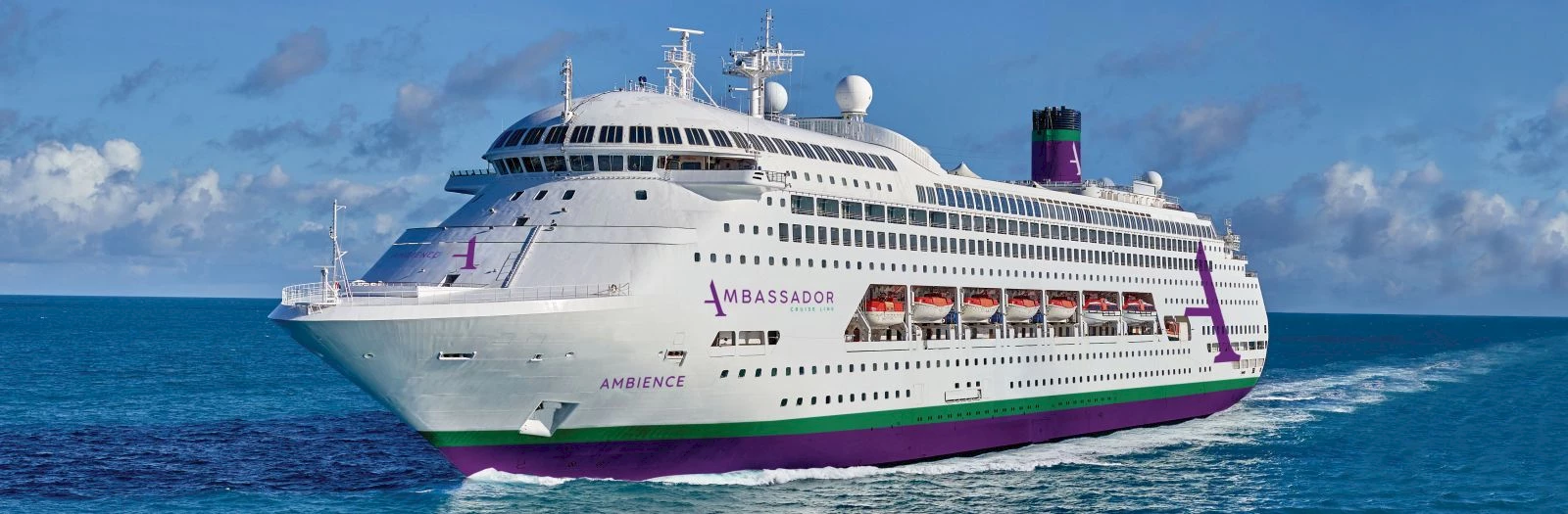
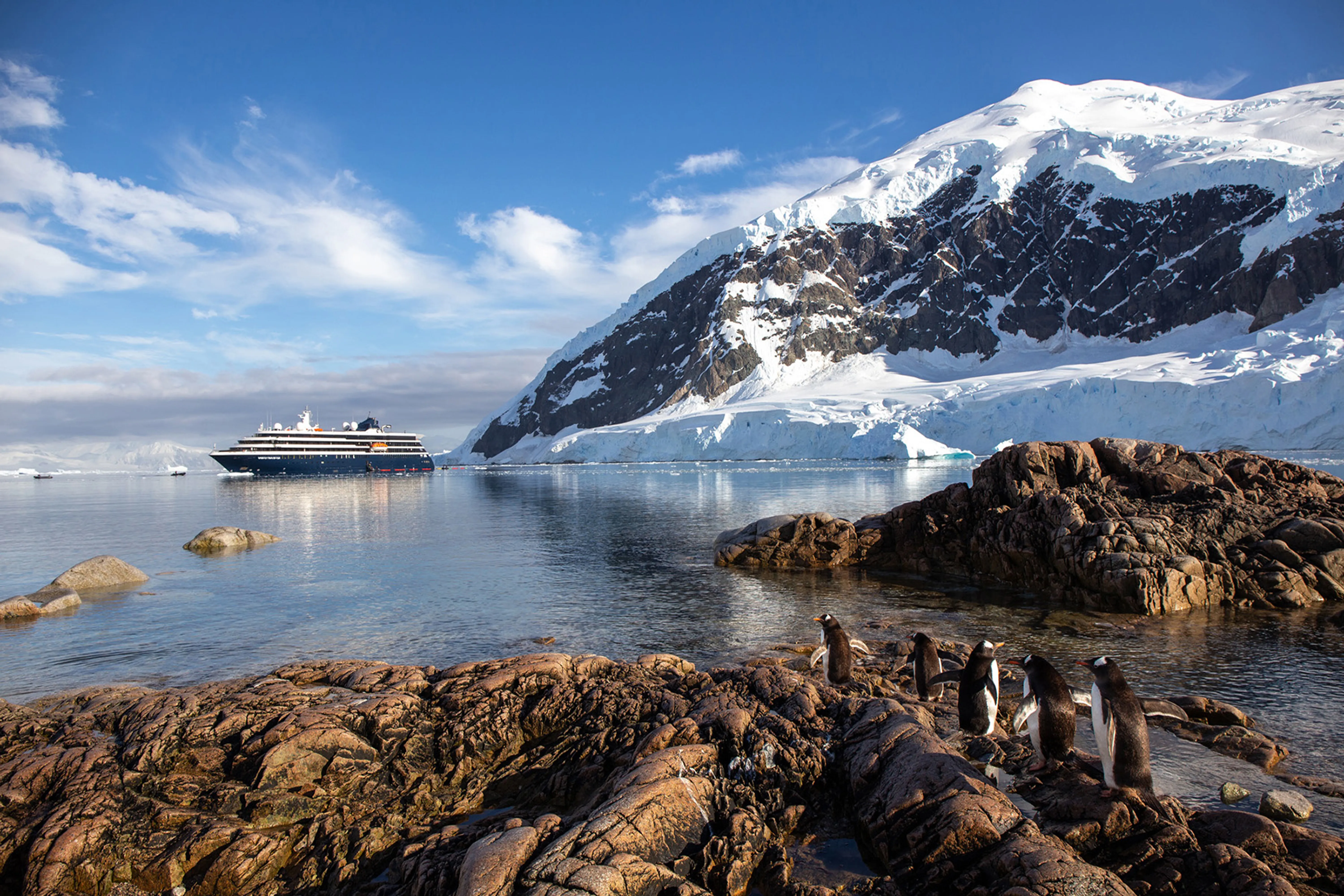
Atlas Ocean Voyages operates three Portuguese-flagged expedition vessels — World Navigator, World Traveller, and World Voyager — each carrying approximately 196 guests. The ships are polar-class with Zodiac fleets, designed for landings on remote beaches, kayaking among icebergs, and wildlife encounters in Antarctica, the Arctic, the Mediterranean, and Central America. The fare includes roundtrip flights from North American gateways, premium drinks, Wi-Fi, and gratuities. The dress code is resort casual. The atmosphere is that of a private yacht exploring places most people will never see.
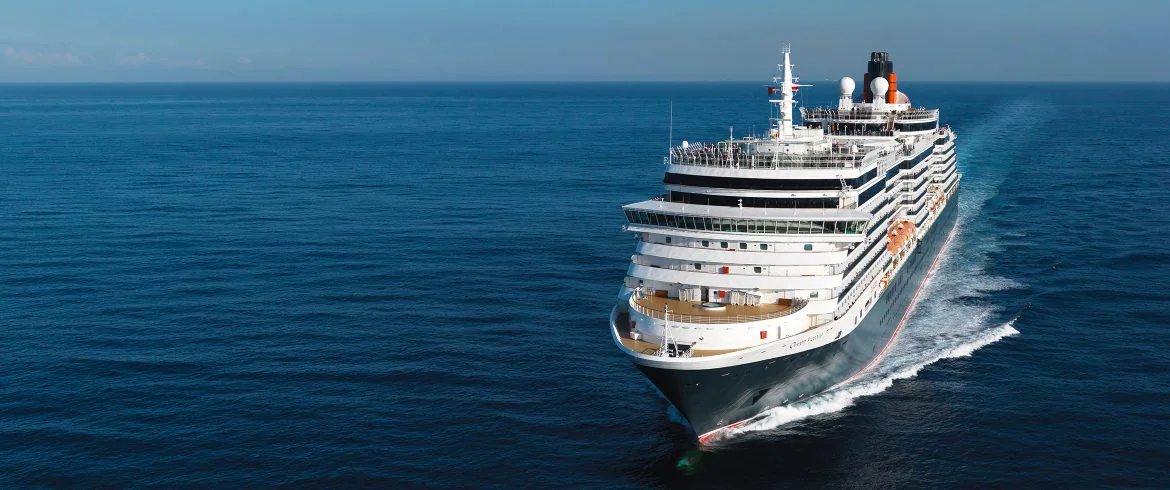
Cunard Line was founded in 1840 and operates four Queens — Queen Mary 2, Queen Victoria, Queen Elizabeth, and Queen Anne. QM2 is the only purpose-built ocean liner in active service, with a reinforced hull designed for North Atlantic crossings. Cunard’s identity is heritage, formality, and the romance of ocean travel: Gala Evenings in black tie, white-gloved afternoon tea, nightly ballroom dancing, a class-based dining system, and the world’s only scheduled Transatlantic Crossing. Ships carry over 2,000 guests in an atmosphere steeped in 185 years of tradition.
These lines do not compete. They serve completely different desires. The comparison exists only because Australian travellers occasionally ask “what is the opposite of Cunard?” — and Atlas, with its intimate expedition yacht philosophy, provides a clear answer.
What is actually included
The inclusion gap between these lines is one of the widest in cruising.
Atlas includes roundtrip flights from select North American gateways, premium alcoholic and non-alcoholic beverages at all hours, Wi-Fi, gratuities, L’Occitane bath amenities in every stateroom, butler service in suites, all dining across six venues without surcharges, and Zodiac excursions as part of the expedition programme. The fare is designed to eliminate onboard spending beyond spa treatments and shop purchases.
Cunard’s Britannia fare includes accommodation, dining in the assigned Britannia Restaurant, buffet dining, daily afternoon tea, entertainment and enrichment, fitness facilities, and breakfast room service. It excludes all alcoholic beverages, gratuities (approximately US$17 per person per night for Britannia), Wi-Fi, speciality dining surcharges, and spa treatments. At the Queens Grill level with promotional packages, Cunard can approach all-inclusive territory — complimentary drinks, waived gratuities, butler service — but at a premium that positions it well above Atlas’s entry fare.
The practical difference for Australian travellers is clear. On Atlas, you board knowing the cost. On Cunard at Britannia level, significant extras accumulate throughout the voyage. At Cunard’s Grills level, the experience becomes more inclusive but at a substantially higher price point.
Dining and culinary experience
The dining philosophies reflect the broader identity of each line — intimate and casual versus grand and hierarchical.
Atlas offers six dining venues aboard its 196-guest ships with regionally inspired menus and no surcharges. The atmosphere is resort casual with no formal dress requirements. The intimacy of the guest count allows personalised service and menu flexibility. All beverages — premium spirits, wines, cocktails — are included throughout the day and evening.
Cunard’s dining is class-tiered. Your stateroom category determines your restaurant: Britannia Restaurant for entry-level guests (seating over 1,300 on QM2), Britannia Club for a smaller dedicated space, Princess Grill for suite guests, and Queens Grill for the top tier with bespoke menus designed by Michel Roux. Speciality restaurants on Queen Anne include Indian, Japanese, and Mediterranean venues with surcharges. The daily afternoon tea in the Queens Room — white-gloved waiters, fine bone china, scones with clotted cream — is a signature ritual with no Atlas equivalent.
Atlas offers inclusive intimacy. Cunard offers grand occasion dining with a class structure that creates genuine aspiration. Neither is objectively better — they serve different dining desires entirely.
Suites and accommodation
The accommodation comparison reflects the fundamental ship-size difference.
Atlas staterooms are modern (ships launched from 2021) with contemporary design, L’Occitane amenities, and balconies in most categories. Suite guests receive butler service included in the fare. Cabins are sized for expedition — comfortable but not palatial, reflecting the philosophy that guests spend their days on Zodiacs and ashore rather than in the stateroom.
Cunard’s accommodation spans an extraordinary range. Britannia Inside cabins start at approximately 152 square feet. At the other extreme, QM2’s Grand Duplex spans 2,249 square feet across two levels with butler service, exclusive dining, private lounges, and a dedicated sun terrace. The Grills ship-within-a-ship concept — separate restaurants, lounges, and outdoor spaces accessible only to Princess and Queens Grill guests — creates a genuine class differentiation refined over nearly two centuries.
Atlas offers modern comfort in an intimate expedition setting. Cunard offers a hierarchy from entry-level to palatial, with each tier unlocking exclusive spaces and services. The choice depends on whether you value intimacy and inclusion or scale and aspiration.
Pricing and value
These lines occupy different price segments, making direct comparison less meaningful than understanding what each delivers for the investment.
Atlas per-diems in the luxury expedition segment typically range from AUD $800 to $1,500 per person per night, with Antarctic and Arctic voyages at the higher end. The included flights from North American gateways represent substantial value, though Australian travellers must budget for positioning flights to those gateways.
Cunard per-diems start significantly lower — Britannia Inside cabins from approximately AUD $200 per person per night on standard itineraries. However, adding drinks, gratuities, Wi-Fi, and speciality dining closes the gap. Queens Grill per-diems start from approximately AUD $700 to $1,200 per person per night, approaching Atlas pricing but delivering a very different product — grand heritage liner versus intimate expedition yacht.
The value question is not “which is cheaper?” but “which delivers more of what you want?” Atlas buyers are purchasing expedition access and comprehensive inclusion. Cunard buyers are purchasing heritage, scale, and the unique experiences only a 2,600-guest ocean liner can deliver.
Spa and wellness
Both lines offer spa facilities, but the scale reflects their ship sizes.
Atlas ships feature compact spas with L’Occitane products, offering treatments in an intimate setting that never feels crowded. The wellness philosophy extends to the expedition itself — kayaking, hiking, and Zodiac excursions provide active engagement that no spa can replicate.
Cunard’s Mareel Wellness and Beauty centres are significantly larger, with Queen Anne offering the most comprehensive facilities: infrared sauna, Himalayan salt sauna, cryo-body therapy, a hydrotherapy pool, and a couples’ suite. Canyon Ranch-developed programmes include structured wellness packages. The Thermal Suite carries per-session charges. The fitness centres feature state-of-the-art equipment at a scale Atlas ships cannot accommodate.
Cunard wins on spa variety and scale. Atlas wins on experiential wellness — the morning kayak past glaciers is a wellness experience no spa treatment can match.
Entertainment and enrichment
The enrichment gap is one of the most significant in this comparison.
Atlas focuses on expedition education. Naturalists, wildlife photographers, and expedition leaders deliver daily briefings and lead shore activities. The curriculum is the destination — polar ecology, marine biology, glaciology, cultural history. Evenings are conversational and intimate aboard a 196-guest ship. No production shows, no theatre, no formal entertainment programme.
Cunard delivers one of the finest enrichment programmes in cruising. The Cunard Insights programme features over 2,000 talks by 430 notable speakers annually — historians, explorers, scientists, diplomats. RADA workshops offer theatrical education. Queen Mary 2 houses the only planetarium at sea. The Queens Room ballroom hosts nightly dancing with a full orchestra and Dance Hosts for unpartnered guests. The Royal Court Theatre presents West End-style production shows.
The distinction is clear. Atlas educates through expedition. Cunard educates through intellectual programming, theatrical production, and cultural tradition. For sea-day engagement, Cunard is unmatched. For destination-day engagement, Atlas is unmatched.
Fleet and destination coverage
The fleets serve completely different purposes.
Atlas operates three polar-class expedition ships (approximately 196 guests each) reaching Antarctica, the Arctic, the Mediterranean, the Caribbean, and Central America. The fleet is compact and purpose-built for expedition. A luxury sailing yacht, Atlas Adventurer, is expected in 2028.
Cunard operates four Queens ranging from QM2 (148,528 gross tonnes, 2,691 guests) to Queen Victoria (90,049 gross tonnes, 2,061 guests). Destinations span the globe — Mediterranean, Northern Europe, Caribbean, Alaska, Asia, world voyages — served by conventional ports. The Transatlantic Crossing between Southampton and New York is Cunard’s defining itinerary, with no equivalent anywhere in cruising.
Atlas reaches places Cunard cannot — polar regions, remote beaches, coastlines without infrastructure. Cunard delivers experiences Atlas cannot — the Transatlantic Crossing, grand ballroom evenings, and the scale and facilities of purpose-built ocean liners.
Where each line excels
Atlas Ocean Voyages excels in:
- Polar expedition. Antarctica and Arctic voyages aboard polar-class ships with Zodiac landings and expert naturalist teams. Cunard has no expedition capability.
- Comprehensive inclusion. Flights, drinks, dining, Wi-Fi, and gratuities bundled into one fare with no onboard extras.
- Ultra-intimacy. At 196 guests, the social dynamic is personal and immediate — a private yacht atmosphere.
Cunard excels in:
- Heritage and tradition. One hundred and eighty-five years of maritime history expressed through formal evenings, afternoon tea, and the Queens Room ballroom.
- The Transatlantic Crossing. QM2’s scheduled seven-night Southampton-to-New-York service is unique in modern cruising.
- Intellectual enrichment. Over 2,000 talks, RADA partnerships, a planetarium, and production theatre on a scale Atlas cannot approach.
- The Grills experience. Exclusive dining, private lounges, butler service, and a class differentiation refined across generations.
Standout itineraries for Australian travellers
Atlas Ocean Voyages
Antarctica Expedition (10–14 nights from Ushuaia) — Zodiac landings on the Antarctic Peninsula, wildlife photography, kayaking among icebergs. Flights from North American gateways included. Connect via Santiago or Buenos Aires from Australian cities.
Arctic Norway and Svalbard (10–14 nights, summer) — Polar expedition in the northern hemisphere with midnight sun, glaciers, and polar bear sightings. A destination Cunard does not serve in expedition format.
Cunard
QM2 Transatlantic Crossing (7 nights, Southampton to New York) — The defining Cunard experience and the only scheduled ocean liner crossing in the world. Many Australians combine this with European travel — fly to London, sail to New York, fly home.
QM2 World Voyage sector from Sydney — When QM2 visits Australia on her annual World Voyage, sector bookings from Sydney are available. A practical way for Australians to experience Cunard without flying to Southampton.
Queen Anne Northern Europe (7–14 nights from Southampton) — The newest Cunard ship with the most contemporary facilities. Baltic capitals and Norwegian fjords paired with the Cunard heritage experience.
Ship-by-ship recommendations
Atlas Ocean Voyages
World Navigator, World Traveller, or World Voyager (196 guests each) — Identical sister ships. Choose based on itinerary and dates. All offer polar-class expedition capability, Zodiac fleets, and the full Atlas all-inclusive package. Modern hardware launched from 2021.
Cunard
Queen Mary 2 — The flagship and the only ocean liner afloat. Book for the Transatlantic Crossing or a World Voyage. The planetarium, library, and grand Queens Room ballroom are unique to this ship.
Queen Anne — The newest ship (2024) with the most contemporary dining and spa facilities. The best entry point for travellers new to Cunard.
Queen Victoria — The most intimate Queen at 2,061 guests. Strong Mediterranean deployment.
For Australian travellers specifically
Neither line offers regular Australian departures, which shapes the decision differently from comparisons involving locally deployed fleets.
Cunard’s Australian presence has contracted significantly. Homeporting ended in February 2025, and Australian visits now occur only on World Voyage segments. The practical implication: Australians wanting to sail Cunard must fly to Southampton, New York, Seattle, or Miami. World Voyage sectors from Sydney provide an alternative when available.
Atlas has no Australian presence — no local departures, no regional office. Australian travellers fly to embarkation points in South America, Europe, or the Americas. The included flights from North American gateways provide partial offset.
For Australians who want to cruise without international flights, neither line serves that need. Both require travel planning and positioning flights. The question is whether you are willing to travel for heritage and tradition (Cunard) or for expedition and adventure (Atlas).
The onboard atmosphere
The atmospheric contrast between these lines is the widest in this series of comparisons.
Atlas is a private expedition yacht. One hundred and ninety-six guests, resort-casual dress, no formal nights, naturalists at breakfast, Zodiac briefings before lunch, and shared expedition stories over included premium drinks at dinner. The ship feels like a floating base camp for adventure — functional, intimate, and driven by the destination rather than the vessel.
Cunard is a floating Edwardian country house. Two thousand guests in Gala Evening black tie, ballroom dancing with a full orchestra, white-gloved afternoon tea, a class-based dining hierarchy, and the grand staircase entrance. The ship is the experience — the heritage, the ceremony, the ritual of dressing for dinner. The cultural atmosphere is British, traditional, and deliberately formal.
For Australian travellers, the choice often reduces to dress code. If you want to pack lightly and wear what is comfortable, Atlas. If you relish the theatre of dressing for dinner and the romance of the ocean liner tradition, Cunard.
The bottom line
Atlas Ocean Voyages and Cunard Line are opposite poles of the cruising world. There is no meaningful crossover — no traveller is genuinely torn between a 196-guest Zodiac expedition in Antarctica and a 2,691-guest black-tie Transatlantic Crossing.
Choose Atlas for genuine expedition adventure on intimate, modern ships with comprehensive inclusion. Choose it for polar wildlife, remote coastlines, kayaking past glaciers, and an atmosphere where the destination defines every day. Accept the positioning flights, the compact fleet, and the absence of formal evening entertainment.
Choose Cunard for 185 years of maritime heritage expressed through formal evenings, intellectual enrichment, and the world’s only scheduled ocean liner crossing. Choose it for the Queens Room ballroom, the planetarium, the RADA workshops, and the Grills ship-within-a-ship experience. Accept the formality, the extras-heavy pricing at entry level, and the need to fly internationally from Australia.
These lines complement each other perfectly. An Atlas Antarctic expedition followed by a Cunard Transatlantic Crossing is not an unusual sequence — and it delivers two of cruising’s most distinctive experiences back to back.