Atlas Ocean Voyages and Oceania Cruises both carry smaller guest counts than the mega-ships, but that is where the similarity ends. Atlas delivers all-inclusive polar expedition on 196-guest ships with Zodiacs and included flights. Oceania delivers the finest cuisine at sea on 684-to-1,200-guest ships with Jacques Pepin's culinary programme. Jake Hower compares expedition adventure with culinary ocean cruising for Australian travellers.
| Atlas Ocean Voyages | Oceania Cruises | |
|---|---|---|
| Category | Expedition / Luxury | Luxury |
| Rating | ★★★★☆ | ★★★★☆ |
| Fleet size | 3 ships | 8 ships |
| Ship size | Small (under 500) | Mid-size (1,000-2,500) |
| Destinations | Antarctica, Arctic, Mediterranean, Caribbean | Mediterranean, Asia, South Pacific, Caribbean |
| Dress code | Resort casual | Country club casual |
| Best for | All-inclusive luxury expedition travellers | Food-focused culturally curious cruisers |
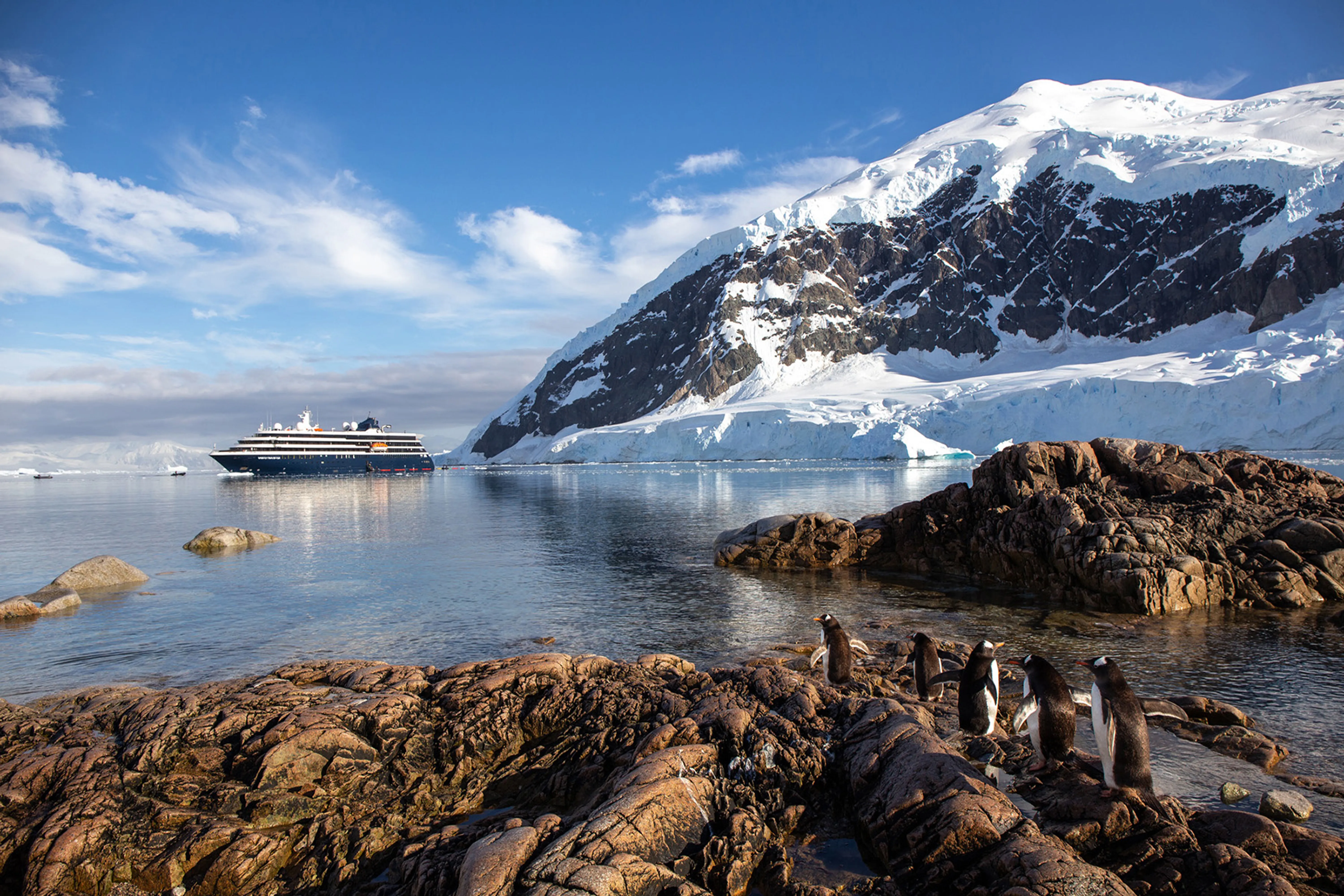
Atlas and Oceania serve completely different travel desires. Atlas is for the traveller who wants to land on an Antarctic beach by Zodiac, kayak past Arctic glaciers, and return to an intimate 196-guest ship for included premium drinks. Oceania is for the traveller who wants ten dining venues, a professional culinary centre, and Jacques Pepin's menus on a relaxed mid-size ship visiting the world's great ports. Neither line has established Australian departures, though Oceania's Riviera has debuted in Australian waters. For expedition, choose Atlas. For the finest dining at sea at a competitive per-diem, choose Oceania.
The core difference
Atlas Ocean Voyages and Oceania Cruises share the smaller end of the ship-size spectrum but diverge completely on purpose, cuisine, and destination philosophy.
Atlas operates three Portuguese-flagged polar-class expedition ships, each carrying approximately 196 guests. The fleet is equipped with Zodiac fleets for shore landings in Antarctica, the Arctic, and remote coastal destinations. The fare includes roundtrip flights from North American gateways, premium drinks, Wi-Fi, gratuities, and butler service in suites. The dress code is resort casual, and the experience is defined by expedition — daily Zodiac excursions, naturalist briefings, wildlife photography, and kayaking in places with no infrastructure.
Oceania Cruises operates eight ships carrying 684 to 1,200 guests, with the trademarked claim to “The Finest Cuisine at Sea” backed by Jacques Pepin as Executive Culinary Director since 2003. The O-class ships (Marina, Riviera, Allura, Vista) offer up to ten dining venues — all included without surcharges — and a professional Culinary Centre with 24 cooking stations. The dress code is Country Club Casual with no formal nights. Under Norwegian Cruise Line Holdings alongside Regent and Norwegian, Oceania delivers port-intensive itineraries across the Mediterranean, Caribbean, Asia, Alaska, and increasingly Australian waters.
For Australian travellers, the choice is unambiguous: expedition adventure (Atlas) or culinary ocean cruising at a competitive per-diem (Oceania). These lines do not compete for the same passenger.
What is actually included
Both lines market inclusivity, but the models differ in scope and emphasis.
Atlas includes roundtrip flights from North American gateways, premium drinks at all hours, Wi-Fi, gratuities, L’Occitane amenities, butler service in suites, all dining across six venues, and Zodiac excursions. The flights inclusion is distinctive and represents significant value in the expedition segment.
Oceania’s “Your World Included” programme covers all speciality restaurant dining without surcharges, shipboard gratuities, unlimited Wi-Fi, speciality coffees, still and sparkling water, laundry services, and room service. Guests choose between complimentary wine and beer at meals or a shore excursion credit scaled by voyage length. Premium spirits and cocktails are available through the beverage amenity selection; otherwise they are charged separately. La Reserve and the Privee Dom Perignon experience carry surcharges.
Atlas delivers more comprehensive all-inclusive packaging — flights, premium spirits, and open bar at all hours. Oceania delivers broader dining inclusion — up to ten restaurants without surcharges, the professional Culinary Centre, and gratuities and laundry bundled. The total cost equation depends on how much you drink, how much you value the flights inclusion, and whether the culinary breadth or the expedition access matters more.
Dining and culinary experience
This is where the comparison becomes most unequal. Oceania’s culinary programme is the benchmark for the entire cruise industry.
Atlas offers six dining venues on its 196-guest ships with regionally inspired menus and no surcharges. All premium beverages are included. The cuisine is quality international fare with Portuguese influences, and the intimate guest count allows genuine personalisation. The dining experience is very good — but it is not the reason passengers choose Atlas.
Oceania is a restaurant ship. Jacques Pepin’s programme spans up to ten dining venues on O-class ships: Jacques (French bistro), Polo Grill (American steakhouse), Red Ginger (pan-Asian), Toscana (Italian), Aquamar Kitchen (wellness-inspired), The Grand Dining Room (over 270 rotating recipes), Terrace Cafe (themed evening buffets), and Waves Grill (casual poolside). The Culinary Centre on O-class ships is a professional teaching kitchen with 24 individual workstations where guests learn regional cuisines. Every restaurant except La Reserve and Privee is included.
Oceania wins this comparison decisively. The breadth of culinary choice, the celebrity chef programme, the professional teaching kitchen, and the quality across ten venues place Oceania in a category that Atlas does not attempt to enter. Atlas passengers do not choose the line for food; Oceania passengers frequently do.
Suites and accommodation
The accommodation comparison reflects the different ship sizes and purposes.
Atlas staterooms are modern (launched from 2021) with L’Occitane amenities, balconies in most categories, and butler service in suites. Cabin sizes are appropriate for expedition — comfortable but designed around the understanding that guests spend their active hours on Zodiacs and ashore.
Oceania’s O-class ships offer Veranda staterooms from 282 to 291 square feet including balcony — generous for the segment. Penthouse Suites reach 440 square feet. Owner’s Suites span approximately 2,000 square feet. On R-class ships, standard staterooms are tighter at 165 to 216 square feet but still functional. All accommodation features Prestige Tranquility Beds, twice-daily housekeeping, and butler service from Penthouse level upward.
Oceania offers larger cabins at every comparable price point. The O-class Veranda stateroom is particularly spacious for the segment. Atlas’s cabins are modern and well-designed but sized for expedition rather than extended relaxation. For travellers who spend significant time in their stateroom, Oceania has the clear advantage.
Pricing and value
The pricing difference is substantial and reflects different market positions.
Atlas per-diems range from approximately AUD $800 to $1,500 per person per night, with Antarctic and Arctic voyages at the premium end. The included flights from North American gateways represent genuine value — expedition flights alone can cost US$1,000 to $3,000 — though Australian travellers must budget separately for flights to gateway cities.
Oceania per-diems run approximately AUD $600 to $800 per person per night for entry-level Veranda staterooms on O-class ships. A 14-night Mediterranean voyage costs roughly AUD $12,000 to $16,000 per person including gratuities, all dining, and Wi-Fi. Oceania is consistently described as offering luxury dining at premium prices — the best value proposition in the upper-premium segment.
The per-diem gap is significant, but it reflects a fundamental difference in product. Atlas is expedition luxury at expedition pricing. Oceania is culinary luxury at a remarkably competitive per-diem. Comparing their prices is like comparing a safari lodge with a Michelin-starred hotel — both are excellent, but they are not the same thing.
Spa and wellness
Both lines offer wellness facilities, though Oceania’s larger ships provide greater scale.
Atlas ships feature compact spas with L’Occitane products. The primary wellness experience is active — kayaking, hiking, and Zodiac excursions in polar and remote environments.
Oceania’s Canyon Ranch SpaClub operates across the fleet with treatment rooms, a thalassotherapy pool, aromatic steam room, Finnish sauna, and relaxation lounge. The fitness centre features Technogym equipment with ocean views. The Aquamar Kitchen restaurant extends the wellness philosophy into dining with calorie-conscious menus. Canyon Ranch’s onshore expertise — health consultations, nutrition counselling, fitness assessments — transfers to the ship.
Oceania wins on traditional spa facilities and the integration of wellness into the culinary programme through Aquamar Kitchen. Atlas wins on experiential wellness — the morning kayak past icebergs is wellness that no spa can replicate.
Entertainment and enrichment
The enrichment philosophies serve different passenger motivations.
Atlas delivers expedition enrichment. Naturalists, expedition leaders, and wildlife photographers lead daily briefings, Zodiac excursions, and shore landings. The education is hands-on and destination-specific. Evenings are conversational aboard a 196-guest ship with no production shows.
Oceania’s enrichment centres on culinary education. The Culinary Centre on O-class ships offers hands-on cooking classes at 24 individual workstations — a professional teaching kitchen where guests learn regional cuisines. Guest lecturers cover history, science, and culture. The Martini Bar hosts live piano. Evening entertainment is a jazz trio, cocktails, and conversation. No production shows, no formal entertainment programme. The dress code is Country Club Casual throughout.
Atlas makes the expedition the curriculum. Oceania makes the kitchen the stage. Both avoid forced entertainment and attract travellers who prefer authentic engagement. For food-passionate travellers, Oceania’s Culinary Centre is unmatched. For nature-passionate travellers, Atlas’s expedition programme is unmatched.
Fleet and destination coverage
The fleets serve different destination strategies.
Atlas operates three polar-class expedition ships (approximately 196 guests each) covering Antarctica, the Arctic, the Mediterranean, the Caribbean, and Central America. The fleet is compact and focused on expedition capability. Atlas Adventurer (luxury sailing yacht) is expected in 2028.
Oceania operates eight ships (684 to 1,200 guests) across the Mediterranean, Caribbean, Alaska, Asia, the South Pacific, and increasingly Australian waters. Over 230 Mediterranean cruises per season make Oceania one of the most prolific luxury lines in Europe. Riviera’s Australian debut for 2025-2026 signals growing commitment to the southern hemisphere.
Atlas reaches destinations Oceania cannot — polar regions, remote expedition coastlines, beaches without piers. Oceania covers classic cruise destinations with a depth of deployment Atlas cannot match — over 230 Mediterranean sailings alone exceed Atlas’s entire annual programme.
Where each line excels
Atlas Ocean Voyages excels in:
- Polar expedition. Antarctica and Arctic voyages with Zodiac landings and expert naturalist teams.
- Comprehensive all-inclusive. Flights, premium drinks, all dining, and gratuities bundled.
- Ultra-intimacy. At 196 guests, the expedition team and crew know every passenger personally.
Oceania Cruises excels in:
- Culinary depth. Up to ten complimentary dining venues, Jacques Pepin’s programme, and a professional Culinary Centre.
- Value positioning. The lowest per-diem of any line with this calibre of dining.
- Mediterranean coverage. Over 230 cruises per season across the region with port-intensive itineraries.
- Australian accessibility. Riviera’s Sydney departures for 2025-2026 provide a local boarding option.
Standout itineraries for Australian travellers
Atlas Ocean Voyages
Antarctica Expedition (10–14 nights from Ushuaia) — Zodiac landings on the Antarctic Peninsula. Included flights from North American gateways. Connect via Santiago or Buenos Aires.
Arctic Norway (10–14 nights, summer) — Polar expedition in the northern hemisphere with glacier approaches and wildlife encounters.
Oceania Cruises
Riviera: Sydney to Bali (14 nights, February 2026) — Oceania’s Australian debut. Sydney, Brisbane, Cairns, Darwin, Bali. No international flights. Ten dining venues. Country Club Casual.
Riviera: Mediterranean Grand Voyage (28–42 nights) — Extended Mediterranean sailing with sea days to explore all ten restaurants. Included Wi-Fi, gratuities, and laundry make long voyages practical.
Regatta: Polynesian Dreams (15 nights, Honolulu to Papeete) — Intimate R-class ship in the South Pacific. Air New Zealand connects from Australian cities via Auckland.
Ship-by-ship recommendations
Atlas Ocean Voyages
World Navigator, World Traveller, or World Voyager (196 guests each) — Identical polar-class sister ships. Choose by itinerary. All launched from 2021 with Zodiac fleets and L’Occitane amenities.
Oceania Cruises
Riviera or Marina (1,200 guests) — The flagship O-class experience with all ten dining venues, the Culinary Centre, and Canyon Ranch SpaClub. Riviera sails from Sydney for 2025-2026.
Regatta (684 guests) — The most intimate Oceania ship. Fewer dining venues but loyal following. Strong South Pacific and French Polynesia deployments.
Allura (approximately 1,200 guests, arriving 2025) — The newest O-class ship. Watch for introductory pricing.
For Australian travellers specifically
Oceania holds the clear advantage on Australian accessibility.
Oceania’s Riviera makes her Australian debut for the 2025-2026 season with Sydney departures. This represents the first significant deployment of Oceania’s flagship dining programme to Australian waters. The Norwegian Cruise Line Holdings Sydney office provides local booking support. Oceania’s Mediterranean programme is also accessible from Australia via major airline connections.
Atlas has no Australian presence. No local departures, no Australian office. Flights from North American gateways are included, but Australian travellers must budget for positioning flights to those gateways.
The loyalty pathway also differs. Oceania’s Club integrates with Norwegian Cruise Line Holdings — status earned on Norwegian or Regent carries to Oceania. Atlas operates a standalone programme without cross-brand integration. For Australians building long-term cruise loyalty, Oceania’s NCLH ecosystem offers a pathway from premium to ultra-luxury through Regent.
The onboard atmosphere
The atmospheric contrast reflects the different products.
Atlas is a private expedition yacht. One hundred and ninety-six guests in expedition gear, sharing Zodiac briefings and wildlife encounters. The atmosphere is adventurous, purposeful, and intimate. Evenings are conversational. The dress code is resort casual.
Oceania is a floating country club. Six hundred and eighty-four to 1,200 guests in casual elegance, moving between up to ten restaurants with no formal nights and no dress code anxiety. The atmosphere is relaxed, food-focused, and sociable. The Martini Bar, the Culinary Centre, and the multiple dining options create variety without formality. The passenger base skews 55-70, predominantly American and Canadian with growing Australian representation.
Atlas passengers bond through shared adventure. Oceania passengers bond through shared appreciation of fine dining and relaxed luxury. Both atmospheres suit well-travelled adults who prefer substance over spectacle.
The bottom line
Atlas Ocean Voyages and Oceania Cruises serve fundamentally different travel motivations, and the choice between them is typically clear.
Choose Atlas for genuine polar and ocean expedition on intimate 196-guest ships with Zodiac landings, wildlife encounters, and comprehensive all-inclusive packaging including flights. Choose it for destinations that conventional cruise ships cannot reach and an adventure-driven experience that defines every day aboard.
Choose Oceania for the finest culinary cruise experience at sea — ten complimentary dining venues, Jacques Pepin’s programme, a professional cooking school, and all of it at a per-diem that makes Oceania the best-value luxury line afloat. Choose it for the growing Australian deployment, the Country Club Casual atmosphere, and the breadth of a fleet covering the world’s great ports.
These lines do not compete. An Atlas Antarctic expedition and an Oceania Mediterranean Grand Voyage serve different desires and deliver different rewards. For Australians who can sail on both, the combination is one of the most satisfying in all of cruising.