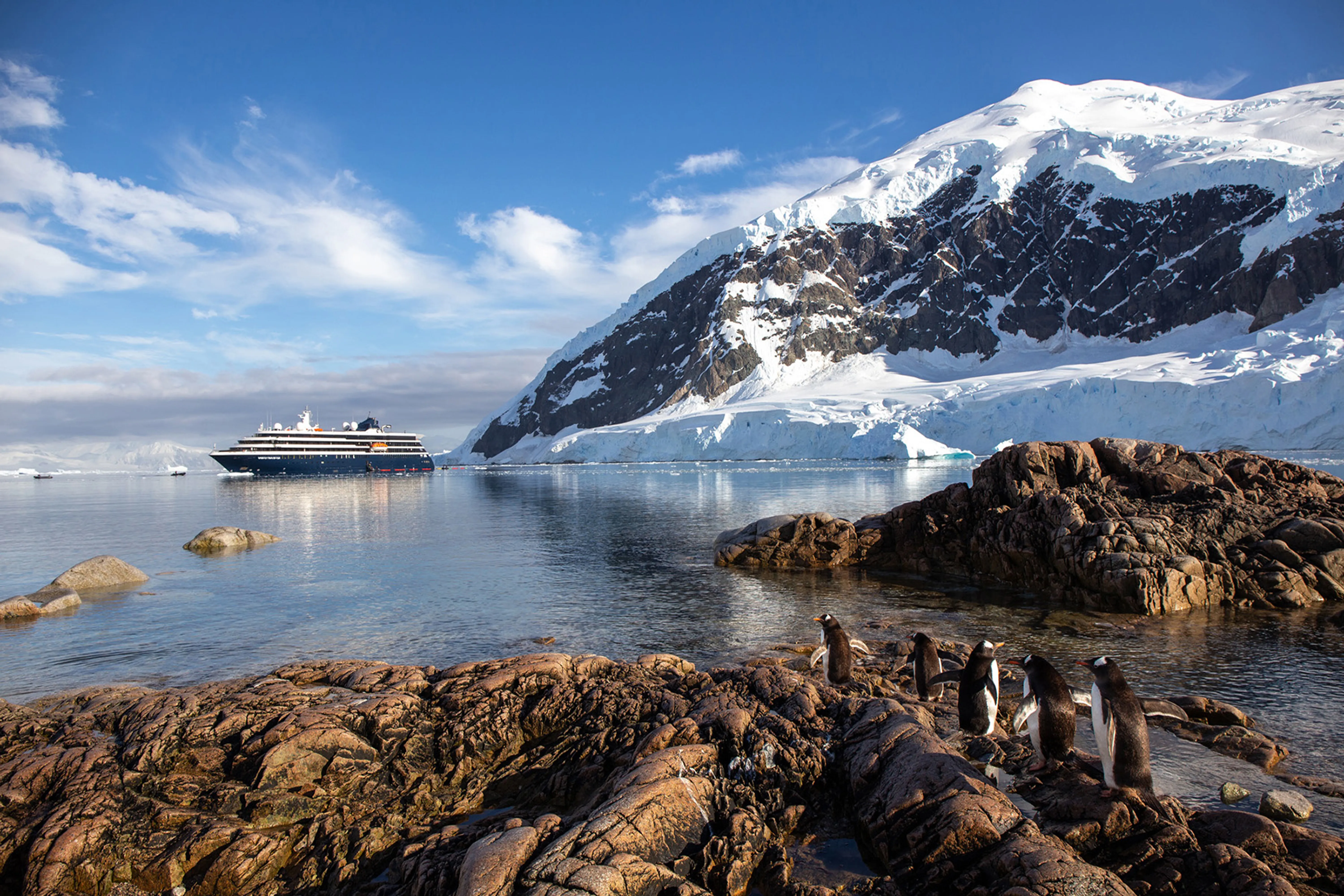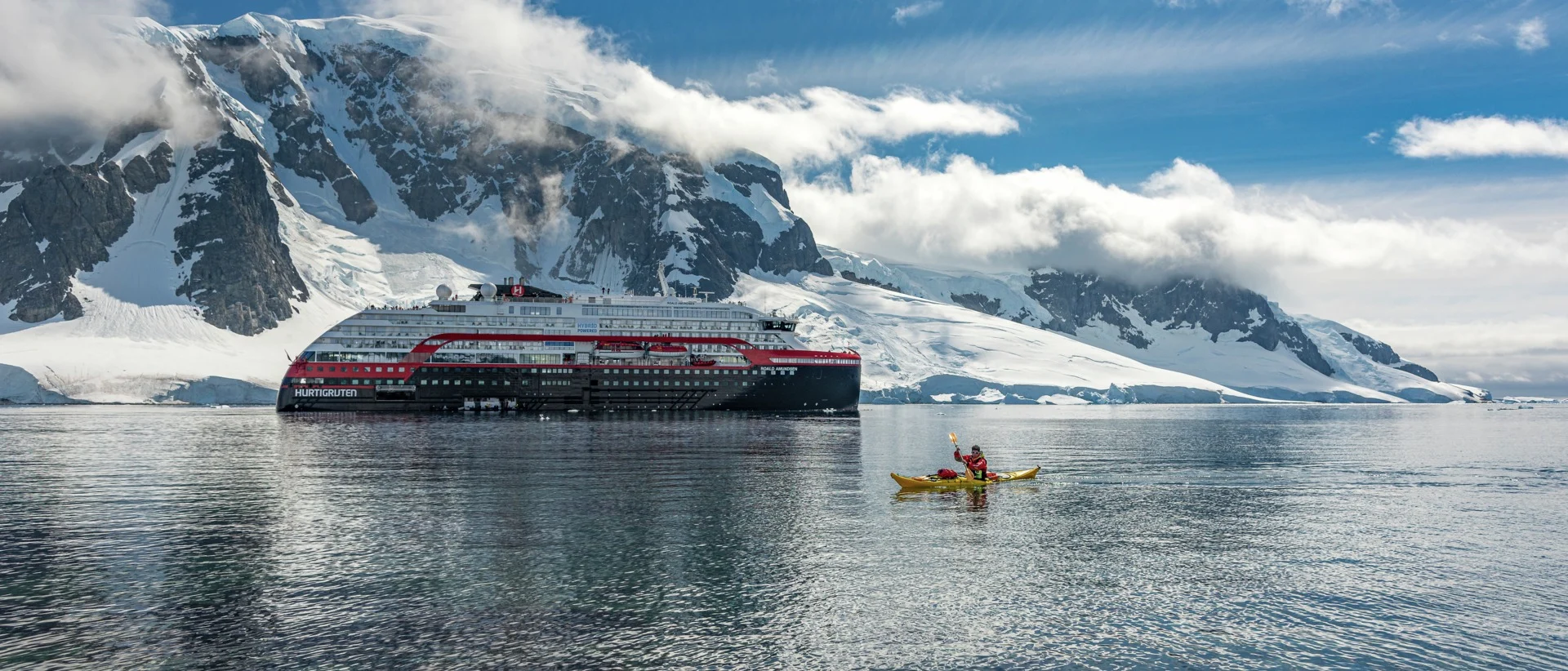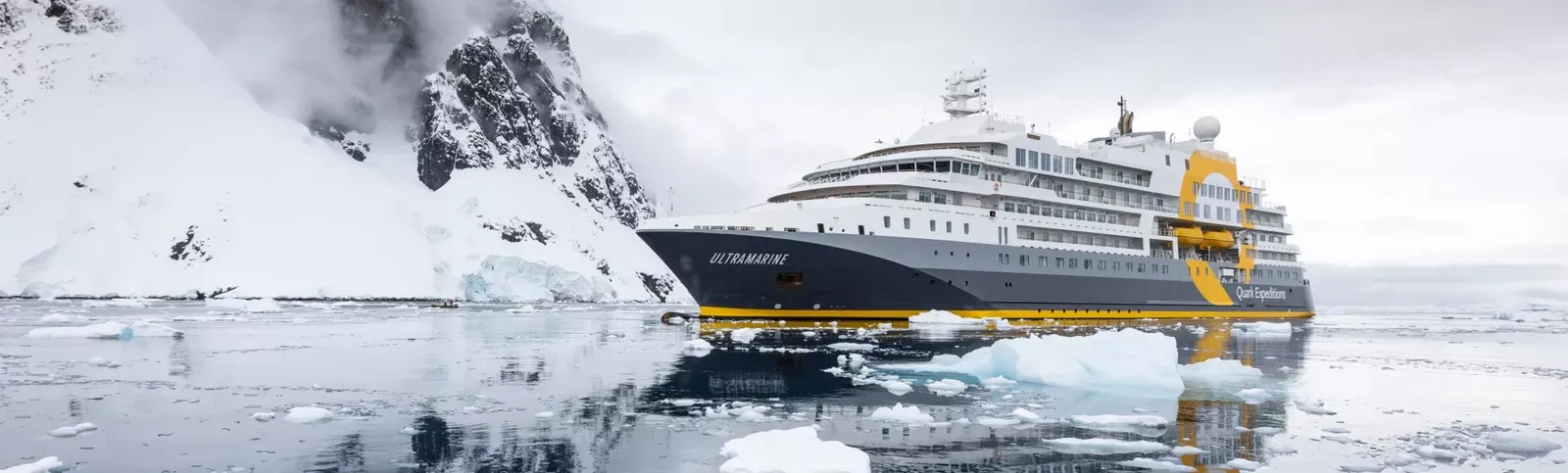
Aurora Expeditions and Ponant are both genuine expedition lines reaching Antarctica, the Arctic, and the Kimberley — but they sit at opposite ends of the expedition philosophy spectrum. Jake Hower compares their ships, guide ratios, ice capability, inclusions, dining, and total value for Australian travellers choosing between Australian adventure heritage and French luxury expedition at scale.
| Aurora Expeditions | Ponant | |
|---|---|---|
| Category | Expedition | Luxury / Expedition |
| Rating | ★★★★☆ | ★★★★★ |
| Fleet size | 3 ships | 13 ships |
| Ship size | Small (under 500) | Small (under 500) |
| Destinations | Antarctica, Arctic, Patagonia, Japan | Antarctica, Mediterranean, Arctic, South Pacific |
| Dress code | Relaxed | Smart casual |
| Best for | Small-ship polar expedition adventurers | French-inspired luxury expedition travellers |
Aurora Expeditions is the Australian-owned adventure specialist — three purpose-built X-BOW ships carrying a maximum of 130 passengers, a 1:8 guide ratio, seven citizen science programmes, B Corp certification, and the widest adventure activity menu in expedition cruising including kayaking, diving, climbing, camping, and ski touring. Ponant counters with the largest luxury expedition fleet afloat — thirteen ships reaching the Geographic North Pole aboard the PC2 icebreaker Le Commandant Charcot, Ducasse-trained French cuisine, an all-inclusive open bar with Henri Abelé champagne, the Blue Eye underwater lounge, and partnerships with National Geographic and the Explorers Club. Choose Aurora when you want a small Australian ship, genuine adventure activities, the smoothest Drake Passage crossing, and sustainability credentials you can verify. Choose Ponant when you want French culinary finesse, fleet-wide all-inclusive pricing, the deepest polar penetration afloat, and over three hundred departures per year across every expedition region on the planet.
The core difference
Aurora Expeditions and Ponant are both genuine expedition lines — both carry Zodiacs, both hold ice-class ratings, both reach Antarctica and the Arctic, and both deploy onboard teams of naturalists, historians, and marine biologists. But they represent fundamentally different philosophies of what expedition cruising should be, and understanding that distinction is the key to choosing between them.
Aurora Expeditions is Australian adventure heritage made seaworthy. Founded in 1991 by Greg Mortimer OAM — one of the first two Australians to summit Everest without supplementary oxygen — and Margaret Werner, the company is headquartered in Sydney and remains privately held and Australian-owned. The fleet of three purpose-built X-BOW expedition vessels carries a maximum of 130 passengers on polar voyages. The expedition team runs at a 1:8 guide-to-guest ratio. The company was the first to introduce kayaking, ice camping, commercial climbing, and SCUBA diving in Antarctica. It holds B Corp certification with an impact score of 87.5 and runs seven active citizen science programmes. The ship is named after a genuine mountaineer. The atmosphere is unpretentious, egalitarian, and adventure-first. The typical Aurora passenger is more likely to be a bushwalker than a black-tie diner.
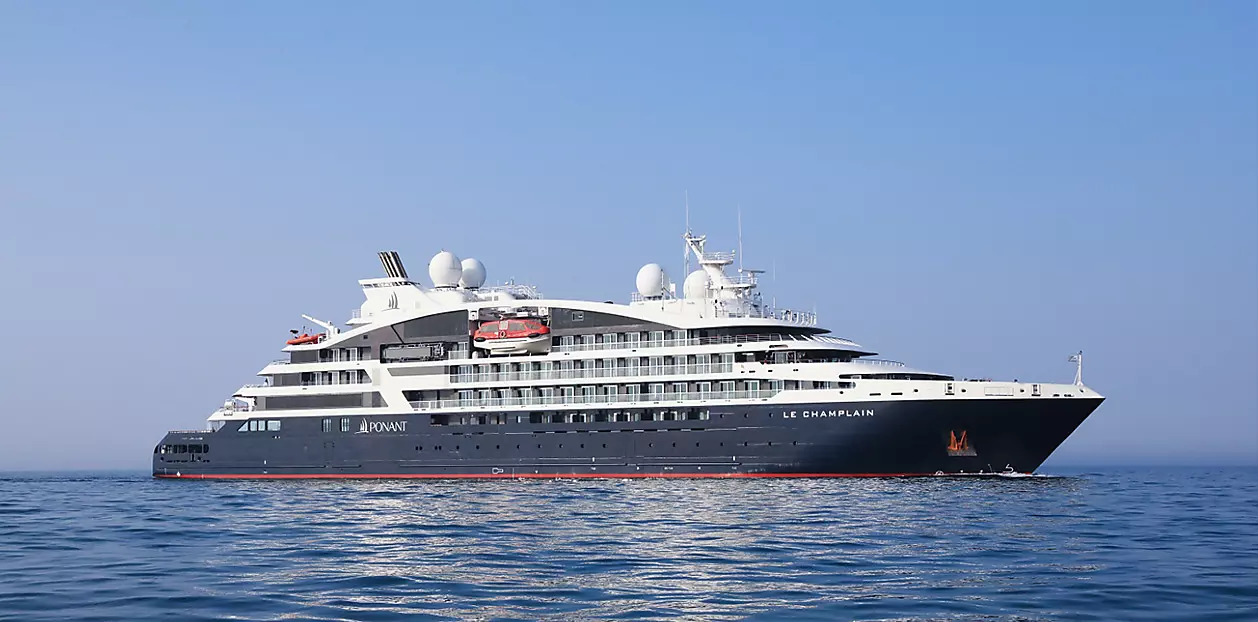
Ponant is French luxury expedition heritage at industrial scale. Founded in 1988 by Jean-Emmanuel Sauvée and twelve merchant navy officers in Marseille, the line was rebranded as Ponant Explorations in March 2025 and operates thirteen ships — from the 32-guest sailing yacht Le Ponant to the 245-guest Le Commandant Charcot, the world’s only luxury icebreaker with PC2 ice class capable of reaching the Geographic North Pole. Owned by Groupe Artémis (the Pinault family investment holding that also controls Kering, Christie’s, and Château Latour), Ponant is unambiguously French — in language, culinary philosophy, and passenger mix. Alain Ducasse Conseil designs the menus on Charcot. The open bar pours Henri Abelé champagne. Announcements are delivered in French first, then English. The fleet deploys across eight to ten regions simultaneously with over three hundred departures per year.
On the adventure-to-luxury spectrum, these two lines sit at different points with surprisingly little overlap:
Aurora occupies the adventure-specialist position — small ships, high guide ratios, the widest activity menu in expedition cruising, genuine sustainability credentials, and a price point that sits below the ultra-luxury tier. Ponant occupies the luxury-expedition position — larger fleet, French fine dining, all-inclusive pricing with champagne, the most capable icebreaker afloat, and a cultural atmosphere defined by French elegance rather than Australian informality.
For Australian travellers, the choice distils to a deceptively simple question: do you want your expedition ship to be a platform for adventure or a destination in its own right?
Expedition team and guides
The quality of the expedition team determines the quality of the expedition — full stop. The difference between a transcendent Antarctic landing and a forgettable one is the naturalist who spots the leopard seal beneath the ice, the historian who explains why Shackleton chose this bay, and the photographer who positions you for the shot of a lifetime.
Aurora’s expedition team operates at a ratio of approximately 1:7 to 1:8 — fifteen to twenty specialists for 130 passengers. This is among the best in the industry. Team members include marine biologists, glaciologists, ornithologists, historians, photographers, and activity leaders for kayaking, diving, climbing, and snowshoeing. Many have been with Aurora for over a decade; several for more than twenty years. Expedition leaders like Hayley Shephard split their seasons between Antarctic and Arctic operations, accumulating deep regional expertise that generalist guides cannot match. A dedicated Photography Guide sails on every expedition — not just select sailings — offering lectures, composition workshops, and informal one-on-one tuition during landings. Richard I’Anson, a Canon Master with twelve published books and a Netflix documentary credit, is a regular guest photographer. The barrier between expert and guest is deliberately low: guides dine with passengers, join them at the bar, and are available for genuine conversation rather than formal presentations only.
Ponant’s expedition team varies significantly by ship class. On Explorer-class ships (184 passengers), approximately ten to twelve naturalist guides sail per voyage — producing a guide-to-guest ratio of roughly 1:15 to 1:18. On Le Commandant Charcot (200 to 245 passengers), the team doubles to approximately twenty guides, improving the ratio to 1:10 to 1:12. The team includes marine biologists, ornithologists, historians, geologists, botanists, and cultural specialists. All expedition staff are bilingual in French and English — a necessity given the passenger mix. Ponant’s approach is more brand-driven than personality-driven; specific expedition leaders are not prominently publicised in the way Aurora showcases its team members. Captain Etienne Garcia of Le Commandant Charcot is a notable exception, profiled as “The Ice Whisperer” in Australian press.
The practical difference is substantial. On Aurora, with 130 passengers and a 1:8 ratio, shore excursion groups are small — typically ten to twenty per guide — and passengers receive genuine individual attention from specialists who know their names. On a Ponant Explorer-class ship, the larger passenger count and smaller expedition team mean groups are bigger, attention is more diffused, and the intimate expert-guest dynamic that defines Aurora’s experience is harder to replicate. On Charcot, the doubled team partially closes this gap, but the ship still carries significantly more passengers than any Aurora vessel.
For citizen science, Aurora leads decisively. Seven active programmes — HappyWhale, eBird, NASA GLOBE Cloud, Secchi Disk Study, Snow Algae Study, FjordPhyto, and a pioneering thermal imaging project — are supported by dedicated Citizen Science Centres on the Sylvia Earle and Douglas Mawson. Ponant’s citizen science is most active on Le Commandant Charcot, where visiting scientists engage passengers in data collection — seventy scientists participated across a recent Charcot season with twenty-three research projects. But on the Explorer and Boreal-class ships, citizen science is less formalised than Aurora’s programme.
Ships and expedition hardware
The fleet comparison is stark: three ships against thirteen. But numbers alone do not tell the story — what matters is what each ship can do.
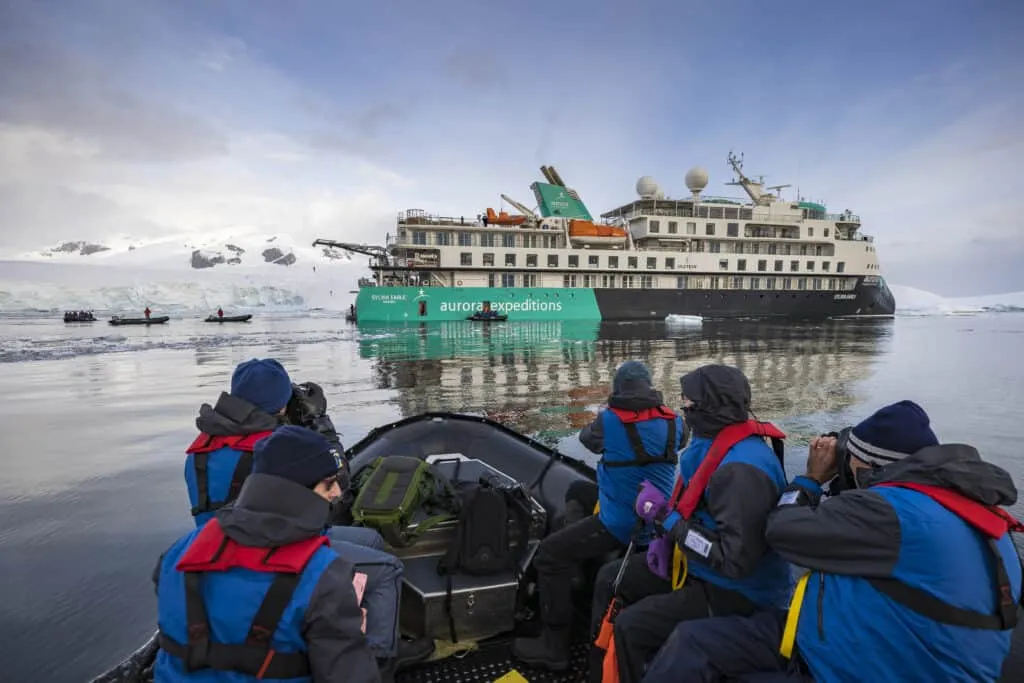
Aurora operates three purpose-built Infinity-class vessels, all featuring the revolutionary Ulstein X-BOW hull design. The Greg Mortimer (2019, 130 passengers), Sylvia Earle (2022, 130 passengers), and Douglas Mawson (2025, 130 polar / 154 non-polar) are sister ships with identical hull forms. At 104 metres long and 8,000 to 8,200 gross tonnes, they are genuine expedition ships — small enough for nimble Zodiac operations, large enough for open-ocean crossings. Ice Class 1A (Polar Code 6) allows Antarctic Peninsula and standard Arctic operations. Each carries fifteen Zodiacs deployed through four dedicated boarding doors. Approximately eighty-five per cent of staterooms have private balconies. The Douglas Mawson adds a heated outdoor swimming pool, a two-storey atrium, and microplastic filtration technology. No Aurora ship carries a helicopter or submarine — the exploration philosophy is Zodiac-based, consistent with the adventure-first positioning.
The X-BOW is Aurora’s single most consequential hardware advantage. The inverted bow design, proven on over one hundred commercial vessels, splits wave energy rather than punching through it. The result in Drake Passage — where conventional ships slam through six-metre swells — is dramatically reduced impact, vibration, and seasickness. Captains and passengers consistently report a noticeably smoother ride. For the forty-eight hours of open ocean between Ushuaia and the Antarctic Peninsula, this is not a minor consideration.
Ponant operates thirteen core vessels across four classes. Le Commandant Charcot (2021, 200 to 245 passengers) is the undisputed flagship — 31,757 gross tonnes, 150 metres, PC2 ice class capable of breaking through multi-year ice up to 2.5 metres thick. It is the only luxury passenger vessel ever to reach the Geographic North Pole and the North Pole of Inaccessibility. It carries a helicopter (for operations and science, not passenger excursions), a Sherp all-terrain vehicle, hovercraft, tethered hot-air balloon, snowmobiles, kayaks, and sixteen Zodiacs. Two onboard laboratories support up to twenty visiting scientists per voyage. Propulsion is hybrid electric powered by liquefied natural gas with a 5 MWh battery pack for silent running. Charcot is, without question, the most capable expedition ship afloat.
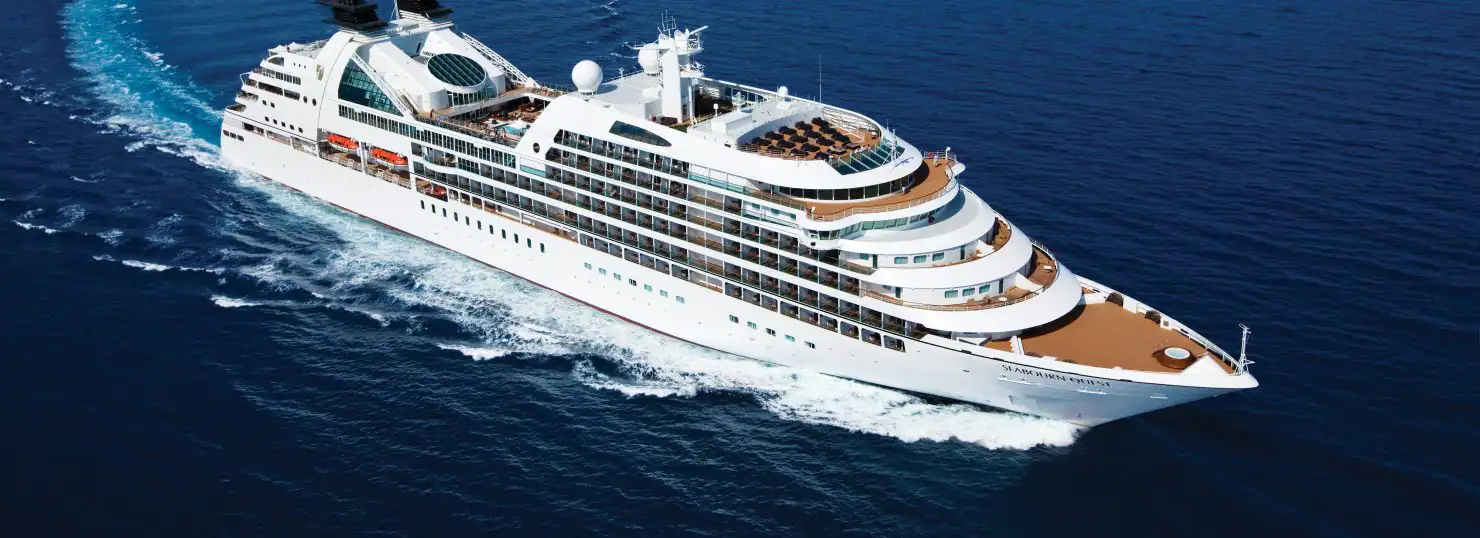
The six Explorer-class ships (2018 to 2020, 184 passengers each) are Ponant’s expedition workhorses. At 131 metres and roughly 10,000 gross tonnes, they are significantly larger than Aurora’s vessels. Ice Class 1C allows standard polar operations — notably lower than Aurora’s 1A rating, meaning they are less ice-capable than Aurora’s ships for Antarctic Peninsula conditions. Every stateroom has a private balcony. The standout feature is the Blue Eye underwater multi-sensory lounge — a genuinely unique space 2.5 metres below the waterline with whale-eye-shaped glass portholes, hydrophones capturing marine sounds across a three-mile radius, and Body Listening Sofas that vibrate with underwater acoustics. No competitor offers anything comparable.
The four Boreal-class ships (2010 to 2015, 264 passengers each) are the fleet’s older workhorses, ice-strengthened at 1C. With 264 passengers, they exceed the IAATO 200-passenger threshold for Category C1, placing them in Category C2 — which means more complex landing rotations and potential site restrictions at some Antarctic locations.
For IAATO landing logistics, the passenger count comparison matters enormously. IAATO regulations permit a maximum of one hundred passengers ashore at any one time. Aurora’s 130-passenger ships can typically land all guests in a single rotation or at most two quick rotations, maximising time ashore. Ponant’s Explorer-class at 184 passengers requires more rotation management but remains in Category C1. The Boreal-class at 264 passengers requires significantly more complex logistics, and some landing sites may be restricted entirely. Charcot reduces to 200 passengers for Antarctic sailings specifically to maintain C1 compliance.
Hardware that Aurora has and Ponant does not: The X-BOW hull for Drake Passage comfort. Dedicated Citizen Science Centres. A fleet where every ship is purpose-built within the last seven years.
Hardware that Ponant has and Aurora does not: Le Commandant Charcot’s PC2 icebreaker capability. The Blue Eye underwater lounge. A helicopter. A retractable marina platform for water sports. A fleet of thirteen ships offering over three hundred annual departures.
Landing experience and shore programme
This is where small-ship expedition cruising earns its premium — and where Aurora’s intimate scale delivers its most tangible advantage.
Aurora typically conducts two landings or Zodiac excursions per day — one morning, one afternoon — with a possible third activity in favourable conditions. With only 130 passengers, Zodiac deployment is fast and efficient: fifteen Zodiacs launch through four dedicated boarding doors, and the entire complement can be ashore within thirty to forty-five minutes. Time ashore per landing is typically two to three hours. Shore groups break into smaller walking groups of ten to twenty led by individual guides. The result is genuine immersion — time to sit with a penguin colony, hike to a glacial overlook, or paddle a kayak among icebergs without feeling rushed back to the ship.
Aurora’s activity menu is the widest in expedition cruising. Included at no extra charge: daily Zodiac cruises, guided walks and hikes, camping on Antarctic ice (on selected voyages), snowshoeing, photography workshops with the dedicated Photography Guide, polar plunge, bird watching, enrichment lectures, and citizen science participation. Available at additional cost: sea kayaking, SCUBA diving (Aurora has pioneered polar diving for over twenty years), snorkelling, stand-up paddleboarding, ski and snowboard touring on Antarctic peaks, alpine trekking and climbing, rock climbing, and the legendary Shackleton’s Crossing trek across South Georgia. No other expedition line offers this breadth of adventure options.
Ponant’s landing programme operates on similar daily rhythms — one to two landings per day plus Zodiac cruises — with ten passengers per Zodiac and naturalist guides accompanying each landing group. On Explorer-class ships, the rotation logistics are managed efficiently within the C1 threshold. On Boreal-class ships, the 264-passenger count requires more complex rotation that reduces individual time ashore.
Ponant’s standard activities include Zodiac landings and cruises, hiking and walking ashore, wildlife observation, polar plunge, and expert-led lectures — all included. Sea kayaking and snowshoeing are available on select itineraries, some at extra cost. Le Commandant Charcot adds exclusive activities available on no other cruise ship: tethered hot-air balloon rides over polar ice, hovercraft excursions, snowmobile rides, and polar diving. These Charcot exclusives are extraordinary experiences, but they are confined to a single ship operating a limited annual programme.
The practical difference for an Australian booking an Antarctic Peninsula voyage: on Aurora, you will spend more time ashore per day with a higher guide ratio in smaller groups, with access to the broadest activity menu including options like ice camping, ski touring, and climbing that Ponant does not offer on its standard fleet. On Ponant’s Explorer-class, you will have a comfortable and well-managed landing experience with expert naturalists, backed by the Blue Eye lounge experience between landings — but the larger passenger count means slightly less time per person ashore and larger groups on shore.
Physical fitness requirements are similar on both lines. Both require the ability to board and exit a Zodiac independently, walk across wet and uneven terrain, and manage the ship’s gangway. Neither line is wheelchair accessible for shore excursions. Aurora accepts passengers from age eight with no upper limit — guests up to age ninety-two have sailed. Ponant similarly requires passengers to be able to move independently around the ship in emergency conditions.
What is actually included
The inclusions comparison is where Ponant’s all-inclusive model and Aurora’s adventure-priced model diverge most clearly — and where the total cost calculation for Australian travellers becomes genuinely important.
Aurora’s base fare includes: fully serviced accommodation, all meals, snacks, tea, coffee, soft drinks, and juices throughout the day, house wine and beer with dinner, the Captain’s Farewell reception with house cocktails, all shore excursions and Zodiac cruises, the full expedition team, a complimentary 3-in-1 polar expedition jacket that passengers keep, complimentary waterproof Muck boots (loaned), Starlink Wi-Fi, port surcharges and landing fees, the enrichment lecture programme, and on Antarctic voyages one night’s pre-voyage accommodation and arrival airport transfer in Ushuaia. Junior Suite and Captain’s Suite bookings add a stocked minibar, champagne, binoculars, and included gratuities.
Aurora’s base fare does not include: international flights, gratuities of USD 15 per person per day for standard cabins (automatically added to the onboard account), premium spirits and cocktails beyond house wine and beer at dinner, optional adventure activities (kayaking, diving, skiing), laundry, and travel insurance.
Ponant’s all-inclusive fare covers: all dining across two to three restaurants including 24-hour room service, an open bar available at all hours (beer, wine, spirits, Henri Abelé Brut champagne, cocktails, soft drinks, mineral water, coffee, and tea), a daily-restocked minibar in every stateroom, unlimited Wi-Fi (Starlink-enhanced on Charcot), all Zodiac excursions and shore landings, daily expert-led lectures and briefings, a complimentary polar parka to keep on polar voyages, expedition boots on loan, onboard entertainment and enrichment, and port taxes and fees. On Antarctic Peninsula voyages, many sailings include an overnight hotel stay in Buenos Aires and a charter flight from Buenos Aires to Ushuaia — a significant inclusion worth approximately AUD 800 to 1,200 per person.
Ponant’s fare does not include: international flights to the embarkation gateway (unless part of a Fly, Stay & Cruise package), travel insurance, gratuities (voluntary but expected), some optional activities such as kayaking and diving on select itineraries, personal laundry (complimentary for upper loyalty tiers), spa treatments, and a small selection of ultra-premium wines and spirits above the generous included range.
The net calculation for an eleven-day Antarctic Peninsula voyage reveals more nuance than the headline fares suggest. Aurora’s entry cabin starts from approximately USD 13,000 to 14,000 per person. Add USD 165 in gratuities, premium drinks across eleven evenings, and the cost of arranging your own transfer and hotel in Ushuaia, and the total reaches approximately USD 14,500 to 16,000. Ponant’s Explorer-class entry cabin starts from approximately AUD 11,000 to 13,000 per person with the open bar, charter flight, and Buenos Aires hotel included. In AUD terms at current exchange rates, the all-in costs are closer than the published fares suggest — and Ponant’s genuine all-inclusive model means almost nothing goes on the onboard account.
The expedition gear comparison is straightforward. Both lines provide a complimentary polar parka to keep and waterproof boots on loan. Aurora’s parka is a 3-in-1 design with a removable insulated liner. Neither line provides binoculars to standard cabin guests — Aurora includes binoculars only in Junior Suite and Captain’s Suite; Ponant does not include binoculars at any level.
Destination coverage and itinerary depth
The scale difference between a three-ship fleet and a thirteen-ship fleet manifests most dramatically in destination coverage. Aurora is a specialist; Ponant is a network.
Aurora’s expedition programme centres on Antarctica as the primary product. Antarctic Peninsula voyages from Ushuaia — Spirit of Antarctica, Antarctic Explorer, Antarctica Active — form the core offering. Longer itineraries combine the Peninsula with South Georgia and the Falklands. Across the Antarctic Circle voyages push below 66 degrees south. East Antarctica and Ross Sea itineraries depart from Hobart, visiting Mawson’s Hut at Commonwealth Bay and the Ross Ice Shelf — rare and premium voyages uniquely accessible from Australia. Sub-Antarctic island expeditions reach the Auckland Islands, Campbell Islands, and Macquarie Island from New Zealand gateways. The Fly the Drake option — charter flights between Punta Arenas and King George Island in approximately one hour forty-five minutes — eliminates the Drake Passage crossing entirely, maximising time in Antarctica.
Beyond the poles, Aurora deploys to the Kimberley Coast between Darwin and Broome (June to July, operating since 1998), Svalbard, Greenland, the Northwest Passage, Iceland, Scotland, Indonesia (three new itineraries for 2026 including Raja Ampat), Costa Rica, Patagonia, and a Tasmania circumnavigation inaugurated by the Douglas Mawson in December 2025. The 2025-2026 Antarctic season features thirty-two voyages across three ships with eight new routes. The 2027-2028 season expands to thirty-four voyages with ten special editions.
Ponant’s expedition programme is vastly broader. Le Commandant Charcot accesses destinations no other luxury vessel can reach: deep Weddell Sea pack ice for emperor penguin colonies at Snow Hill Island, Peter I Island (one of the most remote islands on Earth), the Geographic North Pole (five departures scheduled for 2026), the North Pole of Inaccessibility (first reached September 2024), the McClure Strait through the Northwest Passage, and deep East Antarctic coast. A sixty-two-day full circumnavigation of Antarctica — the first ever — departs in January 2028.
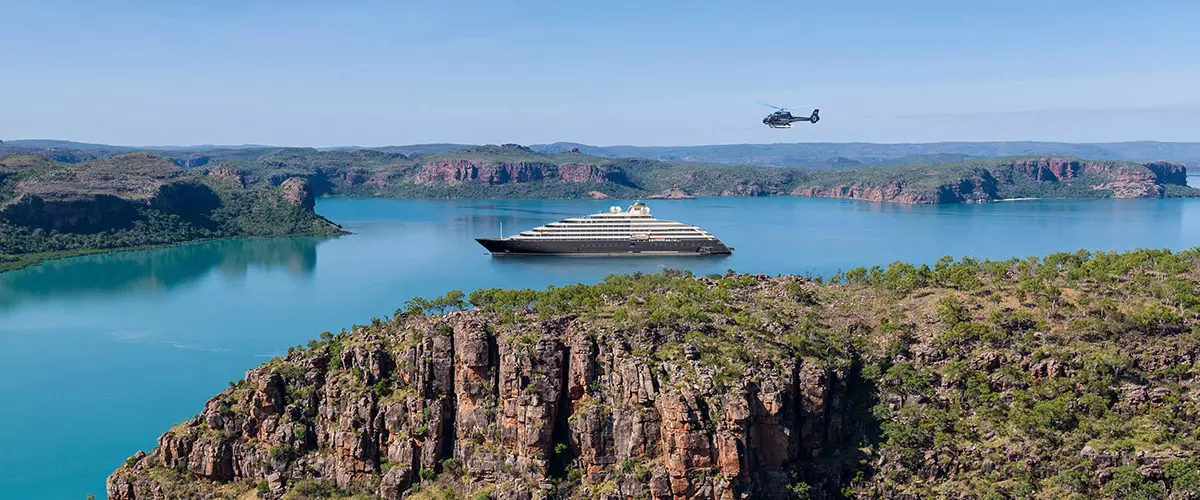
The Explorer and Boreal-class ships handle the standard Antarctic Peninsula programme from Ushuaia, Svalbard and Greenland summer deployments, and seasonal rotations through the Mediterranean, French Polynesia, Papua New Guinea, Japan, the Caribbean, Alaska, and the Great Lakes. The Kimberley programme runs sixteen sailings per season between Broome and Darwin, with Le Jacques-Cartier and Le Soléal deployed plus the thirty-guest Paspaley Pearl superyacht — making Ponant’s Kimberley operation one of the most comprehensive of any cruise line. Ponant Yachting catamarans cover the Mediterranean and Seychelles at ultra-intimate scale.
For an Australian traveller wanting Antarctic Peninsula specifically, both lines deliver strong programmes. For an Australian wanting the Kimberley, Ponant offers dramatically more departure dates but Aurora offers the smaller, more intimate ship. For an Australian wanting East Antarctica from Hobart, Aurora offers dedicated departures and Ponant’s Charcot made its Australian debut in Hobart in February 2026 with East Antarctic itineraries. For an Australian wanting the North Pole, deep Weddell Sea emperor penguins, or a circumnavigation of Antarctica, only Ponant qualifies.
The Fly-the-Drake comparison is worth noting. Aurora’s programme between Punta Arenas and King George Island includes two nights’ hotel accommodation in Punta Arenas, charter flights, and ground transfers. Ponant’s Antarctic logistics typically include a Buenos Aires hotel night and charter flight to Ushuaia — a different approach that eliminates a different segment of the journey. Both save time; the specifics of what is bypassed differ.
Cabins and accommodation
Both lines offer well-appointed expedition accommodation, but the cabin philosophies differ — Aurora optimises for adventure access and practicality; Ponant optimises for French hotel-standard living space.
Aurora’s cabin categories run from the Aurora Stateroom Twin (15.8 to 22.8 square metres, Deck 3, porthole or obstructed view) through Balcony Stateroom categories C, B, A, and Superior, to the Junior Suite (38.9 square metres) and Captain’s Suite (44.5 square metres, the largest accommodation at 479 square feet). Approximately eighty-five per cent of staterooms have private balconies. The Douglas Mawson introduces ten different cabin types — the most variety of any Aurora ship — including fifty-eight connecting balcony staterooms for families and three solo cabin configurations (two with portholes, one on Deck 7 with a French balcony). Each ship has a dedicated mudroom with personal lockers, boot storage, and rapid drying areas — a practical detail that matters enormously when returning from a wet Zodiac landing in Antarctica.
Ponant’s Explorer-class cabins start with the Prestige Stateroom at 200 square feet (18.5 square metres) of interior space plus a 43-square-foot balcony — notably more generous at entry level than Aurora’s entry cabin. All ninety-two staterooms have private balconies; there are no inside cabins on any Ponant ship. The hierarchy runs through Deluxe Suite (290 square feet), Privilege Suite (390 square feet with butler service), Grand Deluxe Suite (485 square feet), and the Owner’s Suite at 580 square feet with an 85-square-foot balcony. On Le Commandant Charcot, the scale escalates dramatically: Prestige Staterooms start at 215 square feet, and the Owner’s Suite spans 1,240 square feet of interior plus a 2,000-square-foot private terrace — the most extravagant suite in the expedition cruise industry, with a private Jacuzzi, personal telescope, separate dining room seating six, and dual bathrooms.
The Duplex Suite on Charcot deserves specific mention — a two-level apartment at 1,010 square feet of interior with a 280-square-foot terrace, private Jacuzzi, separate dining room, dressing room, and master plus guest bathrooms. Nothing in Aurora’s fleet approaches this level of accommodation.
The practical consideration for expedition travellers is whether cabin luxury translates to expedition quality. On Aurora, the smaller ship means shorter walks from cabin to mudroom, faster Zodiac embarkation, and closer proximity to observation decks. The dedicated mudroom with personal lockers means gear drying is efficient and organised. On Ponant’s Explorer-class, the larger ship means slightly longer internal transits but substantially more living space. The retractable marina platform at the stern provides a different boarding experience for Zodiac launches — elegant but not necessarily faster.
For solo travellers, Aurora leads with structural commitment: ten dedicated solo cabins per ship from the 2026-2027 season onwards, three solo cabin types on the Douglas Mawson, a cabin-share programme, and the solo supplement waived across 2025-2026 seasons. Ponant has responded with solo supplement waivers on more than 160 voyages — generous, but without the dedicated solo cabin infrastructure that Aurora offers.
The balcony debate matters differently on expedition ships than on mainstream cruisers. On Aurora, eighty-five per cent of cabins have balconies — and standing on your private balcony at two in the morning watching an Antarctic glacier calve in the midnight twilight is among the most profound moments in travel. On Ponant, every stateroom on every ship has a private balcony. Both lines get this right; Ponant is marginally more consistent.
Pricing and value
Price is not the reason to choose either line — the expedition experience is. But price determines which expedition experience is accessible, and the comparison deserves honest numbers.
Aurora’s directional pricing for an eleven-day Spirit of Antarctica voyage: the entry Aurora Stateroom Twin starts from approximately USD 13,000 to 14,000 per person. Balcony Stateroom C starts from approximately USD 16,000 to 18,000. Junior Suite from approximately USD 28,000 to 35,000. Captain’s Suite from approximately USD 35,000 to 42,000. Prices vary significantly by departure date, ship, and promotional offers — Aurora regularly runs sales of up to thirty-five per cent off. Longer voyages including South Georgia and the Falklands range from USD 19,000 to 60,000-plus depending on cabin and duration.
In AUD terms at current exchange rates, the entry-level Antarctic Peninsula voyage starts from approximately AUD 20,000 to 22,000 per person. Add gratuities (USD 15 per person per day, approximately AUD 250 total), optional adventure activities, and bar spend beyond the included dinner beverages.
Ponant’s directional pricing for an Explorer-class Antarctic Peninsula voyage of ten to eleven nights: from approximately AUD 11,000 to 13,000 per person for the entry-level Prestige Stateroom with balcony, including the Buenos Aires hotel night and charter flight to Ushuaia on most sailings. Le Commandant Charcot Antarctic voyages — such as the Emperor Penguins of the Weddell Sea at fourteen nights — start from approximately AUD 18,000 to 22,000 per person. The North Pole from Longyearbyen runs approximately USD 46,450 per person. The sixty-two-day Antarctic circumnavigation starts from approximately USD 147,360. Kimberley cruise-only fares start from approximately AUD 11,340, with Fly, Stay & Cruise packages from approximately AUD 13,670 including return flights from Australian capitals.
Ponant’s early-booking Ponant Bonus discount of up to thirty per cent off the reference fare substantially improves value for planners willing to commit early — a savings structure similar to Aurora’s own promotional cycles.
The value proposition is not straightforward because the inclusions differ so materially. Ponant’s all-inclusive fare covers the open bar, charter flights, hotel nights, and a daily-restocked minibar — inclusions that Aurora charges separately for. Aurora’s lower headline fare excludes these items but includes a broader adventure activity menu (camping, snowshoeing, photography workshops) without additional charge.
For solo travellers — approximately thirty per cent of Aurora’s passenger base — Aurora’s dedicated solo cabins with no single supplement represent genuine structural value. Ponant’s solo supplement waiver on 160-plus voyages provides breadth of choice. Both are strong for solos; the calculus depends on whether you prioritise a dedicated solo cabin or destination flexibility.
Onboard enrichment and science
Expedition enrichment is not entertainment — it is preparation for the landscape you are about to enter and interpretation of what you have just seen. Both lines invest heavily, but the delivery models differ.
Aurora’s enrichment programme is built into every voyage rather than reserved for special departures. A full lecture programme runs daily, covering wildlife behaviour, glaciology, polar history, climate science, photography, and destination context. The citizen science programme — seven active projects supported by dedicated Citizen Science Centres on the Sylvia Earle and Douglas Mawson — transforms passengers from observers into participants. Photographing whales for HappyWhale, recording bird sightings for eBird, documenting cloud conditions for NASA, and collecting phytoplankton samples for climate research gives every voyage a dimension of scientific purpose that few competitors match. The Photography Guide on every expedition offers workshops, composition advice, and editing sessions. Special partnerships with New Scientist Discovery Tours create science-focused voyages. The Douglas Mawson’s inaugural season featured Douglas Mawson’s great-granddaughter Emma McEwin and travel photographer Richard I’Anson — connecting the ship to genuine Australian exploration heritage.
Daily recap sessions review what was seen and preview the following day’s activities — a rhythm that structures the expedition experience around learning and anticipation rather than passive consumption.
Ponant’s enrichment programme leverages three major institutional partnerships that bring global credibility. The Explorers Club partnership (expanded November 2025) places scientists, filmmakers, and explorers on select voyages — including mountaineer Peter Hillary and filmmaker John Heminway. Smithsonian Journeys collaborations bring Smithsonian experts on themed voyages, with thirty-five ocean cruise departures planned for 2027. National Geographic branding appears on select Charcot voyages. These are genuine content partnerships that shape the character of specific sailings — but they are event-driven rather than universal. On a standard Explorer-class voyage without a marquee partnership, the enrichment programme comprises the expedition team’s daily lectures and briefings, which — while professional — may lack the structural depth of Aurora’s citizen science and dedicated photography programme.
On Charcot, the enrichment reaches its peak: two purpose-built laboratories, a dedicated science coordinator, capacity for twenty visiting scientists, and engagement that includes setting up research stations on ice floes and deploying satellite transmitters. Seventy scientists participated across a recent Charcot season with twenty-three different research projects. This is genuine scientific expedition, not just enrichment programming.
The distinction matters: Aurora delivers consistent enrichment depth on every single voyage through embedded programmes (citizen science, photography, lectures). Ponant delivers marquee enrichment moments on selected voyages through institutional partnerships, with standard-tier enrichment on the majority of departures.
Dining on expedition
Dining is secondary to the expedition on both lines — but Ponant treats it as a defining feature while Aurora treats it as fuel for adventure.
Ponant’s culinary programme is a genuine differentiator. French chefs prepare all meals across the fleet with a strong emphasis on classic French technique, high-quality ingredients, and refined presentation. On Le Commandant Charcot, the Nuna restaurant — the first Alain Ducasse restaurant at sea, included in the fare at no surcharge — is widely cited as among the finest restaurants on any cruise ship. Sila offers buffet and themed dinners. Inneq provides casual al fresco grilling beside the heated pool. On Explorer-class ships, Le Nautilus serves à la carte four-course French-European dinners and Le Nemo provides poolside casual dining. Pierre Hermé macarons, Kaviari caviar, boulangerie-quality bread and pastries, a curated French wine list, and the included Henri Abelé champagne elevate every meal. A French cheese course is standard at dinner.
The all-inclusive bar means wine flows freely with every meal, champagne is poured at any hour, and the dining experience extends naturally into evening drinks without cost anxiety. Twenty-four-hour room service is included.
Aurora’s dining sits firmly in the “hearty expedition fare with aspirational touches” category. The Gentoo main restaurant offers buffet breakfast and lunch with à la carte dinner. A secondary venue on each ship — Tuscan Grill on the Greg Mortimer, Rockhopper on the Sylvia Earle — provides intimate steakhouse-style dining at limited capacity. The Douglas Mawson adds two restaurants and two bars including a pool bar. The Sustainable Food Programme sources locally wherever possible — organic produce, free-range chicken, Argentinian grass-fed beef. In a distinctive sustainability stance, Aurora has banned all salmon from onboard menus from the 2025-2026 season due to environmental impacts of salmon farming.
The food is good, fresh, and well-prepared — designed to fuel adventurous days rather than win culinary awards. Open seating at all meals encourages the communal atmosphere that defines Aurora’s character. House wine and beer with dinner are included; the Captain’s Farewell reception adds house cocktails. Twenty-four-hour tea, coffee, and snacks are available. Room service is not a significant feature.
The honest assessment: Ponant’s dining is measurably superior in technique, presentation, ingredient quality, and variety. The Ducasse heritage on Charcot is in a category of its own. Aurora’s dining is reliably satisfying and sustainability-focused but does not compete with Ponant at the culinary level — nor does it pretend to. Aurora competes on the ice, not in the kitchen. For travellers who prioritise dining as a core part of the cruise experience, Ponant wins this category decisively. For travellers who see the ship as a base camp and care more about what happens between meals than during them, Aurora’s approach is entirely fit for purpose.
Standout itineraries for Australian travellers
Aurora Expeditions
Spirit of Antarctica (11 days, Ushuaia roundtrip, November to March) — The gateway Antarctic voyage. 130 passengers on an X-BOW ship, 1:8 guide ratio, two landings per day. Entry from approximately USD 13,000. Fly from Sydney or Melbourne to Buenos Aires via Santiago, connect to Ushuaia. The most accessible Antarctic Peninsula experience from an Australian company.
East Antarctica and the Ross Sea (departing Hobart, 20 to 30 days) — The uniquely Australian Antarctic expedition. Depart from Hobart — no international flight required — and sail south to Commonwealth Bay, Mawson’s Hut, and the Ross Ice Shelf. These rare itineraries connect Australia’s Antarctic heritage directly, visiting the places where Mawson himself explored. Premium pricing but irreplaceable experiences.
Across the Antarctic Circle: Fly the Drake (Fly/Fly option from Punta Arenas) — Skip the Drake Passage entirely, fly to King George Island in under two hours, and maximise time in Antarctica. The Fly/Fly option reduces total voyage time while delivering the same number of landing days. Ideal for time-conscious Australian travellers.
Kimberley Coast (11 days, Darwin to Broome, June to July) — Aurora has sailed the Kimberley since 1998. Domestic flights only from eastern Australian capitals. 130 passengers explore King George Falls, Montgomery Reef, and Indigenous rock art sites with the same small-group intimacy that defines the polar programme.
Sub-Antarctic Islands and Tasmania (from Hobart and New Zealand gateways) — The Douglas Mawson’s inaugural season includes a Coastal Tasmania circumnavigation. Auckland Islands, Campbell Islands, and Macquarie Island voyages reach royal albatross colonies, sea lion haul-outs, and yellow-eyed penguin habitats — all within the Australian and New Zealand travel sphere.
Ponant
Le Jacques-Cartier: Kimberley (10 nights, Broome to Darwin, May to September) — Sixteen sailings make this the most flexible Kimberley programme of any expedition line. Fly, Stay & Cruise packages from approximately AUD 13,670 include return flights from five Australian capitals, a hotel night, and all-inclusive expedition cruising. The Blue Eye underwater lounge adds a dimension no Kimberley competitor can match.
Le Commandant Charcot: Emperor Penguins of the Weddell Sea (14 nights from Punta Arenas) — Only Charcot’s PC2 ice class can break through Weddell Sea pack ice to reach the emperor penguin colonies at Snow Hill Island. From approximately AUD 18,000 to 22,000. An experience available on no other luxury vessel.
Le Commandant Charcot: Geographic North Pole (15 nights from Longyearbyen, July to August) — Five departures in 2026. The first and only luxury vessel to reach 90 degrees North. From approximately USD 46,450. For the Australian traveller who has done Antarctica and wants the ultimate polar achievement.
Le Commandant Charcot: Antarctic Circumnavigation (62 nights, Ushuaia roundtrip, January 2028) — The first-ever full circumnavigation of Antarctica. From approximately USD 147,360. The defining expedition voyage of the decade, combining Peninsula, Weddell Sea, East Antarctic coast, Ross Sea, and sub-Antarctic islands in a single, continuous voyage.
Le Soléal: West Coast Odyssey (10 nights, Broome to Fremantle, July to August 2026) — A uniquely Australian itinerary exploring Shark Bay (UNESCO), Abrolhos Islands, Montebello Islands, and Murujuga National Park. Domestic flights only from Perth or connecting from eastern capitals. No Aurora equivalent exists.
For Australian travellers specifically
Both lines maintain Australian offices and actively court the Australian market — but the nature of their presence differs significantly.
Aurora Expeditions is Australian-owned and Australian-headquartered. The Sydney head office runs a company that was founded in Australia by an Australian explorer. The brand DNA is distinctly Australian — unpretentious, adventure-first, egalitarian. Aurora is the first Australian member of IAATO. Australian crew members and expedition team members feature prominently. Hobart departures for East Antarctica and sub-Antarctic voyages offer a uniquely Australian gateway to the continent. Kimberley operations have run since 1998. For Australian travel advisors, recommending Aurora means supporting a home-grown expedition company in a category dominated by European and American operators.
Ponant’s Australian operation is the most established foreign expedition line presence in the APAC region. The North Sydney APAC headquarters was built under Sarina Bratton AM and now generates approximately twenty per cent of Ponant’s global revenue — a significant market. Current CEO Asia Pacific Deb Corbett serves on the CLIA Australasia Executive Committee. Le Commandant Charcot made its Australian debut in Hobart in February 2026, reinforcing the Hobart gateway for the Australian market. Fly, Stay & Cruise packages from five Australian capitals simplify Kimberley bookings. Discovery Sessions in five Australian cities offer exclusive cruise deals and flight credits. For Australians, Ponant feels like a line that understands the Australian market because it has invested heavily in it for over a decade.
Flight routing from Australia: For Aurora’s Antarctic programme, fly from Sydney or Melbourne to Buenos Aires via Santiago (approximately fourteen to sixteen hours), then onward to Ushuaia. For Fly-the-Drake departures, fly to Punta Arenas via Santiago. For Aurora’s Hobart departures, no international flight is required. For Aurora’s Kimberley, domestic flights to Darwin or Broome from eastern capitals (two to four hours). For Ponant’s Antarctic programme, fly to Buenos Aires where Ponant provides the hotel night and charter flight to Ushuaia — a significantly smoother arrival experience. For Ponant’s Kimberley Fly, Stay & Cruise, flights from five capitals are bundled. For Ponant’s North Pole departures, fly to Longyearbyen via Oslo.
Travel insurance deserves emphasis. Standard travel policies often exclude Antarctica and expedition activities. Both Aurora and Ponant require travel insurance as a condition of booking. For Antarctic expeditions, a minimum of AUD 500,000 medical coverage and AUD 250,000 emergency evacuation coverage is recommended. Check your policy explicitly covers the Antarctic Treaty area and Zodiac-based activities.
The loyalty pathway favours Ponant for frequent travellers. Ponant’s Yacht Club offers lifetime status across four tiers with no requalification required, and cross-brand matching extends across Ponant Explorations, Paul Gauguin Cruises, and Aqua Expeditions — genuinely useful for travellers who sail multiple brands within the group. Aurora’s three-tier loyalty programme (Bronze, Silver, Gold) offers five per cent discounts, onboard credits up to USD 500, and complimentary stateroom upgrades — solid benefits with no expiry. Neither programme is a reason to choose the line, but Ponant’s cross-brand structure creates more compounding value over time.
The onboard atmosphere
The cultural feel of these two lines is the single most important non-technical difference — and it is the difference most likely to determine whether an Australian traveller loves or merely likes the experience.
Aurora’s atmosphere is distinctly Australian. The passenger mix is predominantly Australian and New Zealand with a growing international contingent. The onboard language is English throughout — no bilingual complexity, no translation delays, no wondering whether the French version of the briefing contained information the English version omitted. The dress code is casual expedition: most passengers wear the same clothes from the day’s adventures to dinner. No formal nights. Optional smartening up for the Captain’s Welcome and Farewell, but no pressure. The expedition team mingles with guests at meals and drinks. By day two, passengers know each other’s names. The average demographic is over fifty, well-travelled, educated, physically active — but increasingly younger guests are attracted by adventure activities and photography workshops. Solo travellers make up approximately thirty per cent of passengers, creating a social dynamic that welcomes individuals as naturally as couples.
The evening atmosphere revolves around drinks at the bar, sharing the day’s stories, and enrichment lectures. No organised entertainment in the traditional cruise sense — no shows, no casino, no theatre. The lecture programme is the primary evening attraction. The bar stays open, conversation flows naturally, and early nights are common after full expedition days with early starts. The Australian character shows through in the unpretentiousness, the adventure-first mindset, the egalitarian mixing of captain and passengers, and a can-do attitude toward weather and conditions that feels unmistakably Australian.
Ponant’s atmosphere is distinctly French. The passenger mix is approximately fifty per cent French, with significant Australian, European, and smaller North American contingents. The bridge team is French. All announcements, menus, signage, lectures, and safety briefings are delivered in French first, then English. Multiple English-speaking guests report that the French version is longer, more detailed, and delivered with more warmth and humour than the English translation. Some describe feeling like secondary participants — not excluded, but not the primary audience either.
The design aesthetic is understated French elegance — more Parisian boutique hotel than adventure outpost. The dress code is “Casual Chic” after six o’clock: men in long trousers and collared shirts, women in smart casual. One or two gala evenings per sailing recommend dark suits and cocktail dresses. French passengers tend to dress more formally than Anglo guests — women in heels and designer clothing, men in jackets. Australians accustomed to Aurora’s expedition-casual approach may feel underdressed if they have not packed at least one smart outfit.
Evening entertainment includes live music in the main lounge, cocktails, and the signature Soirée Blanche (White Party) on warm-climate sailings — an all-white dress event with music and dancing on the outer decks. The Blue Eye underwater lounge on Explorer-class ships offers an atmospheric alternative for after-dinner drinks. The mood is refined, conversational, and distinctly European — beautiful, but very different from the Australian informality that defines Aurora’s onboard life.
For Australians who love French culture, enjoy bilingual environments, and embrace the European approach to dress and dining, Ponant’s atmosphere is a genuine attraction. For Australians who want to fully understand every announcement at first delivery, feel equally prioritised in every briefing, and relax into an English-speaking environment where expedition gear is the evening dress code, Aurora is the natural choice.
The bottom line
Aurora Expeditions and Ponant represent two of the most compelling — and most different — approaches to expedition cruising available to Australian travellers. Both are genuine expedition lines. Both reach Antarctica. Both deploy expert teams. Both carry Zodiacs. The similarities end there.
Choose Aurora Expeditions for the most intimate expedition experience available on purpose-built ships. Three X-BOW vessels carrying a maximum of 130 passengers, a 1:8 guide-to-guest ratio, the widest adventure activity menu in the industry (kayaking, diving, climbing, camping, skiing, Shackleton’s Crossing), seven citizen science programmes with dedicated onboard science centres, B Corp certification with auditable sustainability credentials, an entirely English-speaking environment, the smoothest Drake Passage crossing on any expedition ship, Hobart departures for East Antarctica, and the knowledge that your fare supports Australia’s own expedition company. Accept that the dining is expedition-hearty rather than Michelin-aspirational, that drinks beyond dinner are additional, and that the smaller fleet means fewer departure dates and regions.
Choose Ponant for the most comprehensive luxury expedition fleet afloat. Thirteen ships reaching destinations no other line can access — the Geographic North Pole, the deep Weddell Sea, Peter I Island — aboard the only luxury icebreaker in existence. French fine dining with Ducasse Conseil heritage, an all-inclusive open bar with Henri Abelé champagne, the Blue Eye underwater lounge, over three hundred annual departures across every expedition region on the planet, and partnerships with National Geographic, Smithsonian Journeys, and the Explorers Club. Accept the French-first language dynamic, the larger passenger counts on standard fleet ships, the lower ice class on the Explorer and Boreal-class compared to Aurora’s 1A rating, and the reality that the French cultural orientation — charming for some — will be a constant presence.
For the Australian traveller who wants both, the combination is natural. An Aurora East Antarctica voyage from Hobart — the most Australian expedition experience available — followed by a Ponant Kimberley for French culinary intimacy, the Blue Eye lounge, and the broadest departure schedule on the coast. Or an Aurora Antarctic Peninsula for the X-BOW comfort and adventure activities, followed by a Ponant Charcot North Pole for the ultimate polar achievement. These lines do not compete for the same niche. They complement each other, and together they represent two of the finest expedition options an Australian traveller can book.