Aurora Expeditions and Seabourn represent the two ends of expedition cruising — adventure-first authenticity versus ultra-luxury refinement, both reaching Antarctica, the Arctic, and the Kimberley. Jake Hower compares their ships, guides, inclusions, landing logistics, and total value for Australian travellers choosing between Australia's own expedition pioneer and one of cruising's most prestigious luxury brands.
| Aurora Expeditions | Seabourn | |
|---|---|---|
| Category | Expedition | Expedition / Ultra-Luxury |
| Rating | ★★★★☆ | ★★★★★ |
| Fleet size | 3 ships | 5 ships |
| Ship size | Small (under 500) | Small (under 1,000) |
| Destinations | Antarctica, Arctic, Patagonia, Japan | Mediterranean, Caribbean, Antarctica, Northern Europe |
| Dress code | Relaxed | Casual elegance |
| Best for | Small-ship polar expedition adventurers | Ultra-luxury intimate ship enthusiasts |
Aurora Expeditions is the Australian-owned adventure specialist — three purpose-built X-BOW ships carrying a maximum of 130 passengers, a 1:8 guide ratio, seven citizen science programmes, B Corp certification, and the widest adventure activity menu in expedition cruising. Seabourn counters with ultra-luxury expedition — 264-passenger ships carrying all-veranda suites with marble bathrooms, complimentary premium spirits, Swarovski binoculars, a gifted Helly Hansen parka, and included charter flights and hotel for Antarctic voyages. Choose Aurora when you want smaller ships, more time ashore, genuine adventure credentials, Australian heritage, and a more accessible price point. Choose Seabourn when you want five-star luxury as the foundation of your expedition, all-inclusive premium beverages, larger suites, and the convenience of included Antarctic logistics.
The core difference
Aurora Expeditions and Seabourn occupy opposite ends of the expedition cruising spectrum — and the gap between them is wider than almost any other pairing in this comparison series. This is not a comparison between two adventure lines or two luxury lines with slightly different approaches. This is adventure versus luxury, expedition heritage versus five-star refinement, mud on your boots versus marble in your bathroom.
Aurora Expeditions is the Australian expedition company. Founded in 1991 by Greg Mortimer OAM — the first Australian to summit Everest without supplementary oxygen — and Margaret Werner, Aurora is headquartered in Sydney and named after Sir Douglas Mawson’s legendary Antarctic vessel. The company operates three purpose-built Infinity-class ships (Greg Mortimer, Sylvia Earle, and the brand-new Douglas Mawson), all featuring the Ulstein X-BOW inverted hull, all capped at 130 passengers on polar expeditions. Aurora pioneered ice camping, kayaking, commercial climbing, and SCUBA diving in Antarctica. It holds B Corp certification with an impact score of 87.5, runs seven citizen science programmes, and has banned salmon from all menus on environmental grounds. The brand DNA is distinctly Australian — egalitarian, unpretentious, adventure-obsessed, and environmentally conscious. Greg Mortimer himself still joins special voyages. For Australian travellers, Aurora is a home-grown success story in a category dominated by European and American operators.
Seabourn is ultra-luxury cruising applied to expedition. Owned by Carnival Corporation and headquartered in Seattle, Seabourn launched its expedition division in 2022 with Seabourn Venture, followed by sister ship Seabourn Pursuit in 2023. Both were purpose-built at T. Mariotti in Italy — 23,615 gross tonnes, 264 passengers, 132 all-veranda suites with marble-lined bathrooms and heated floors. The ships carry Swarovski Optik binoculars for every cabin, gift passengers a Helly Hansen parka and waterproof backpack, pour complimentary premium spirits and fine wines at all hours, and include caviar throughout the voyage. Adam Tihany designed the interiors with a “luxe lodge” aesthetic — faux fireplaces, fur pillows, and green velveteen banquettes. Antarctic voyages include charter flights from Buenos Aires to Ushuaia and a pre-cruise hotel night. The expedition programme is genuine and well-executed, with a 23-person expedition team and 24 Zodiacs per ship. But the primary sell is unmistakable: this is ultra-luxury first, expedition second.
For Australian travellers, the choice between these lines is not about quality — both deliver exceptional experiences. It is about what you value most. Aurora offers smaller ships, more time ashore, a wider adventure activity menu, genuine sustainability credentials, and a distinctly Australian character. Seabourn offers larger suites, all-inclusive luxury, included Antarctic logistics, and the assurance that every comfort will be attended to while you explore some of the wildest places on earth. The question is whether you want the expedition to be the luxury, or whether you want luxury alongside your expedition.
Expedition team and guides
The expedition team defines the quality of every landing, every Zodiac cruise, and every enrichment lecture — and both lines invest heavily in this area, though the team structures differ significantly.
Aurora’s expedition team operates at a ratio of approximately 1:7 to 1:8 — with 15 to 20 specialists sailing alongside 130 passengers. This is among the best ratios in expedition cruising. Team members include marine biologists, glaciologists, ornithologists, historians, photographers, and activity leaders for kayaking, diving, climbing, and snowshoeing. Many have been with Aurora for over a decade; several for more than twenty years. Hayley Shephard, a New Zealand-born expedition leader, splits her seasons between Antarctic and Arctic operations. Richard I’Anson — Canon Master, twelve published books, Netflix documentary Tales By Light — sails as a guest photographer on select voyages. Aurora places a dedicated Photography Guide on every expedition, not just special departures. The team’s longevity and deep institutional knowledge are notable — these are career expedition professionals who know Aurora’s ships, itineraries, and passengers intimately. The citizen science programme, supported by dedicated Citizen Science Centres on the Sylvia Earle and Douglas Mawson, adds a participatory dimension that most expedition lines do not offer.
Seabourn’s expedition team consists of 23 professionals per ship, producing a guide-to-guest ratio of approximately 1:11 with 264 passengers. The team is drawn from diverse specialisms — ornithologists, marine biologists, historians, oceanographers, geologists, photographers, and kayak guides. Notable team members include Luciano Bernacchi (fifteen-plus years polar experience, Certified Senior Polar Guide since 2015), Brent Houston (thirty-plus years wildlife research, 400-plus expeditions, penguin specialist), and Robert Egelstaff (world-renowned expedition canoeist). Seabourn’s expedition team delivers lectures, leads Zodiac excursions, interprets wildlife encounters, and hosts fireside chats. The team is professionally deployed and well-regarded in guest reviews — staff consistently receive praise for passion and knowledge.
The practical difference between these ratios shows on shore. With Aurora’s 1:8 ratio and 130 passengers, walking groups during landings are small — typically 10 to 20 per guide — and passengers receive genuinely personal attention from naturalists. With Seabourn’s 1:11 ratio and 264 passengers requiring rotated landings, individual guide attention is inevitably more distributed. Aurora’s dedicated Photography Guide on every sailing is a meaningful advantage for the many expedition travellers who consider photography a primary reason for the voyage. Seabourn offers photography masterclasses through the Image Masters programme, but this is an extra-cost, limited-capacity experience rather than an included programme.
Where Seabourn’s team excels is in the integration of expedition expertise with luxury service. Expedition staff mingle with guests throughout the ship — at dinner, at the bar, in Seabourn Square — and the barrier between expert and guest is deliberately low. The combination of expedition knowledge and Seabourn’s legendary service culture creates a distinctive atmosphere where a glaciologist might discuss calving dynamics over champagne and caviar. It is a different kind of expedition enrichment — less participatory than Aurora’s citizen science model, but genuinely engaging.
Ships and expedition hardware
The ships themselves represent fundamentally different design philosophies — and those philosophies shape every aspect of the expedition experience.
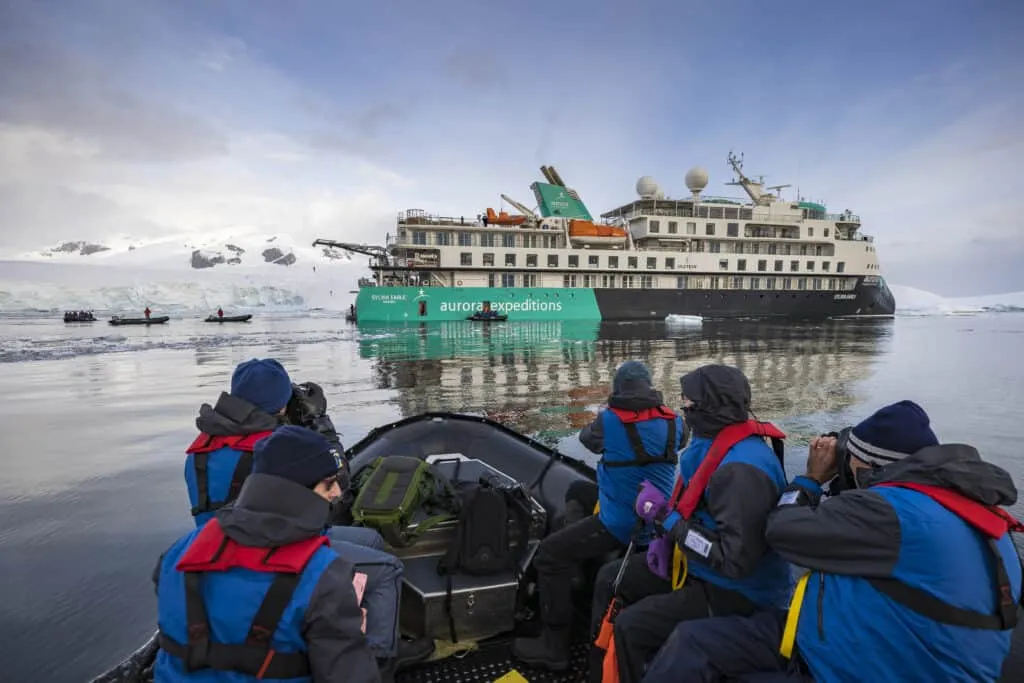
Aurora operates three Infinity-class vessels, all built at China Merchants Heavy Industry and chartered from SunStone Maritime Group. The Greg Mortimer (2019, 8,035 GT), Sylvia Earle (2022, 8,076 GT), and Douglas Mawson (2025, 8,178 GT) are identical in length (104.4 metres) and beam (18.4 metres), carrying a maximum of 130 passengers on polar expeditions. All three feature the Ulstein X-BOW — a patented inverted bow design that splits wave energy rather than punching through it, delivering noticeably smoother crossings in the Drake Passage. Aurora was the first to use the X-BOW on an expedition passenger ship, and captains and passengers consistently report less slamming, vibration, and seasickness compared to conventional hulls. Each ship carries 15 Zodiacs with four dedicated boarding doors for fast deployment. Ice class is 1A / Polar Code 6. The fleet is young, purpose-built, and expedition-optimised — no legacy vessels, no retrofits.
Seabourn’s expedition fleet consists of two ships — Seabourn Venture (2022) and Seabourn Pursuit (2023), both built at T. Mariotti in Italy. At 23,615 gross tonnes and 170 metres in length, they are roughly three times the tonnage and sixty-five per cent longer than Aurora’s ships, carrying 264 passengers in 132 all-veranda suites. Ice class is PC6. Each ship carries 24 Zodiac RIBs. Propulsion is via twin ABB Azipod units providing 360-degree manoeuvrability — lower vibration and superior close-quarters handling. The ships feature a Cineflex bow camera live-streamed to suites, an interactive virtual bridge with weather and ice displays, and open bridge access for all guests. Swarovski Optik binoculars are loaned to every cabin.
The submarine programme — once a signature differentiator — has ended. Seabourn confirmed in February 2026 that the two custom-built submersibles on each ship are being retired by early March 2026, citing low guest participation, operational complexity, and evolving regulatory restrictions. No replacement programme has been announced. This removes what was once a genuine distinguishing feature from Seabourn’s expedition proposition.
The passenger capacity difference is the single most consequential specification. Under IAATO regulations, a maximum of 100 passengers may be ashore at any Antarctic landing site at one time. Aurora’s 130 passengers can be landed in a single rotation or at most two quick rotations, maximising time ashore. Seabourn’s 264 passengers require split rotations — while one group is ashore, others conduct Zodiac cruises, then swap. Seabourn starts landings as early as 7:00 AM to accommodate all guests, and the system works — but the mathematics of 264 passengers through 100-person landing limits means less individual time on the ground compared to a 130-passenger ship. For travellers who consider shore time the primary purpose of an expedition cruise, Aurora’s smaller ships deliver a structural advantage that no amount of luxury can replicate.
Both lines operate modern, purpose-built fleets with no legacy vessels. The difference is that Aurora’s ships are designed around expedition capability — the X-BOW, the fast Zodiac deployment, the intimate passenger count. Seabourn’s ships are designed around luxury that happens to operate in expedition waters — the marble bathrooms, the Azipod manoeuvrability, the space ratio of 72 to 87 gross tonnes per passenger (compared to Aurora’s roughly 62).
Landing experience
The shore programme is where the adventure-versus-luxury distinction becomes most tangible — and where the practical implications of passenger count are felt most directly.
Aurora typically conducts two landings or Zodiac excursions per day when conditions permit — one in the morning, one in the afternoon. In favourable conditions, this can extend to three activities. With only 130 passengers, Zodiac deployment is fast: 15 Zodiacs with four dedicated boarding doors enable efficient loading. Time ashore per landing is typically two to three hours — notably more than larger ships can offer per rotation. Shore landing groups break into smaller walking parties of 10 to 20 led by individual guides, creating a personal and immersive experience. The small passenger count means genuine flexibility — if a pod of humpbacks appears during a landing, the expedition leader can extend time or redirect activities without complex logistics.
Aurora’s adventure activity menu is the broadest in expedition cruising. The company pioneered ice camping, kayaking, commercial climbing, and SCUBA diving in Antarctica. Included activities encompass daily Zodiac cruises, guided walks and hikes, camping on Antarctic ice, snowshoeing, a full photography programme, polar plunge, bird watching, enrichment lectures, and citizen science participation. Optional activities at additional cost include sea kayaking in inflatable kayaks designed for ice navigation, scuba diving, snorkelling, stand-up paddleboarding, ski and snowboard touring, alpine trekking and climbing, rock climbing, and the legendary Shackleton’s Crossing — a multi-day trek across South Georgia. Each ship features a dedicated mudroom with personal lockers, boot storage, and rapid drying areas.
Seabourn’s landing programme operates within the same IAATO framework but manages the logistics of double the passengers. Landings are split into groups — while one group is ashore (maximum 100), others conduct Zodiac cruises guided by naturalists for 90 to 120 minutes, then swap. The system is professionally managed and guests consistently report satisfaction, but the rotation model means that each group spends less total time on any given landing site than Aurora passengers do. The 24 large-capacity Zodiac RIBs are stored on the top deck rather than at water level — a design choice that slows deployment compared to some competitors.
Seabourn’s included shore activities comprise Zodiac cruises and landings, nature walks and hikes, snorkelling in appropriate destinations, polar plunge, and cultural experiences. Kayaking is an additional charge at approximately USD 199 to 250 per person per session, with capacity limited to eight double kayaks per ship — not all guests can kayak on every sailing. This is a common criticism in reviews: on an ultra-luxury product where premium spirits and caviar are complimentary, charging extra for a core expedition activity feels incongruous. Aurora’s activity programme is broader and more adventure-oriented; Seabourn’s is more curated and comfort-focused.
The physical fitness requirements are broadly similar for both lines. Both require guests to be confident on their feet, able to board and exit Zodiacs, and capable of walking on wet, rocky, or snowy terrain. Seabourn’s expedition staff are particularly adept at assisting guests who are uncertain — this is a luxury product that accommodates a broader physical capability range than a pure adventure operation. Aurora’s more strenuous activities — ski touring, alpine climbing, Shackleton’s Crossing — demand genuine fitness and attract a self-selecting group of adventurers.
What is actually included
The inclusion models represent two fundamentally different pricing philosophies — and the differences have significant financial implications for Australian travellers.
Aurora’s inclusion model covers fully serviced accommodation, all meals, snacks, tea, coffee, soft drinks, and juices, house wine and beer with dinner, the Captain’s Farewell reception with house cocktails, daily shore excursions and Zodiac cruises, the expedition team and enrichment programme, a complimentary 3-in-1 polar expedition jacket (yours to keep), waterproof Muck boots (loaned), complimentary Starlink Wi-Fi, port surcharges and landing fees, and one night’s pre-voyage accommodation with airport transfer on Antarctic voyages departing from Ushuaia. Junior Suite and Captain’s Suite passengers receive a stocked mini bar, champagne, binoculars, and included gratuities. What Aurora does not include: international flights, gratuities at US$15 per person per day for standard cabins (added to the onboard account), premium spirits and cocktails beyond dinner service, optional adventure activities (kayaking, diving, skiing), laundry, travel insurance, and personal bar expenditure.
Seabourn’s inclusion model is substantially more comprehensive. The fare covers all dining across every restaurant with no surcharges, premium spirits and fine wines at all bars at all hours, welcome champagne and in-suite bar stocked to personal preferences, complimentary caviar throughout the voyage, gratuities (tipping neither required nor expected), Starlink Wi-Fi, all Zodiac excursions and landings, the expedition team and enrichment programme, a Helly Hansen PolarShield parka and branded beanie (gifted, yours to keep), a Helly Hansen WaterShield waterproof backpack (gifted), waterproof boots (loaned), Swarovski Optik binoculars (loaned), a pre-cruise hotel stay in Buenos Aires for Antarctic voyages, charter flights between Buenos Aires and Ushuaia for Antarctic voyages, open bridge access, entertainment and live music, Dr Andrew Weil wellness classes, and pool, jacuzzi, sauna, and gymnasium access. What Seabourn does not include: kayaking at approximately USD 199 to 250 per session, helicopter flights on select itineraries, spa treatments beyond complimentary wellness classes, and laundry (complimentary for Gold-tier Seabourn Club members).
The charter flights and Buenos Aires hotel are Seabourn’s most valuable inclusion for Australian travellers. Getting from Buenos Aires to Ushuaia — a three-hour flight — is a logistical step that other expedition lines leave to the passenger. Seabourn bundles the charter flight, a hotel night in Buenos Aires, and all transfers into the fare. This is worth roughly AUD 1,500 to 2,000 per person in flights, accommodation, and transfers that would otherwise be booked separately. Aurora includes one night’s pre-voyage accommodation and airport transfer in Ushuaia for Antarctic voyages, but does not include the Buenos Aires connection.
The Helly Hansen parka gifted by Seabourn is a higher-profile branded item than Aurora’s 3-in-1 expedition jacket — though both are functional, waterproof, and yours to keep. Seabourn adds a branded waterproof backpack and beanie. Aurora provides the jacket and loans Muck boots. Both approaches are adequate for the expedition; Seabourn’s is more generous in branded takeaway gear.
The beverage inclusion is the most visible daily difference. Seabourn guests drink premium spirits, fine wines, and champagne from morning to midnight with no onboard account charges. Aurora guests receive house wine and beer at dinner; everything else is charged. On a ten-day polar expedition, a couple having two cocktails per evening and wine with lunch would add roughly USD 500 to 800 to their Aurora bill — included on Seabourn. The Seabourn model means almost nothing appears on the final account; the Aurora model means the onboard spend is not trivial.
Destination coverage
Both lines operate in Antarctica, the Arctic, and the Kimberley — but their deployment patterns and regional reach differ.
Aurora’s three-ship fleet covers an impressive geographic range for its size. The Antarctic season runs October to March with approximately 32 voyages across all three ships, including Antarctic Peninsula, South Georgia and Falklands, Weddell Sea, and the rare East Antarctica and Ross Sea itineraries departing from Hobart. Aurora also visits sub-Antarctic islands including Auckland Islands, Campbell Islands, and Macquarie Island — uniquely relevant for Australian travellers. The Arctic season runs June to August covering Svalbard, Greenland, the Northwest Passage, Iceland, Norway, and the Faroe Islands. Shoulder seasons include the Kimberley (11-day itineraries between Darwin and Broome, June to July — Aurora has visited the Kimberley since 1998), Indonesia (Raja Ampat, Borneo), Costa Rica, Scotland, and the British Isles. The Douglas Mawson’s inaugural season included a Coastal Tasmania circumnavigation. Aurora offers Fly the Drake options — charter flights between Punta Arenas and King George Island — to eliminate the notorious Drake Passage crossing.
Seabourn’s two-ship fleet deploys efficiently across expedition and non-expedition regions. Both ships operate simultaneously in Antarctica during the austral summer, with 16-plus departures between them covering Antarctic Peninsula, South Georgia and Falklands, and extended Wild South Atlantic voyages. The 2026-2027 season offers 19 Antarctic departures ranging from 10 to 20 days. In the Arctic, Seabourn Venture covers Svalbard, Iceland, Greenland, the British Isles, and the Northwest Passage — with two 24-day Northwest Passage crossings in 2026. Seabourn Pursuit operates the Kimberley exclusively from May to September, with eight departures in the expanded 2026 season and four confirmed for 2027. Pursuit also covers the South Pacific (Easter Island, Raja Ampat, Vanuatu, Samoa) and the Amazon. A notable offering is the 82-day “Across Three Continents” voyage combining Oceania and Antarctica, departing Broome in September 2026.
The Kimberley comparison is particularly relevant for Australian travellers, as both lines operate between Broome and Darwin. Aurora’s Kimberley voyages run 11 days on 130-passenger ships at a lower price point. Seabourn’s Kimberley voyages run 10 days on the 264-passenger Pursuit with ultra-luxury inclusions — from AUD 17,799 per person in a Veranda Suite. The Pursuit was named with the Wunambal Gaambera people (traditional landowners of the Kimberley) serving as godparents, and cultural experiences with Indigenous communities are included on Kimberley voyages. Both lines visit key sites including King George Falls, Montgomery Reef, and Hunter River.
Aurora’s unique advantage is Hobart departures for East Antarctica and sub-Antarctic voyages — no other comparable expedition line offers an Australian gateway to Antarctica. Seabourn does not depart from Australian ports for Antarctic voyages.
Cabins and accommodation
The accommodation gap between these two lines is perhaps the starkest difference in the entire comparison — and it reflects their fundamentally different priorities.
Aurora’s cabins are expedition-functional. The Greg Mortimer and Sylvia Earle offer seven cabin categories ranging from the Aurora Stateroom Twin on Deck 3 (15.8 to 22.8 square metres, porthole or obstructed view) to the Captain’s Suite (44.5 square metres with walk-in wardrobe and large lounge area). Approximately 85 per cent of staterooms have balconies. The Douglas Mawson expands to ten stateroom types, adds 58 connecting balcony staterooms for families and groups, and introduces three dedicated solo cabin configurations including a Deck 7 option with French balcony. The newest ship also features a two-storey atrium, panoramic forward-facing lounge, and the fleet’s first heated outdoor swimming pool. Cabins are well-designed and comfortable — Nordic-inspired interiors, en-suite bathrooms, and functional storage for expedition gear. Junior Suite and Captain’s Suite guests receive a stocked mini bar, champagne, binoculars, and included gratuities. The design philosophy prioritises what happens off the ship: the cabin is where you sleep and store your gear between adventures.
Seabourn’s suites are a destination in themselves. Every one of the 132 suites on each ship features a private veranda, ocean-front views, a marble-lined bathroom with heated floors, a separate bathtub (genuinely valuable after cold Antarctic landings), an in-suite clothes dryer (extremely practical for polar voyages), a walk-in closet, and an in-suite bar stocked to personal preferences. The entry-level Veranda Suite measures 33 square metres including a 7-square-metre veranda — already larger than most Aurora cabin categories. The range ascends through Panorama Veranda Suites (39 square metres with semi-circular living area and large soaking tub beside the window), Penthouse Suites (49 square metres with separate bedroom, dining for two, and Nespresso machine), Owner’s Suites (95 square metres with commanding forward views and a 45-square-metre curved veranda with sun loungers), Wintergarden Suites (97 square metres with glass-enclosed solarium, dining for six, and whirlpool bathtub), Signature Suites (128 square metres with canopied whirlpool spa on a 55-square-metre veranda), and the extraordinary Grand Wintergarden Suite — a two-storey, 130-square-metre apartment with lower-level living, dining, and guest bedroom, and an upper-level master suite with five-piece bathroom. Penthouse and above categories receive full butler service. The Grand Wintergarden Suite stocks Shackleton Blended Malt Scotch in the wet bar — a knowing nod to expedition heritage.
The accommodation comparison is not close, and it is not meant to be. Aurora’s Captain’s Suite at 44.5 square metres is smaller than Seabourn’s entry-level Veranda Suite when including the veranda. The marble bathrooms, heated floors, bathtubs, and in-suite clothes dryers on Seabourn have no equivalent on Aurora. Butler service is not part of Aurora’s offering at any level. Aurora’s cabins are comfortable and well-suited to expedition cruising — but Seabourn’s suites are hotel-quality accommodation that happens to be floating in Antarctic waters. The in-suite clothes dryer alone is worth mentioning to every client — drying expedition gear in a small cabin without one is a daily nuisance that Seabourn has elegantly solved.
For solo travellers, the gap is significant. Aurora offers ten dedicated solo cabins per ship with no single supplement on many sailings, a cabin-share programme, and has waived solo supplements across 2025-2026 seasons. Approximately 30 per cent of Aurora passengers travel solo. Seabourn’s standard solo supplement is 200 per cent of the double occupancy fare — effectively the full double fare for one person — with a reduced 125 per cent available on select voyages. For a Kimberley Veranda Suite, the solo supplement exceeds AUD 20,000. Aurora is dramatically more accessible for solo expedition travellers.
Pricing and value
Pricing is where the Aurora proposition becomes most compelling for budget-conscious expedition travellers — and where Seabourn’s premium must be justified by the luxury it delivers.
Aurora’s pricing is positioned 30 to 50 per cent below ultra-luxury expedition lines for entry-level cabins. A Spirit of Antarctica voyage (approximately 11 days, Antarctic Peninsula) starts from roughly USD 13,000 to 14,000 per person in the Aurora Stateroom Twin, rising to USD 35,000 to 42,000 for the Captain’s Suite. In Australian dollars, entry-level Antarctic voyages fall in the AUD 20,000 to 22,000 range per person. Longer voyages including South Georgia, Falklands, or East Antarctica range from USD 19,000 to 60,000-plus depending on cabin and duration. Aurora regularly runs sales of up to 35 per cent off published fares, and the loyalty programme offers five per cent off for repeat guests with onboard credits up to USD 500 for Gold Pioneer members. The solo supplement waiver across 2025-2026 seasons is a significant promotional advantage for single travellers.
Seabourn’s pricing reflects its ultra-luxury positioning. A 12-day Great White Continent voyage starts from AUD 21,504 per person in an entry Veranda Suite, rising to AUD 50,879 for a Wintergarden Suite. A 14-day Antarctica Exploration starts from AUD 24,099. Extended voyages including South Georgia and Falklands start from AUD 47,999 for 22 days. Kimberley voyages start from AUD 17,799 per person in a Veranda Suite for 10 days. The critical context for Seabourn’s Antarctic pricing is that charter flights from Buenos Aires to Ushuaia and a pre-cruise hotel night are included — worth approximately AUD 1,500 to 2,000 per person. Gratuities are also included, as are all beverages and dining. When comparing true total cost, the gap between Aurora and Seabourn narrows from headline figures.
A worked example illustrates the real comparison. For a standard 11 to 12-day Antarctic Peninsula expedition in the most affordable cabin:
Aurora: approximately AUD 20,000 base fare, plus AUD 240 gratuities (US$15 per day for 11 days), plus AUD 1,500 to 2,000 for Buenos Aires hotel and flight to Ushuaia, plus AUD 300 to 500 for drinks beyond dinner. Total: approximately AUD 22,000 to 23,000 per person.
Seabourn: approximately AUD 21,500 all-inclusive — charter flight, hotel, gratuities, premium drinks, and caviar all covered. Total: approximately AUD 21,500 per person.
The headline gap is smaller than it appears. But the experience gap remains substantial. Aurora delivers 130-passenger intimacy, more time ashore, the X-BOW Drake Passage advantage, the broadest adventure activity menu, and citizen science programmes. Seabourn delivers 264-passenger ultra-luxury, marble bathrooms, premium spirits, Swarovski binoculars, butler service for premium suites, and included logistics. Both represent excellent value for what they deliver — the question is what you value most.
For travellers considering longer voyages or premium cabins, the gap widens. Aurora’s Junior Suite for a 20-day Antarctica and South Georgia voyage might cost AUD 50,000 to 55,000. Seabourn’s Penthouse Suite for a comparable 22-day voyage exceeds AUD 60,000. At the top end, Seabourn’s Grand Wintergarden Suite commands fares well above AUD 80,000 — a tier of expedition luxury that Aurora does not attempt to match.
Onboard enrichment and science
Both lines deliver enrichment programmes appropriate to their positioning — but the models differ in character and participatory depth.
Aurora’s enrichment programme is built around citizen science and participatory learning. Seven active citizen science projects run across the fleet: HappyWhale (whale identification and migration tracking), eBird (global biodiversity monitoring), NASA GLOBE Cloud (climate modelling), Secchi Disk Study (ocean clarity measurement), Snow Algae Study (Antarctic melt rate research), FjordPhyto (phytoplankton sampling), and the pioneering Thermal Imaging of Polar Ice programme — Aurora is the first expedition company to facilitate this pilot project. The Sylvia Earle and Douglas Mawson both feature dedicated Citizen Science Centres where passengers can participate in projects, analyse data, and attend science briefings. Research partnerships include the Polar Citizen Science Collective, Oceanites penguin colony counts, the Friedlaender Lab whale studies, Reef Life Survey, and New Scientist Discovery Tours. The photography programme places a dedicated Photography Guide on every expedition with lectures, workshops, and informal one-on-one tuition during landings. Special photography voyages — including a 20-day Antarctica and South Georgia expedition with Richard I’Anson — offer intensive photographic instruction.
The enrichment programme on Aurora is genuinely participatory. Passengers do not merely listen to lectures about Antarctic ecology — they photograph whale flukes for HappyWhale, collect phytoplankton samples for FjordPhyto, and measure water clarity for the Secchi Disk Study. This transforms the expedition from observation to contribution, and it resonates strongly with travellers who want their voyage to have meaning beyond personal experience.
Seabourn’s enrichment programme takes a more traditional lecture-and-presentation approach, delivered at a consistently high standard. The 23-person expedition team delivers daily briefings, enrichment lectures, and fireside chats covering wildlife, geology, climate, history, and photography. The Dr Andrew Weil Mindful Living programme adds wellness-oriented content — meditation, yoga, and wellness lectures led by a certified Mindful Living Coach. Seabourn Conversations brings expert speakers aboard select sailings. The virtual bridge with interactive screens provides real-time ice, weather, and landing site information. Open bridge access allows guests to observe navigation and discuss conditions with officers. The Cineflex bow camera live-streamed to suites is a distinctive touch — watching the ship nose through sea ice from the comfort of a heated suite is quintessentially Seabourn.
Seabourn’s enrichment is polished, professional, and consistently excellent — but it is presenter-to-audience rather than participatory. There is no citizen science programme, no onboard science centre, and no mechanism for passengers to contribute data to ongoing research. For travellers who want to learn about Antarctica, Seabourn delivers superbly. For travellers who want to contribute to Antarctic science, Aurora is the clear choice.
Dining on expedition
Dining plays a different role on expedition ships than on luxury ocean cruisers — the schedule revolves around landings, weather, and wildlife rather than fixed mealtimes — but the gap between these two lines’ culinary approaches is substantial.
Aurora sits firmly in the “hearty expedition fare with aspirational touches” category. Two dining venues operate on each ship: Gentoo (main restaurant, buffet-style breakfast and lunch, a la carte dinner) and a secondary venue — Tuscan Grill on the Greg Mortimer, Rockhopper on the Sylvia Earle, and two restaurants plus two bars on the Douglas Mawson. The food is sustainable (Aurora runs a Sustainable Food Programme sourcing organic produce, free-range chicken, and Argentinian grass-fed beef), deliberately salmon-free (banned on environmental grounds from the 2025-2026 season), and quality without pretension — well-prepared food designed to fuel adventurous days rather than win culinary awards. Open seating encourages socialising. House wine and beer are included with dinner; premium beverages are extra. The secondary dining venue has limited capacity and reservations fill quickly — a consistent point of feedback. Room service is not a significant feature. The food is competitive with Quark and Hurtigruten Expeditions, and marginally above both, but it does not compete with ultra-luxury lines.
Seabourn’s dining is ultra-luxury applied to expedition — and it is a significant differentiator. The Restaurant (main dining room, designed by Adam D. Tihany, inspired by snowflake geometry) serves breakfast, lunch, and dinner at the same quality as fine-dining restaurants ashore. The Colonnade serves buffet breakfast and lunch, then converts to Earth and Ocean for dinner — waiter-served bistro-style cuisine with rotating themed nights including Singaporean, Indian, French, and American. The Club offers sushi and sashimi. Seabourn Square serves specialty coffees, pastries, artisan gelato, and gourmet sandwiches throughout the day. The Bow Lounge provides grab-and-go sandwiches and soups between expedition activities. Full in-suite dining is available 24 hours a day, with butler service for premium suites.
All dining on Seabourn is complimentary — no surcharges for any venue. Complimentary fine wines are poured at lunch and dinner. Complimentary caviar is available throughout the voyage. Seabourn’s famous breadsticks and daily souffles continue on expedition ships. The themed dinner nights in Earth and Ocean add genuine variety on longer voyages. Dietary requirements are accommodated individually by chefs working directly with guests.
The dining gap between these lines is significant and deliberate. Seabourn passengers dine on caviar, sushi, and fine wines with dedicated waiter service across six venues. Aurora passengers eat hearty, well-prepared expedition fare in two venues with house wine at dinner. Both approaches are appropriate to their respective products — Aurora’s food fuels adventure, Seabourn’s food is part of the luxury experience. For travellers who consider dining a primary component of the cruise experience, Seabourn is the clear choice. For travellers who view food as fuel for the next landing, Aurora delivers perfectly well.
Standout itineraries for Australian travellers
Aurora Expeditions
Spirit of Antarctica (11 days, Ushuaia roundtrip, multiple departures October to March) — The classic Antarctic Peninsula expedition on a 130-passenger X-BOW ship. Two landings per day, citizen science, and the full adventure activity menu. Entry from approximately AUD 20,000 per person. The gateway voyage for Australian travellers new to polar expedition cruising.
East Antarctica and the Ross Sea (departing Hobart) — Aurora’s unique Australian-gateway Antarctic expedition, visiting Mawson’s Hut at Commonwealth Bay, the Ross Ice Shelf, and sub-Antarctic islands. These are rare, premium itineraries departing from an Australian port — no other comparable expedition line offers this routing. Twenty-plus days at sea. A genuine bucket-list voyage for Australians with a connection to Mawson’s exploration heritage.
Kimberley Coast (11 days, Darwin to Broome or reverse, June to July) — Aurora has sailed the Kimberley since 1998. 130-passenger intimacy along one of Australia’s most spectacular coastlines. Entirely domestic — no international flights required. The adventure activity focus translates naturally to the Kimberley’s landscapes.
Antarctic Photography Workshop (20 days, Antarctica and South Georgia, November 2026) — A dedicated photography expedition with Richard I’Anson (Canon Master, Netflix Tales By Light). For serious photographers, this combines Aurora’s expedition credentials with intensive photographic instruction from one of Australia’s most published travel photographers.
Across the Antarctic Circle: Fly the Drake — Fly one or both directions between Punta Arenas and King George Island, eliminating the Drake Passage crossing. Maximum Antarctic time on a tight schedule. The Fly/Fly option suits Australian travellers with limited leave.
Seabourn
The Great White Continent (12 days, roundtrip Ushuaia) — Seabourn’s signature Antarctic Peninsula voyage. Buenos Aires hotel night and charter flights included. All-veranda suites with marble bathrooms and complimentary premium spirits. From AUD 21,504 per person. The entry point for ultra-luxury Antarctic expedition from an Australian starting position.
Antarctica, South Georgia and Falkland Islands (22 days, roundtrip Ushuaia) — The comprehensive Antarctic expedition at ultra-luxury level. South Georgia’s king penguin colonies, the Falklands’ wildlife, and the Antarctic Peninsula — with Swarovski binoculars, caviar, and butler service for premium suites. From AUD 47,999. A once-in-a-lifetime voyage for travellers who want no compromise on comfort.
Kimberley (10 days, Broome to Darwin or reverse, May to September) — Seabourn Pursuit exclusively. Cultural experiences with Wunambal Gaambera people, King George Falls, Montgomery Reef, and Horizontal Falls. From AUD 17,799 per person in a Veranda Suite. No international flights required from any Australian capital. Optional helicopter to Mitchell Falls.
Across Three Continents (82 days, departing Broome September 2026) — An extraordinary grand voyage combining Oceania, the South Pacific, and Antarctica. Departs from an Australian port and covers Easter Island, Cenderawasih Bay, Vanuatu, and the Antarctic Peninsula in a single continuous expedition. For the Australian traveller with time and ambition, this eliminates multiple international flight legs.
Northwest Passage (24 days, Kangerlussuaq to Anchorage, August 2026) — Two departures in 2026. Complimentary economy airfare from home cities included on select sailings, plus full-service laundry. One of exploration history’s most storied routes, experienced with Seabourn’s luxury standards.
For Australian travellers specifically
Both lines maintain meaningful Australian operations and actively court the Australian market — but the nature of their presence differs.
Aurora Expeditions is headquartered in Sydney — it is an Australian company, not an international brand with a local office. The CEO, the founder, the B Corp certification, and the fleet name (Greg Mortimer, Sylvia Earle, Douglas Mawson — all Australian exploration icons) are Australian to the core. The practical advantages for Australian travellers are tangible: Hobart departures for East Antarctica and sub-Antarctic voyages eliminate the need for international flights to reach Antarctica’s doorstep. Kimberley voyages between Darwin and Broome are entirely domestic. Pricing is frequently advertised in AUD. The expedition team includes Australian crew members. The onboard atmosphere is distinctly Australian — egalitarian, unpretentious, and adventure-first. Aurora’s loyalty programme offers lifetime membership with no requalification. For Australian travel advisors, Aurora represents a genuine local industry success story.
Seabourn’s Australian operation runs through Carnival Australia at 15 Mount Street, North Sydney. The dedicated phone line (13 24 02) is staffed Monday to Saturday AEST by Australian sales and reservations specialists. Director of Sales Tony Archbold manages the Australian market. The Kimberley — Seabourn’s key Australian product — generates strong demand from Australian advisors and clients. Pricing through Australian agents is available in AUD. The Seabourn Club loyalty programme applies identically on expedition ships, with points earned per day sailed and award cruises redeemable on expedition sailings.
Getting to embarkation ports from Australia varies by destination. For the Kimberley, both lines depart from Broome and Darwin — accessible via direct domestic flights from Perth, Sydney, Melbourne, and Brisbane. No international flights required; no jet lag; no complex logistics. For Antarctica, Australian travellers fly to Buenos Aires (approximately 15 to 20 hours via Santiago or Auckland). Seabourn includes the onward charter flight to Ushuaia and a Buenos Aires hotel night; Aurora includes one night in Ushuaia. For the Arctic, both lines require connecting flights via Singapore, Dubai, or London to reach Reykjavik, Tromso, or Longyearbyen — long-haul journeys regardless of which line you choose. Aurora’s unique advantage is Hobart for East Antarctica — a domestic flight from any Australian capital.
Travel insurance deserves specific mention for both lines. Standard Australian travel policies often exclude Antarctica and expedition activities. Minimum recommended coverage is AUD 500,000 medical and AUD 250,000 emergency evacuation. Both lines require mandatory travel insurance. Ensure your policy explicitly covers Antarctic waters, Zodiac activities, and emergency helicopter evacuation from remote polar locations.
The loyalty pathway differs meaningfully. Aurora’s programme is simple — three tiers (Bronze, Silver, Gold) with lifetime membership, no requalification, and escalating discounts and onboard credits. Seabourn’s programme is more complex — six tiers from Club Member to Diamond Elite with points earned per day sailed, per premium suite night, and per onboard purchase. Award cruises become available at 350 Club Days. For travellers who plan to sail one or two expeditions, neither programme is a deciding factor. For dedicated expedition cruisers who will sail repeatedly, Seabourn’s programme offers greater long-term reward depth, while Aurora’s simpler structure and lower entry thresholds may prove more practical.
The onboard atmosphere
The cultural feel of these two lines is the clearest indicator of whether a traveller belongs on one versus the other — and it is worth stating candidly.
Aurora’s atmosphere is the expedition campfire. With 130 passengers, everyone knows each other by day two. The expedition team mingles at meals and drinks — the glaciologist who lectured on ice dynamics that morning is sitting at the next table at dinner. There is no formal social hierarchy, no VIP stratification, no class distinction. The Australian DNA shows through in the unpretentiousness — expedition leaders wear parkas, not white uniforms. The schedule revolves around conditions, wildlife, and getting off the ship. The dress code is casual expedition — most passengers wear the same clothes from the day’s adventures to dinner. The Captain’s Welcome and Farewell events offer optional smartening up, but no pressure. No formal nights. The evening atmosphere revolves around drinks at the bar, sharing the day’s stories, and enrichment lectures. No organised entertainment in the traditional cruise sense — no shows, no casino, no theatre. The typical Aurora passenger is more likely to be a bushwalker than a black-tie diner. Solo travellers make up approximately 30 per cent of passengers, contributing to a communal atmosphere where conversation with strangers is expected and welcomed. Demographics skew over 50, well-travelled, educated, curious, and physically active — though the adventure activities are attracting younger guests.
Seabourn’s atmosphere is the private expedition lodge. The 264 passengers are accommodated in genuine luxury — the marble bathrooms, the heated floors, the in-suite bars, the butler service — and the atmosphere reflects this investment. The Adam Tihany interiors create a “luxe lodge” aesthetic with warm tones, faux fireplaces, and sophisticated furnishings. The dress code is casual expedition by day and “elegant casual” after 6:00 PM — slacks with a collared shirt or sweater for men, jacket optional. Elegant jeans are welcome in all dining venues. No formal nights on expedition ships — a significant and welcome departure from traditional Seabourn ocean ship expectations. The Expedition Lounge is the social hub — guests share photos and stories over cocktails. Live music plays in The Club. Enrichment lectures and fireside chats fill the evening programme. Entertainment is more subdued than ocean ships by design, not oversight. The core audience is experienced luxury cruisers — Seabourn stalwarts and repeat brand loyalists — who skew older affluent (60-plus) with strong North American, British, and Australian representation. The atmosphere is a “private club” — elegance feels natural and relaxed.
The crew-to-guest ratio deserves honest discussion. Seabourn markets “nearly 1:1 staff-to-guest ratio” — but actual numbers are approximately 120 ship crew plus 23 expedition team equalling roughly 143 staff to 264 guests, a ratio of 1:1.8. This is still excellent — service is genuinely outstanding, staff learn names quickly, and personalised attention is authentic. But it is not the “nearly 1:1” the marketing suggests. Aurora’s 94 crew and approximately 18 expedition staff for 130 passengers produces a comparable ratio of roughly 1:1.2 — actually closer to 1:1 than Seabourn’s claim.
The distinction between these atmospheres is not about quality — both are excellent. It is about identity. Aurora’s atmosphere suits travellers who want the expedition to be the experience and the ship to be the base. Seabourn’s atmosphere suits travellers who want the expedition and the luxury to be equally weighted.
The bottom line
Aurora Expeditions and Seabourn represent the clearest adventure-versus-luxury choice in expedition cruising — and both deliver exactly what they promise. This is not a comparison where one line is objectively better. It is a comparison where one line is better for you.
Choose Aurora when you want the expedition itself to be the defining experience. Choose it for 130-passenger intimacy that delivers more time ashore at every landing. Choose it for the smoothest Drake Passage crossing on X-BOW ships that split waves rather than punching through them. Choose it for the broadest adventure activity menu in expedition cruising — ice camping, kayaking, SCUBA diving, alpine climbing, ski touring, and Shackleton’s Crossing. Choose it for seven citizen science programmes that transform you from observer to contributor. Choose it for an Australian company founded by a genuine explorer, certified as a B Corporation, and headquartered in Sydney. Choose it for Hobart departures to East Antarctica. Choose it for dedicated solo cabins with no single supplement. Choose it for a price point 30 to 50 per cent below ultra-luxury at entry level. Accept that the food is expedition-hearty rather than fine-dining, that drinks beyond dinner are extra, that cabins are functional rather than lavish, and that evenings are quiet rather than curated.
Choose Seabourn when you want five-star luxury as the permanent foundation — even in Antarctica. Choose it for all-veranda suites with marble bathrooms, heated floors, and in-suite clothes dryers. Choose it for complimentary premium spirits, fine wines, and caviar from morning to midnight. Choose it for a gifted Helly Hansen parka, Swarovski binoculars, and included charter flights and hotel for Antarctic voyages. Choose it for six dining venues serving sushi, themed global cuisine, and 24-hour in-suite dining with butler service. Choose it for a Dr Andrew Weil wellness programme and a Cineflex bow camera live-streamed to your suite. Accept that 264 passengers mean rotated landings with less individual shore time, that kayaking costs extra on a product where caviar is free, that the fleet’s future carries some uncertainty under Carnival Corporation ownership, and that the submarine programme that once distinguished these ships no longer exists.
For Australian travellers who want both ends of the spectrum, the combination is worth considering. An Aurora Kimberley or East Antarctica voyage for the adventure, the intimacy, and the Australian heritage — paired with a Seabourn Antarctic Peninsula or South Pacific expedition for the luxury, the included logistics, and the experience of watching icebergs from a heated marble bathroom. These are not competing lines so much as complementary ones, and together they represent the full breadth of what expedition cruising can be.