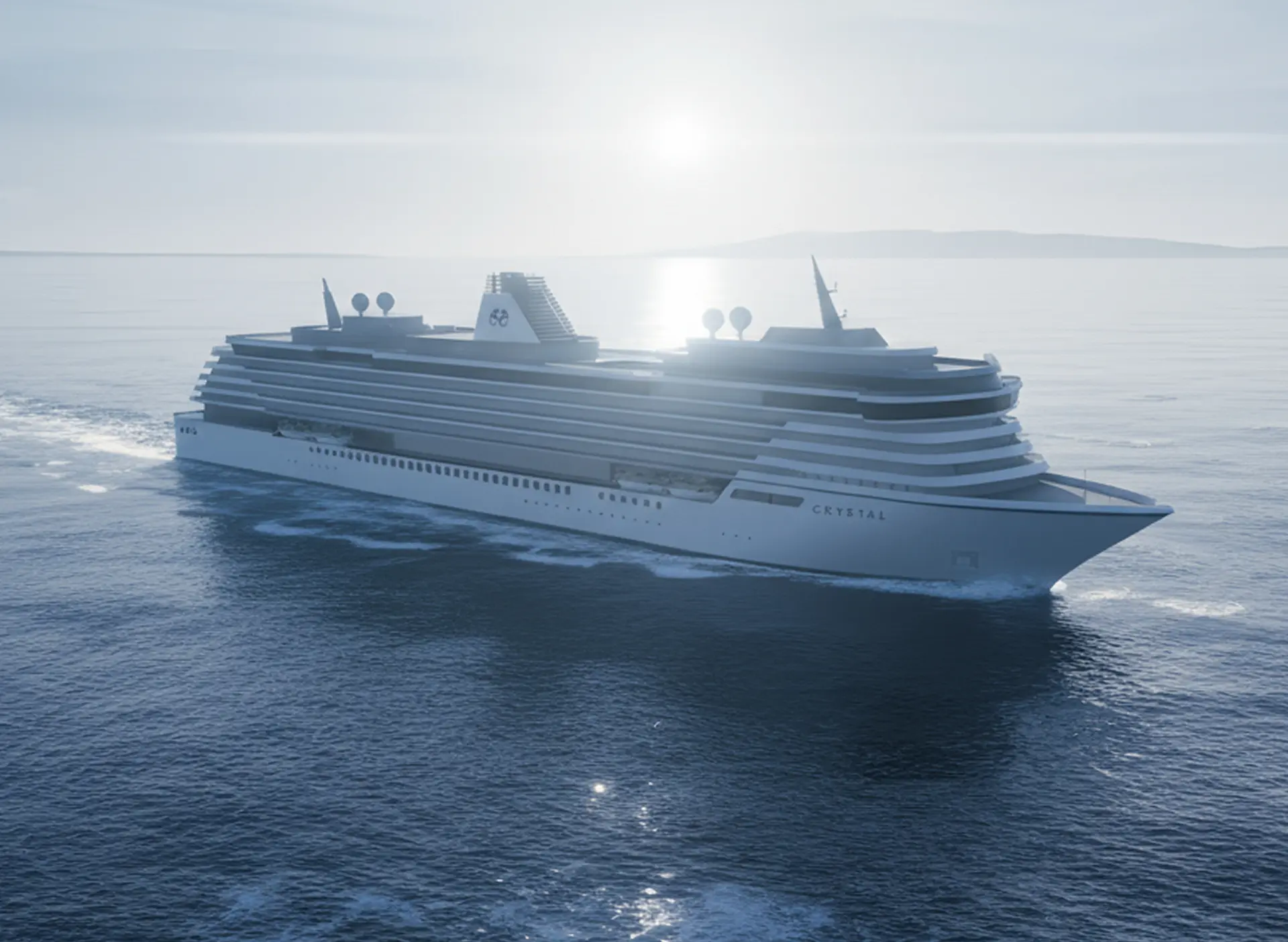
| Crystal Cruises | Hapag-Lloyd Cruises | |
|---|---|---|
| Category | Ultra-Luxury | Expedition / Ultra-Luxury |
| Rating | ★★★★★ | ★★★★★ |
| Fleet size | 2 ships | 5 ships |
| Ship size | Mid-size (600–740) | Small (under 1,000) |
| Destinations | Worldwide — Mediterranean, Asia, Alaska, Caribbean, Northern Europe | Worldwide, Arctic, Antarctica, Mediterranean |
| Dress code | Crystal Casual to Black-Tie Optional | Casual elegance |
| Best for | Ultra-luxury travellers seeking space, world-class dining, and global itineraries | German-heritage luxury and expedition travellers |
These two lines represent different traditions of luxury at sea — American warmth versus German precision. Crystal is the all-inclusive choice: premium drinks, butler service in every category, the best dining partnerships in ultra-luxury (Nobu, Alajmo, Beefbar), and enrichment programming with genuine depth. Hapag-Lloyd is the connoisseur's line: the world's only five-star-plus-rated fleet, the highest space-per-guest ratio afloat, expedition ships with the strongest ice class certification available, and a design sensibility rooted in contemporary European restraint. For Australians, the critical questions are language (Hapag-Lloyd is bilingual German-English from 2026 but German remains primary), expedition interest (only Hapag-Lloyd offers Antarctica, Arctic, and the Kimberley from 2028), and inclusion philosophy (Crystal includes drinks and butler service fleet-wide; Hapag-Lloyd does not include alcohol but includes all dining without surcharges at any venue).
The core difference
Crystal and Hapag-Lloyd Cruises represent two distinct European traditions of luxury at sea — one filtered through an American sensibility, the other rooted in German precision.
Crystal was founded in 1988 by Japanese shipping conglomerate NYK, operated for three decades as America’s pre-eminent luxury cruise line, went through bankruptcy in 2022, and re-emerged under A&K Travel Group — a partnership between Manfredi Lefebvre d’Ovidio (who built Silversea into a luxury icon) and Geoffrey Kent (founder of Abercrombie & Kent). Over 80 per cent of the original crew returned, bringing with them a service culture built on warmth, familiarity, and the kind of anticipatory care that cannot be recruited from scratch. The ships are older, the entry-level cabins are smaller than competitors, but the dining is rated the finest in the ultra-luxury segment and the enrichment programming has genuine depth.
Hapag-Lloyd traces its heritage to 1891 — the merger of Hamburg America Line and North German Lloyd, two of the great transatlantic shipping companies. Today it operates under TUI Cruises (a joint venture between TUI Group and Royal Caribbean Group) and holds a distinction no other cruise company can claim: every ship in its five-vessel fleet has received the maximum five-star rating from Insight Guides (formerly Berlitz), with Europa and Europa 2 holding the only five-stars-plus distinctions ever awarded — maintained for over two decades. The fleet spans two luxury ocean ships and three purpose-built expedition vessels with the highest ice class certification available for passenger ships.
For Australian travellers, the choice hinges on three questions. First, language: Crystal operates entirely in English; Hapag-Lloyd is bilingual German-English from 2026, but German remains the primary onboard language and most fellow passengers will be German-speaking. Second, expedition interest: if Antarctica, the Arctic, or the Kimberley are on your list, only Hapag-Lloyd can take you there. Third, inclusion philosophy: Crystal includes premium drinks and butler service in every category; Hapag-Lloyd does not include alcohol but includes all dining without a single surcharge at any venue.
What is actually included
This is the area of sharpest divergence between the two lines, and it matters significantly for total cost.
Crystal includes: premium spirits, wines, and cocktails throughout the ship; butler service in every suite and guest room category; Starlink Wi-Fi (standard tier, up to 10 devices); all gratuities; 24-hour in-suite dining; all enrichment programming and fitness classes. Crystal also includes dining at most venues, but caps speciality restaurant visits — one to three complimentary reservations per person at Umi Uma and Osteria d’Ovidio depending on voyage length, with additional visits costing USD $50 each. The Vintage Room wine dinner carries a surcharge of USD $220–$1,200 per person. Beefbar’s standard menu is included but premium Wagyu and Kobe cuts cost USD $90–$220 extra.
Hapag-Lloyd includes: all dining at every restaurant on every ship without surcharges, reservation limits, or cover charges — a genuine advantage over Crystal. The daily-replenished minibar includes non-alcoholic beverages in standard categories, with alcoholic selections added for higher suite tiers. From January 2026, a selection of soft drinks is complimentary throughout the day. Gratuities are included. On expedition ships, Zodiac excursions and expert-guided landings are included. Europa 2 uniquely carries Zodiacs for selected luxury itineraries, enabling beach landings and coastal exploration that ocean-only competitors cannot offer.
Hapag-Lloyd does not include: alcoholic beverages. This is the single most significant gap versus Crystal and every other ultra-luxury competitor — Silversea, Regent, Seabourn, and Explora all include premium drinks. Cocktails and wine at dinner are charged to your onboard account. Hapag-Lloyd also offers only 60 minutes of complimentary Wi-Fi daily, with additional usage at extra cost. Flights and standard shore excursions (on Europa and Europa 2 luxury voyages) are not included.
The practical impact: on a 14-night Mediterranean voyage, a couple who drinks two cocktails before dinner and shares a bottle of wine each evening could easily spend EUR 2,000–$3,000 on beverages that would be complimentary on Crystal. This narrows the apparent price gap between the two lines considerably.
Dining and culinary experience
Both lines deliver exceptional dining, but through fundamentally different philosophies. Crystal has invested in celebrity chef partnerships that create headline-grabbing exclusivity. Hapag-Lloyd has invested in consistent culinary excellence across every venue with no restrictions on access.
Crystal offers nine dining venues across both ships. The standouts are Umi Uma by Nobu Matsuhisa — the only Nobu restaurant at sea, serving Japanese-Peruvian fusion — and Osteria d’Ovidio, a collaboration with Massimiliano Alajmo (the youngest chef in history to receive three Michelin stars, held for 22 consecutive years). Beefbar brings the Monte Carlo steakhouse concept to sea. Waterside is the main dining room with open seating. Scoops serves artisan gelato by Badiani of Florence. Multiple independent reviewers rate Crystal’s post-relaunch dining as the best in the ultra-luxury segment — above Regent, Silversea, and Seabourn. The friction point is the reservation allocation system: one to three complimentary visits per speciality restaurant depending on voyage length, with USD $50 charged for each additional visit. Crystal Penthouse guests receive unlimited access.
Hapag-Lloyd’s Europa offers four dining venues, headlined by Restaurant Dieter Muller — created by the three-Michelin-starred chef, seating just 26–30 guests. Europa 2 offers eight dining venues including the pan-Asian Elements, the Italian Serenissima, the French brasserie Tarragon, and the sushi counter Sakura. The Hanseatic expedition ships feature three restaurants including Nikkei — the first Nikkei (Japanese-Peruvian fusion) restaurant at sea. Every single restaurant on every Hapag-Lloyd ship is included in the fare — no surcharges, no reservation caps, no cover charges. You can dine at Dieter Muller or Tarragon every night of your voyage without paying a cent extra.
The trade-off is clear. Crystal has higher-profile chef partnerships and a main dining room that benefits from decades of refined recipes and returning kitchen staff. Hapag-Lloyd offers complete freedom to dine wherever you wish, whenever you wish, without worrying about allocations or surcharges. If unrestricted access to every restaurant matters more to you than a Nobu reservation, Hapag-Lloyd has the edge.
Suites and accommodation
Hapag-Lloyd holds a meaningful advantage at entry level, though Crystal compensates with butler service in every category.
Crystal’s entry-level Guest Room is 215 square feet without a balcony — the smallest in the ultra-luxury segment. The Guest Room with Veranda adds a 57-square-foot balcony but the interior remains 230 square feet. The Aquamarine Veranda Suite (323 square feet plus 86-square-foot veranda) is where the experience becomes competitive. At the top, the Crystal Penthouse Suite spans 1,265 square feet with a separate den, dining area, and butler’s pantry. Every category — including the smallest guest room — receives dedicated butler service: unpacking, shoe shine, restaurant reservations, in-suite dining service, welcome champagne, and 24-hour availability.
Europa 2’s entry-level Veranda Suite is 301 square feet with a 75-square-foot private veranda — 40 per cent larger than Crystal’s entry-level and equipped with outdoor space that Crystal’s cheapest rooms lack. The Grand Penthouse Suite (840 square feet plus veranda) features an electric star ceiling and steam shower sauna. The Owner Suite at the top spans 1,066 square feet with a 165-square-foot veranda, whirlpool bath, and steam sauna. Butler service is reserved for Penthouse Suite and above — roughly the top 15 per cent of cabins.
Europa’s suites were comprehensively refurbished during the 2024 drydock, with new colour schemes, furnishings, and carpeting across 130+ suites. Entry-level suites start at 291 square feet.
The Hanseatic expedition ships offer 120 cabins each, ranging from 237-square-foot outside cabins to 764-square-foot Grand Suites with 172-square-foot verandas. The majority (63 of 120) are balcony cabins at 290 square feet including outdoor space.
Crystal’s incoming Crystal Grace (May 2028) will address the accommodation gap with all-veranda suites throughout, an Owner’s Suite with a 1,965-square-foot private veranda, and entry-level rooms starting at 230 square feet plus veranda. Until then, Hapag-Lloyd’s Europa 2 delivers more space per dollar at every comparable price point.
Pricing and value
Both lines sit in similar territory, but the value equation differs once you account for what is and is not included.
Crystal’s per-diem for entry-level Mediterranean sailings runs approximately USD $685–$750 per person per night on seven-night voyages, dropping to USD $500–$630 for longer sailings and Caribbean itineraries. The 2026 World Cruise (135 nights) starts from approximately USD $622 per night. Crystal’s fare includes premium drinks, butler service, Wi-Fi, and gratuities — making the headline price closer to the true cost.
Hapag-Lloyd Europa 2’s per-diem ranges from approximately EUR $520–$600 per person per night for European voyages, rising to EUR $700+ for peak-season Mediterranean sailings. Hanseatic expedition Antarctic voyages run EUR $882–$950 per night but include charter flights to Ushuaia. Europa 2’s headline fare is comparable to Crystal’s, but the exclusion of alcoholic beverages means the real onboard spend is materially higher.
The value equation for Australians: Neither line includes intercontinental flights. Return business-class flights from Australian east coast gateways to European embarkation ports run AUD $8,000–$18,000 per person. Hapag-Lloyd has announced an Emirates partnership from the 2026/27 season creating fly-cruise packages with bespoke fares on Emirates flights — relevant for Australians given Emirates’ extensive Australian network and direct Dubai connections to European and African embarkation ports. Crystal offers air credits on select sailings (up to USD $5,000 per person on World Cruises) but no structured air programme.
Total cost for a 14-night Mediterranean voyage including flights will run AUD $45,000–$80,000+ per couple on either line. Crystal delivers more per-dollar inclusion (drinks, butler, Wi-Fi). Hapag-Lloyd delivers more space per dollar and unrestricted dining. Neither matches Regent’s value proposition for Australians, which includes business-class air from Australian gateways and unlimited shore excursions.
Spa and wellness
Both lines offer quality spa facilities, but Europa 2’s OCEAN SPA and dedicated wellness programming represent a more ambitious commitment.
Europa 2’s OCEAN SPA spans approximately 1,000 square metres (10,764 square feet) — significantly larger than Crystal’s offering. Facilities include eight treatment rooms (one for couples), a private Personal SPA area with private sauna and whirlpool (bookable hourly or daily), herbal sauna, Deep Ocean sauna, Finnish sauna, steam bath, ice fountain, relaxation area with whirlpool and outdoor deck access, and a comprehensive fitness studio with Technogym equipment and kinesis walls. The IN2BALANCE wellness programme — exclusive to Europa 2 — features dedicated Wellness Retreat Voyages with daily meditation, yoga, hypnosis, breathwork, sound healing, honey sauna rituals, and nutritious cooking workshops, created in partnership with Berlin-based meditation studio OHIA.
Crystal’s Aurora Spa offers 10–12 treatment rooms depending on the ship, gender-separated steam rooms and saunas, a relaxation room, and a fitness centre with Technogym equipment and panoramic views. Crystal launched dedicated Wellness Retreat Cruises in 2025 aboard Crystal Symphony, featuring functional training, sunrise yoga, mindfulness meditation, and wellness-focused menus. Each ship has two pools with retractable glass roofs and two outdoor whirlpools.
Both lines charge for hands-on spa treatments. Sauna, steam room, and fitness centre access is complimentary on both. The gap is primarily in scale and ambition: Europa 2’s four distinct saunas, ice fountain, private bookable spa suite, and structured IN2BALANCE wellness programme represent a different level of investment. Crystal’s spa is pleasant but conventional by comparison — no thermal suite, no salt cave, no thalassotherapy pool.
The Hanseatic expedition ships feature a 235-square-metre OCEAN SPA with Finnish sauna (floor-to-ceiling windows with outdoor access), steam sauna, hydrotherapy shower, ice fountain, and a counter-current pool — impressive for an expedition vessel.
Entertainment and enrichment
Crystal excels in structured enrichment; Hapag-Lloyd excels in cultural programming and expedition expertise.
Crystal’s entertainment centres on the Galaxy Lounge with Broadway-inspired production shows curated by a multi-Tony Award-winning producer. The Stardust Club features a seven-piece show band and transforms into the Stardust Supper Club on select evenings — a reservations-only dinner-and-show evoking mid-century glamour. The Casino de Monte-Carlo — the first and only one at sea, launched in late 2024 — adds a distinctive social venue. Crystal’s genuine differentiator is the Creative Learning Institute: Berlitz language classes, Yamaha keyboard lessons, Cleveland Clinic wellness lectures, PGA golf training with Callaway equipment, professional bridge instruction, and ballroom dance lessons with gentleman hosts for solo travellers. The Crystal Visions lecture series brings historians, anthropologists, and destination specialists aboard.
Hapag-Lloyd’s Europa 2 programmes are curated exclusively for each voyage — no repeating shows across sailings. The two-tier theatre hosts intimate performances including acrobatics, comedy, and enrichment talks. A notable Australian connection: Brisbane-based Circa Contemporary Circus (one of the world’s leading contemporary circus companies) has an extended collaboration with Europa 2, performing on multiple 2026 voyages. Europa 2 also features a 3D cinema, piano bar, and jazz lounge. Europa’s evening programme is more traditional: classical music concerts, chamber ensembles, and themed cultural voyages with art experts and sommeliers.
The Hanseatic expedition ships carry full teams of marine biologists, polar researchers, historians, and naturalists. The lecture programme is extensive, with presentations before and after every shore landing. Hapag-Lloyd partners with the Alfred Wegener Institute for Polar and Marine Research, enabling genuine scientific data collection — guests participate in citizen science activities alongside professional researchers. This level of expedition expertise has no Crystal equivalent.
Dress codes differ meaningfully. Crystal retains black-tie optional evenings on sailings over seven nights. Europa 2 operates under “21 knots without a tie” — smart casual at the Deck 4 restaurants, no jacket required at the Yacht Club. No formal nights, no captain’s receptions. Expedition ships are casual throughout.
Fleet and destination coverage
Crystal operates two ocean ships — Crystal Serenity (740 guests, 68,870 GT, built 2003) and Crystal Symphony (606 guests, 51,044 GT, built 1995). Both were refurbished in 2023, with Symphony receiving an additional drydock in November 2025. Crystal Grace, the line’s first new build in 25 years, arrives May 2028 (61,800 GT, approximately 650 guests, all-veranda), with two sister ships following in 2030 and 2032. Crystal has no expedition capability — the Crystal Endeavor was sold to Silversea during the 2022 bankruptcy.
Hapag-Lloyd operates five ships across two distinct divisions. The luxury fleet comprises Europa (400 guests, 28,890 GT, built 1999, refurbished 2024) and Europa 2 (516 guests, 42,830 GT, built 2013). The expedition fleet comprises three identical Hanseatic-class ships — Nature (2019), Inspiration (2019), and Spirit (2021) — each carrying 230 guests (199 in Antarctic waters) at 15,650 GT with PC6 ice class. Hapag-Lloyd has no new ships on order — a notable contrast to Crystal’s three confirmed builds.
Destination coverage differs fundamentally. Crystal deploys globally: Mediterranean, Northern Europe, Alaska (returning 2026 for the first time since 2019), Caribbean, Asia, and annual 135-night World Cruises touching every continent. Hapag-Lloyd’s luxury ships cover the Mediterranean, Northern Europe, Africa, Asia-Pacific, and South Pacific. But it is the expedition fleet that sets Hapag-Lloyd apart: Antarctica (including the Weddell Sea), the Arctic and Svalbard, Greenland, the Northwest Passage, Papua New Guinea, Palau, the Great Lakes of North America (the only cruise line to connect all five in a single voyage), and from 2028, the Kimberley coast of Western Australia.
Crystal’s advantage is fleet growth — by 2032, five modern ocean ships offering substantially more choice. Hapag-Lloyd’s advantage is range — no other luxury cruise company spans ultra-luxury ocean voyages and hardcore polar expedition under one brand.
Where each line excels
Crystal excels in:
- Dining. Nobu at sea, the Alajmo brothers’ Italian, Beefbar’s Monte Carlo steakhouse — the most impressive collection of chef partnerships in ultra-luxury cruising, backed by a main dining room with returning chefs who have refined these menus over decades.
- All-inclusive value. Premium drinks, butler service in every category, Wi-Fi, and gratuities are all included. No other ultra-luxury line matches Crystal’s combination of inclusion breadth and dining calibre.
- Enrichment depth. The Creative Learning Institute’s structured programmes — language classes, music lessons, professional golf, bridge — go well beyond the guest lecturer format. Crystal Visions enrichment lectures add destination and cultural depth.
- Service warmth. Eighty per cent of the pre-bankruptcy crew returned, creating a continuity of service that reviewers consistently describe as warm, intuitive, and personal. Crew remember names after a single encounter.
- World Cruises. Crystal’s annual 135-night circumnavigation benefits from the Abercrombie & Kent partnership, offering curated overland experiences at iconic destinations.
Hapag-Lloyd excels in:
- Expedition capability. Three purpose-built expedition ships with the highest ice class certification available for passenger vessels. Antarctica, the Arctic, Svalbard, Greenland, Papua New Guinea, and the Kimberley — destinations Crystal simply cannot reach.
- Space per guest. Europa 2 holds the highest space-per-passenger ratio of any cruise ship afloat (83 gross tonnes per guest). Even Europa, at 72, exceeds both Crystal ships.
- Unrestricted dining. Every restaurant on every ship is included without surcharges, reservation limits, or cover charges. You can dine at Dieter Muller every evening without paying a cent extra.
- Design and hardware. Europa 2’s contemporary European design, museum-quality art collection (890 original works), and expansive spa (10,764 square feet) represent a different aesthetic standard. The Hanseatic ships are among the finest expedition vessels afloat.
- Scientific expedition credibility. The Alfred Wegener Institute partnership, citizen science programmes, and full onboard teams of marine biologists and polar researchers add genuine intellectual depth to expedition voyages.
Standout itineraries for Australian travellers
Neither line offers dedicated Australian roundtrip itineraries, but both have compelling options for Australians willing to position internationally — and Hapag-Lloyd’s 2027 deployment brings a ship to Australian waters.
Crystal
World Cruise: Auckland to Melbourne (approximately 8 nights, February 2026 on Crystal Serenity) — The most accessible Crystal sailing for Australians. Embark Auckland (3-hour direct flight from Sydney) and sail through New Zealand’s fiords to Melbourne, with scenic cruising of Dusky Sound, Doubtful Sound, and Milford Sound.
Melbourne to Bali (18 nights, February–March 2026 on Crystal Serenity) — Embark Melbourne (no flight required for Victorians), sail via Sydney, Gold Coast, Brisbane, Airlie Beach, Cairns, Thursday Island, Darwin, Komodo Island, and Bali. From USD $15,500 per person.
Alaska from Vancouver (July–September 2026 on Crystal Symphony) — Seven back-to-back nine-night roundtrip Vancouver sailings — Crystal’s first Alaska season since 2019. Fly Sydney or Melbourne to Vancouver via Los Angeles (approximately 14–16 hours on Qantas).
2027 World Cruise: Stories of the South Seas (140 nights on Crystal Serenity) — The March segment visits Milford Sound, Tasmania, Sydney, Melbourne, and the Great Barrier Reef. Join in Auckland and disembark in Brisbane for an accessible Australian segment.
Hapag-Lloyd
Europa 2: Singapore to Perth (17 days, January–February 2027) — Embark Singapore (7.5 hours direct from Sydney or Melbourne), sail via Semarang, Bali, Lombok, Komodo, then Broome, Exmouth, Geraldton, and Fremantle. Hapag-Lloyd’s first dedicated Western Australian deployment.
Europa 2: Perth to Auckland (19 days, February 2027) — Embark Fremantle (domestic flight), sail via Busselton, Albany, Kangaroo Island, Adelaide, Melbourne, Sydney, and across to Auckland. The most accessible Hapag-Lloyd itinerary ever offered for Australian travellers — the entire voyage operates in Australian time zones.
Europa 2: New Zealand circumnavigation (18 days, March 2027) — Auckland roundtrip visiting Tauranga, Napier, Wellington, Kaikoura Bay, Stewart Island, Nelson, Bay of Islands, and more. A comprehensive New Zealand itinerary rarely offered by ultra-luxury lines.
Hanseatic Spirit: Kimberley expedition (18 days, February 2028) — Hapag-Lloyd’s first Kimberley deployment, with Zodiac adventures on the King George River and at Montgomery Reef, plus the Houtman Abrolhos archipelago. A significant addition for Australian expedition enthusiasts.
Hanseatic Inspiration: Weddell Sea Antarctica (22 days, December 2026–January 2027) — Ushuaia roundtrip via the Antarctic Peninsula and Weddell Sea. Hapag-Lloyd’s first extended Weddell Sea expedition. Charter flights from Buenos Aires to Ushuaia are included.
Ship-by-ship recommendations
Crystal
Crystal Serenity (740 guests, 2003, refurbished 2023) — The larger ship and Crystal’s flagship, deployed for World Cruises and Mediterranean seasons. Nine dining venues, the full Aurora Spa, and two pools with retractable glass roofs. The better choice for first-time Crystal guests and the ship that visits Australian waters annually.
Crystal Symphony (606 guests, 1995, refurbished 2023 and 2025) — Smaller, more intimate, deployed to Alaska (summer 2026) and the Caribbean. Symphony is over 30 years old; while the refurbishments addressed suites and public spaces, some secondary areas show their age. Best for guests specifically wanting Alaska or who value a smaller ship. Avoid if modern hardware matters — wait for Crystal Grace.
Crystal Grace (arriving May 2028) — Crystal’s first new build in 25 years. All-veranda suites, approximately 650 guests, an Owner’s Suite with a 1,965-square-foot private veranda. This ship will finally pair Crystal’s service and dining quality with contemporary hardware.
Hapag-Lloyd
Europa 2 (516 guests, 2013) — The recommended ship for English-speaking Australians. Bilingual from launch, eight included dining venues, the 10,764-square-foot OCEAN SPA, no formal nights, contemporary European design with 890 original artworks. The 2027 Australia/New Zealand deployment makes this the most accessible Hapag-Lloyd experience for Australians. Families are welcome — children 11 and under travel free when accompanied by two full-fare adults.
Europa (400 guests, 1999, refurbished 2024) — Hapag-Lloyd’s flagship and the world’s highest-rated cruise ship according to Insight Guides. Smaller, more formal, and historically German-language dominant (bilingual from 2026). Restaurant Dieter Muller is the crown jewel. Best for experienced cruisers who appreciate traditional European formality and do not require an English-language-dominant environment. Avoid as a first Hapag-Lloyd experience for Australians.
Hanseatic Nature / Hanseatic Inspiration (230 guests each, 2019) — Near-identical sister ships with PC6 ice class for polar access. Choose based on itinerary rather than ship preference. Both welcome families and carry full expedition teams. Hanseatic Inspiration operates bilingually and is the better choice for English-speaking first-timers.
Hanseatic Spirit (230 guests, 2021) — The newest Hanseatic and the only adults-only vessel in the fleet. Ideal for Australian couples wanting an expedition experience without children aboard. The ship confirmed for the 2028 Kimberley deployment.
For Australian travellers specifically
Neither Crystal nor Hapag-Lloyd has a strong established Australian presence — both remain niche choices compared to Silversea and Regent, which have dedicated Australian offices and regular local departures.
Crystal’s Australian access comes through A&K Travel Group, which has Australian representation and regional sales directors covering every state. Crystal has an Australian reservations team reachable at 1300 503 640. The brand is distributed through Virtuoso, Ensemble Travel Group (which includes Australian agencies), and direct booking. Crystal Serenity visits Australia annually during February–March as part of the World Cruise programme, with embarkation options in Auckland and Melbourne.
Hapag-Lloyd’s Australian access is handled through Luxury Travel Marketing, a Perth-based representative agency with two staff — one covering the east coast and New Zealand, the other covering the west coast. There is no dedicated Australian cruise office. The newly announced Emirates partnership (from 2026/27) will enable fly-cruise packaging on Emirates flights from Australian gateways — a practical improvement for Australian travellers. Europa 2’s 2027 Australia/New Zealand deployment (Singapore–Perth–Auckland–South Pacific) represents Hapag-Lloyd’s most significant Australian market investment to date.
The language factor for Australians: This is the critical consideration. Crystal operates entirely in English — you will never feel like a linguistic outsider. Hapag-Lloyd is bilingual German-English from January 2026, but German remains the primary language and most fellow passengers will be German-speaking. Reviewers note that socialising can be more challenging for English speakers, though crew English is consistently praised as excellent. Europa 2 is the most comfortable option for Australians, with a dedicated International Hostess who hosts cocktail parties and dinners for non-German-speaking guests.
Loyalty pathways for Australians: Crystal’s Crystal Society programme is free to join and offers 2.5 per cent savings on all voyages. Hapag-Lloyd’s Cruises Club charges a paid membership (EUR 170 sign-up plus EUR 70 annual fee) — unusual in the ultra-luxury segment. Both lines are recognised by Explora Journeys for status matching, making it easy to trial Explora without losing loyalty benefits.
The onboard atmosphere
This is where personal preference matters most — the two lines feel fundamentally different.
Crystal’s atmosphere is warm American luxury. The service style is effusive, personal, and emotionally engaged — crew remember your name after a single encounter, call you by name in corridors, and anticipate needs with warmth that reviewers describe as “like family.” The passenger base averages around 61 for new guests and 68 for returning loyalists, overwhelmingly American with British and European guests. Black-tie optional evenings appear on most sailings over seven nights. Afternoon tea with live music is a daily ritual. Louis Armstrong’s “What A Wonderful World” plays during port departures — capturing the sentimental, nostalgic quality Crystal loyalists adore. The Casino de Monte-Carlo adds a social dimension that Hapag-Lloyd does not offer.
Hapag-Lloyd’s atmosphere is refined European restraint. The service style is equally attentive but more reserved — precise, efficient, and professionally courteous rather than emotionally demonstrative. One reviewer captured the difference perfectly: Crystal feels like “being looked after by a favourite uncle”; Hapag-Lloyd feels like “being served by a consummate European maître d’.” Europa 2’s passenger mix is predominantly German-speaking professionals and retirees, with growing international diversity since the bilingual expansion. The “21 knots without a tie” dress code means smart casual is the ceiling — no tuxedos, no gowns, no captain’s receptions. The interior design is contemporary Scandinavian-influenced with 890 original artworks, a 3D cinema, and cooking studios. There is no casino. Families with children are welcome on Europa 2 (unusual in ultra-luxury), with dedicated family apartments and the Knopf Club childcare service.
If you are the kind of traveller who values emotional warmth in service, enjoys dressing for dinner, and wants an English-language social environment, Crystal will feel like home. If you prefer understated European elegance, dislike formality, and are comfortable in a bilingual environment where German predominates, Hapag-Lloyd’s Europa 2 offers a distinctive and refined alternative that no English-language cruise line replicates.
The bottom line
Crystal and Hapag-Lloyd occupy the same ultra-luxury tier but appeal to different sensibilities — and offer genuinely different capabilities.
Choose Crystal if what matters most is the completeness of the all-inclusive experience: premium drinks flowing freely, a butler in every cabin, the finest dining partnerships at sea, and rich enrichment programming — all in English, all included. Accept that the current ships are older and entry-level suites are smaller than competitors, and book at least an Aquamarine Veranda Suite. If you can wait until 2028, Crystal Grace will pair the legendary service with a modern vessel.
Choose Hapag-Lloyd if you want access to destinations Crystal cannot reach — Antarctica, the Arctic, Papua New Guinea, and from 2028, the Kimberley. Choose it too if you value space (Europa 2’s industry-leading space ratio), unrestricted dining (every restaurant included without caps), and contemporary European design. Be prepared for a bilingual German-English environment where German predominates, and factor in the cost of alcoholic beverages that other ultra-luxury lines include. Start with Europa 2, which is the most comfortable ship for English-speaking Australians.
For Australians specifically, Hapag-Lloyd’s 2027 Europa 2 deployment through Western Australia and New Zealand is the most exciting near-term development — an ultra-luxury ship in Australian waters with domestic embarkation in Perth. Crystal’s annual World Cruise segments through Australia and New Zealand (Auckland and Melbourne embarkation) remain the most established access point. Neither line matches Silversea or Regent for overall Australian accessibility, but both reward the effort of getting aboard.