| Crystal Cruises | The Ritz-Carlton Yacht Collection | |
|---|---|---|
| Category | Ultra-Luxury | Yacht-Style / Ultra-Luxury |
| Rating | ★★★★★ | ★★★★★ |
| Fleet size | 2 ships | 3 ships |
| Ship size | Mid-size (600–740) | Yacht (under 300) |
| Destinations | Worldwide — Mediterranean, Asia, Alaska, Caribbean, Northern Europe | Mediterranean, Caribbean, Northern Europe, Central America |
| Dress code | Crystal Casual to Black-Tie Optional | Casual elegance |
| Best for | Ultra-luxury travellers seeking space, world-class dining, and global itineraries | Ultra-luxury yacht lifestyle travellers |
This comparison pits the ultra-luxury segment's finest dining and service warmth against its most ambitious newcomer — a luxury hotel brand that went to sea. Crystal delivers Nobu at sea, a three-Michelin-starred Italian collaboration, butler service in every cabin, and a per-night fare 30–50 per cent lower than Ritz-Carlton's. Ritz-Carlton delivers brand-new yachts with the highest passenger space ratio at sea, Forbes Five-Star recognition (a cruise industry first), a signature marina platform for ocean swimming and water sports, and Marriott Bonvoy integration that rewards hotel loyalists. For Australians, Crystal is significantly more accessible — annual visits to Australian waters, embarkation in Auckland and Melbourne, and an established local sales team. Ritz-Carlton's Asia-Pacific expansion is bringing the brand closer, but Australian sailings remain aspirational. Choose Crystal if dining, enrichment, and value matter most. Choose Ritz-Carlton if modern hardware, intimate yacht-style cruising, and the Ritz-Carlton brand experience speak to you.
The core difference
Crystal and Ritz-Carlton Yacht Collection represent two fundamentally different answers to the question: what should ultra-luxury cruising be?
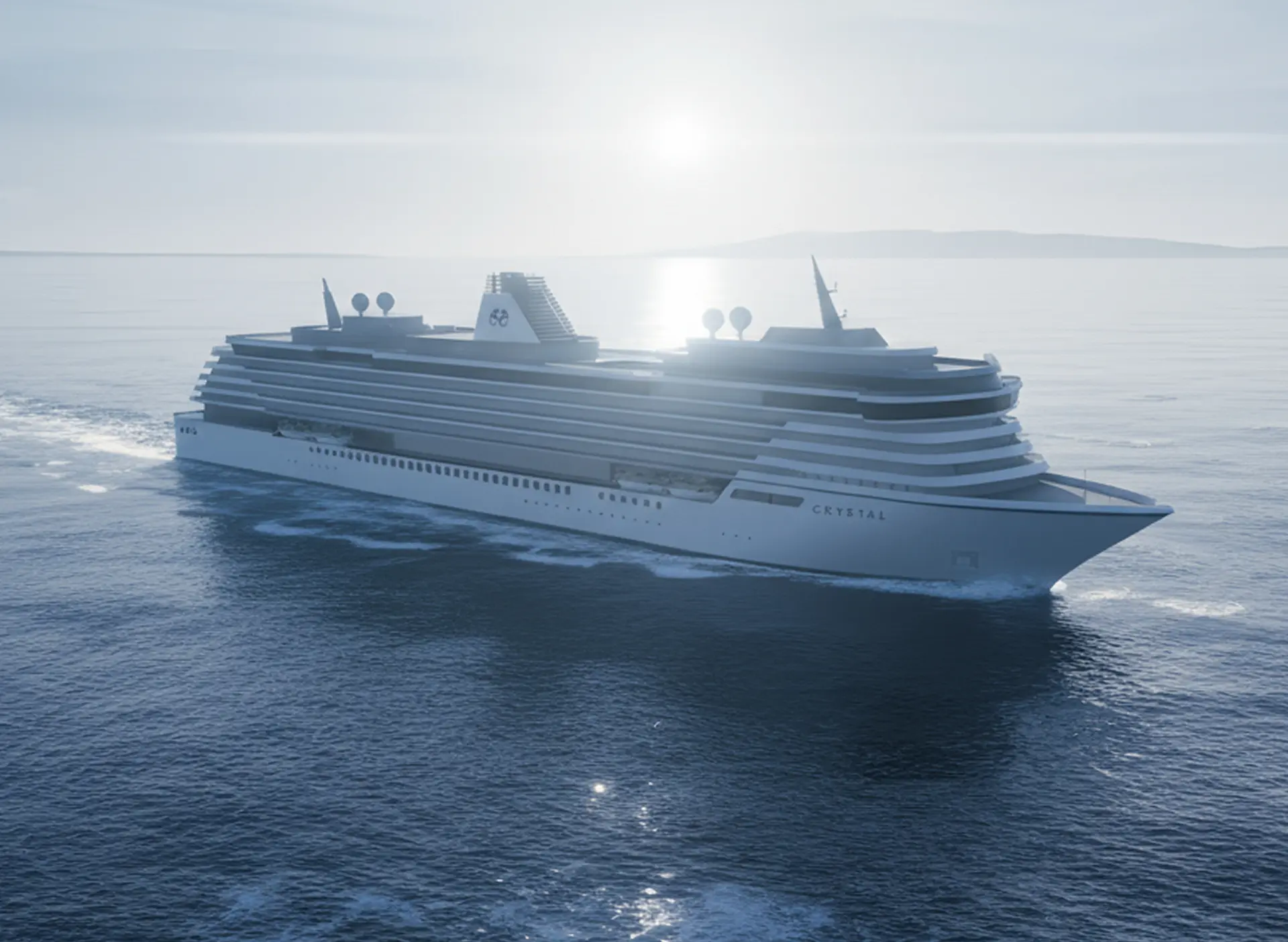
Crystal’s answer is the ocean liner perfected. Take a mid-size ship with decades of service culture, staff it with crew who remember your name from three voyages ago, install the only Nobu restaurant at sea alongside a collaboration with a three-Michelin-starred Italian chef, add a casino, a theatre with Broadway-calibre shows, language classes, golf instruction, and bridge tournaments — then charge less per night than almost any competitor. Crystal’s ships are older (1995 and 2003), but the experience they deliver is the product of 35 years of refinement.
Ritz-Carlton’s answer is the luxury hotel transplanted to water. Take one of the most trusted hotel brands on earth, build intimate yachts carrying 298 to 452 guests — roughly half Crystal’s capacity — and create something that feels like a floating Ritz-Carlton property rather than a cruise ship. The design is contemporary and residential. The entertainment is deliberately low-key: no cruise director, no overhead announcements, no scheduled activity pressure. A hydraulic marina platform lowers from the stern for swimming, kayaking, and paddleboarding directly in the ocean. The ships are brand new, and Ilma became the first cruise vessel in history to receive a Forbes Travel Guide Five-Star rating.
For Australian travellers, the choice also involves a practical dimension: Crystal visits Australian waters annually and has an established local sales team. Ritz-Carlton has opened a Sydney headquarters and is expanding into Asia-Pacific, but no Australian sailings are confirmed. The brand is coming closer — but it is not here yet.
What is actually included
Both lines include core ultra-luxury amenities, but the details differ meaningfully — and Crystal’s inclusion model is more generous.
Crystal includes: premium spirits, wines, and cocktails throughout the ship; butler service in every suite and guest room category (including the smallest cabin); Starlink Wi-Fi (standard tier); all gratuities; 24-hour in-suite dining; and all enrichment programming. Dining at most venues is included, but Umi Uma by Nobu and Osteria d’Ovidio are subject to reservation caps — one to three complimentary visits depending on voyage length, with additional visits costing USD $50 each. The Vintage Room wine dinner carries a surcharge of USD $220–$1,200 per person. Crystal does not include flights, shore excursions, or airport transfers (except for Crystal Penthouse guests).
Ritz-Carlton includes: premium spirits, wines, and cocktails; Personal Concierge service in all suite categories; complimentary high-speed Wi-Fi; all gratuities for housekeeping, dining, and bar staff; 24-hour in-suite dining; and all enrichment programming. Marina platform water sports — paddleboarding, kayaking, Seabobs, and electric foiling — are complimentary when conditions permit. Four of five restaurants on each ship are included without surcharge. Ritz-Carlton does not include flights, shore excursions (USD $100–$500 per person per activity), laundry (included only for Titanium and Ambassador Bonvoy members), Ritz Kids club sessions (USD $45–$65 per session), or spa gratuities.
The critical surcharge difference: Crystal charges USD $50 for additional visits to its signature restaurants beyond the complimentary allocation. Ritz-Carlton charges USD $289 per person for its pinnacle fine-dining venues — S.E.A. on Evrima and Seta su Ilma — nearly six times Crystal’s supplement for a comparable experience. This is a meaningful cost for couples wanting to experience the headline dining attraction.
The butler versus concierge distinction: Crystal provides dedicated butler service in every category, including the cheapest guest room. Your butler unpacks and packs luggage, draws baths, serves afternoon canapés, arranges dining reservations, and manages any special request. Ritz-Carlton provides Personal Concierge service, which handles reservations and requests but is positioned as less hands-on than a traditional cruise butler. The practical difference matters most to experienced luxury cruisers who expect proactive, anticipatory service in their suite.
Dining and culinary experience
Crystal has the edge in both breadth and peak quality — and the cost of accessing the best dining on each line favours Crystal significantly.
Crystal offers eight to nine dining venues across both ships. Umi Uma by Nobu Matsuhisa is the only Nobu restaurant at sea, serving Japanese-Peruvian fusion with signature dishes including miso black cod, yellowtail sashimi with jalapeño, and Wagyu beef filet — multiple reviewers have rated it as exceeding land-based Nobu locations. Osteria d’Ovidio is a collaboration with the Alajmo brothers, whose Massimiliano Alajmo was the youngest chef in history to receive three Michelin stars. Beefbar brings the Monte Carlo steakhouse concept to sea. Waterside is the main dining room with open seating and rotating menus. Tastes Kitchen & Bar serves global street food. The Bistro offers Parisian-style light fare. Scoops serves artisan gelato by Badiani of Florence. Crystal won U.S. News Best Cruise Line for Dining (2026).
Ritz-Carlton offers five restaurants on each ship. On Ilma: Tides is the main dining room with destination-inspired seasonal menus. Seta su Ilma by Fabio Trabocchi (James Beard Award-nominated) serves modern Italian fine dining — a 28-seat venue with a seven-course tasting menu and optional wine pairings. The Beach House by Michael Mina (James Beard Award winner) offers open-air Pan-Latin and Caribbean cuisine. Memorī features a 12-seat sushi bar with modern pan-Asian cuisine. Mistral is the poolside steakhouse and seafood grill. On Evrima: S.E.A. by Sven Elverfeld (three Michelin stars at Aqua, Wolfsburg) is the signature European tasting menu. Talaat Nam serves contemporary Asian cuisine. The Evrima Room is the main dining room, designed as ten intimate alcoves rather than one large space.
The comparison: Crystal has more venues (eight versus five), higher-profile chef partnerships (Nobu and Alajmo are globally recognised names), and lower surcharges for signature dining (USD $50 versus USD $289). Ritz-Carlton’s chef partnerships are genuinely impressive — Trabocchi, Mina, and Elverfeld are accomplished chefs — but the USD $289 surcharge for the pinnacle experience is a significant premium. On a seven-night voyage, a couple dining once at Crystal’s Nobu would pay nothing extra (the first visit is complimentary); the same couple dining once at Ritz-Carlton’s S.E.A. would pay USD $578 plus wine pairings.
Suites and accommodation
Ritz-Carlton has the hardware advantage — every suite is new, every suite has a private terrace, and the design language is contemporary. Crystal compensates with universal butler service and, at the top end, competitive suite sizes.
Crystal’s entry-level Guest Room is 215 square feet without a balcony — the smallest in the ultra-luxury segment. The Guest Room with Veranda adds a 57-square-foot balcony but the interior remains 230 square feet. Crystal’s Aquamarine Veranda Suite (323 square feet plus 86-square-foot veranda) is the realistic comparison point against Ritz-Carlton’s entry level. The Sapphire Veranda Suite offers 430 square feet plus 107-square-foot veranda. Crystal Penthouse suites span 850–1,265 square feet plus veranda. Every category, including the cheapest, receives dedicated butler service — a feature unique to Crystal in the ultra-luxury segment.
Ritz-Carlton’s entry-level Terrace Suite on Ilma is 294 square feet plus a 52–108-square-foot terrace — every single suite has a private outdoor terrace with no exceptions. Signature Suites measure 409 square feet plus 71–151-square-foot terrace. Grand Suites offer 560 square feet with a dining table for four and a walk-in closet. Owner’s Suites reach 1,033 square feet with expansive terraces featuring private hot tubs. On Evrima, the entry-level Terrace Suite is 300 square feet plus 67-square-foot terrace, and the unique two-storey Loft Suites (611 square feet) offer a split-level layout with living area above and bedroom below. Interior design uses a neutral palette — grey, taupe, sandstone — with bathrooms clad in grey granite.
The practical comparison: Ritz-Carlton’s entry-level Terrace Suite (294–300 square feet plus terrace) is meaningfully larger than Crystal’s cheapest Guest Room (215 square feet, no balcony) and comparable to Crystal’s Aquamarine Veranda Suite. Ritz-Carlton’s all-terrace policy means you never face the compromise of an inside cabin. Crystal’s advantage is butler service in every category and, at the top end, the Crystal Penthouse’s 1,265 square feet — larger than Ritz-Carlton’s Owner’s Suite at 1,033 square feet. Crystal Grace (arriving May 2028) will be all-veranda throughout, with an Owner’s Suite spanning 1,950 square feet plus a 1,965-square-foot private veranda.
Pricing and value
Crystal is the significantly better value proposition at every comparable price point — a rare clarity in the ultra-luxury segment.
Crystal’s per-diem runs approximately USD $500–$750 per person per night depending on voyage length and suite category. A seven-night Mediterranean sailing in an Aquamarine Veranda Suite costs roughly USD $685–$750 per night. Longer sailings drop to USD $500–$630. The 2027 World Cruise starts from approximately USD $493 per night.
Ritz-Carlton’s per-diem runs approximately USD $700–$1,000 per person per night for entry-level Terrace Suites, rising to USD $1,200–$2,000 for Signature Suites and USD $2,000–$5,000+ for upper categories. Australian online agencies advertise from approximately AUD $823–$887 per day. A seven-night Mediterranean voyage in a Terrace Suite costs roughly USD $5,000–$7,000 per person.
The total cost reality for an Australian couple on a seven-night Mediterranean voyage:
Crystal (Aquamarine Veranda Suite): approximately AUD $14,000–$16,000 for the cruise fare. Add business-class flights from Sydney to Europe: AUD $10,000–$18,000. Add shore excursions (four to five ports): AUD $1,000–$2,500. Total: approximately AUD $25,000–$36,500 per couple.
Ritz-Carlton (Terrace Suite on Ilma): approximately AUD $16,000–$22,000 for the cruise fare. Add business-class flights from Sydney to Europe: AUD $10,000–$18,000. Add shore excursions (four to five ports): AUD $1,000–$2,500. Add one S.E.A./Seta dinner for two: AUD $900. Total: approximately AUD $28,000–$43,400 per couple.
Crystal delivers more dining venues, butler service, richer enrichment programming, and a lower headline fare. Ritz-Carlton delivers newer ships, a higher space-per-guest ratio, the marina platform, and Marriott Bonvoy points earning. The value equation clearly favours Crystal unless the Ritz-Carlton brand experience and modern hardware are your primary motivations.
A recurring sentiment on cruise forums captures this well: “If you’re spending Ritz-Carlton money, consider Regent or Silversea instead — you get more for the same budget.” Crystal offers a comparable warning: at Crystal’s price point, the value is difficult to beat in ultra-luxury.
Spa and wellness
Both lines offer quality spa facilities with premium product lines, but Ritz-Carlton’s newer ships have a scale advantage.
Crystal’s Aurora Spa features 10–12 treatment rooms depending on the ship, gender-separated steam rooms and saunas, a relaxation room, and a fitness centre with Technogym equipment. Skincare is by ELEMIS; hair care by Kérastase. Crystal launched dedicated Wellness Retreat Cruises in 2025 aboard Crystal Symphony, featuring functional training, sunrise yoga, mindfulness meditation, and wellness-focused menus. Each ship has two pools with retractable glass roofs.
Ritz-Carlton’s Spa by The Ritz-Carlton has 5 treatment rooms on Evrima and 11 treatment rooms on Ilma (some with private terraces overlooking the sea). Products are by ESPA, 111SKIN, and Pisterzi. Separate male and female saunas and steam rooms, a relaxation lounge, a full-service beauty salon with Oribe hair products, and a gentleman’s grooming salon. Daily wellness classes operate in three tiers — Renewal (sunrise stretch, meditation), Balanced (moderate activity), and Power (circuits, high-intensity). Personal training starts from USD $75 for 30 minutes; private yoga from USD $100 per hour.
Both lines charge for hands-on spa treatments at similar price points. Neither includes a complimentary thermal suite comparable to Regent’s Hydrothermal Suite on Explorer-class ships. Ritz-Carlton’s Ilma has the edge on treatment room count and the unique offering of ocean-view treatment terraces. Crystal’s wellness cruise concept and retractable-roof pools are distinctive features Ritz-Carlton does not match.
Entertainment and enrichment
Crystal has a significant advantage in both the breadth and depth of onboard programming — this is one of the clearest differentiators between the two lines.
Crystal retains a comprehensive entertainment programme. The Galaxy Lounge hosts Broadway-inspired production shows curated by a multi-Tony Award-winning producer. The Stardust Club features a seven-piece show band and transforms into the Stardust Supper Club on select evenings — a reservations-only dinner-and-show experience evoking mid-century glamour. The Casino de Monte-Carlo — the first and only one at sea — adds a social dimension no other ultra-luxury line offers. Crystal’s genuine differentiator is the Creative Learning Institute: Berlitz language classes, Yamaha keyboard lessons, Cleveland Clinic wellness lectures, PGA golf training with Callaway equipment, professional bridge instruction, and ballroom dance lessons with gentleman hosts. The Crystal Visions lecture series brings historians, scientists, and destination specialists aboard.
Ritz-Carlton takes a deliberately minimalist approach. There are no production shows, no casino, no cruise director, and no overhead activity announcements. The entertainment philosophy emphasises creating sophisticated ambiance: live piano in The Living Room, acoustic musicians and small ensembles in lounges, themed evenings (En Blanc, Havana Nights), and cultural performances reflecting the destination. On Ilma, The Observation Lounge transitions from cocktail bar to late-night dancing venue, and La Rumba brings Latin-influenced poolside ambiance with DJs. Enrichment includes guest speakers, culinary demonstrations, wine tastings, and art-focused experiences.
The philosophical difference: Crystal believes a luxury cruise should offer more activities, more choice, and more intellectual stimulation than you could possibly fit into one sailing. Ritz-Carlton believes a luxury cruise should feel like a quiet evening at a fine hotel — no forced fun, no programmed schedule, just space to be. If you want to learn Italian before arriving in Portofino, take a bridge lesson, and dance to a seven-piece band before visiting the casino, Crystal is the only option. If you want to read by the pool undisturbed, swim from the marina platform, and let the ship’s ambiance be the entertainment, Ritz-Carlton delivers exactly that.
Dress codes: Crystal retains black-tie optional evenings on sailings over seven nights. Ritz-Carlton has no formal nights — the atmosphere is elegant casual throughout, reflecting the brand’s more contemporary positioning.
Fleet and destination coverage
Crystal has the larger fleet and more itinerary variety in any given season, but Ritz-Carlton’s ships are significantly newer and growing rapidly.
Crystal operates two ships — Crystal Serenity (740 guests, 68,870 GT, built 2003) and Crystal Symphony (606 guests, 51,044 GT, built 1995). Both were refurbished in 2023 with a combined USD $150 million investment that reduced passenger capacity and modernised suites and public spaces. Crystal Grace arrives May 2028 (approximately 650 guests, all-veranda), with two sister ships following in 2030 and 2032. By the early 2030s, Crystal expects five ocean ships.
Ritz-Carlton operates three yachts — Evrima (298 guests, 26,500 GT, launched October 2022), Ilma (448 guests, 46,750 GT, launched September 2024), and Luminara (452 guests, 46,750 GT, launched July 2025). Ilma and Luminara are LNG dual-fuel vessels — among the first ultra-luxury ships powered by liquefied natural gas. No additional ships have been announced, but the three-ship fleet is complete and operational.
Destination coverage overlaps significantly but with key differences. Crystal deploys across the Mediterranean, Northern Europe, Alaska (returning 2026), Caribbean, Asia, and annual 135–140-night World Cruises touching every continent including Australian waters. Ritz-Carlton covers the Mediterranean and Caribbean year-round, with Luminara now deployed seasonally to Asia-Pacific (Singapore, Japan, Philippines, Indonesia, Vietnam, Thailand) and Evrima debuting in French Polynesia (Bora Bora, Moorea, Huahine) and Hawaii for winter 2026–2027. Ritz-Carlton’s maiden Alaska season (Luminara, summer 2026) adds another significant region.
Crystal’s advantage is the annual World Cruise, which provides the only ultra-luxury Crystal experience accessible from Australian ports. Ritz-Carlton’s advantage is fleet modernity and a rapidly expanding geographic footprint — three brand-new yachts versus Crystal’s two refurbished ships built in the 1990s and 2000s.
Where each line excels
Crystal excels in:
- Dining. Eight venues per ship, the only Nobu at sea, a three-Michelin-starred Italian collaboration, and a main dining room staffed by returning chefs with decades of experience. Multiple independent reviewers rate it the best in ultra-luxury.
- Service warmth. Over 80 per cent of the pre-bankruptcy crew returned. This continuity creates a familiarity and emotional warmth — crew remember your name, walk you to your destination, and greet returning guests with genuine affection — that purpose-built ships with new crews cannot replicate.
- Enrichment depth. The Creative Learning Institute and Crystal Visions lecture series offer structured programming that goes far beyond guest speakers: language classes, music lessons, golf, bridge, ballroom dancing, and destination immersion.
- Value. A 30–50 per cent lower per-night fare than Ritz-Carlton, with more inclusive dining, butler service in every category, and richer onboard programming. Crystal delivers more for less.
- Australian accessibility. Annual visits to Australian waters, embarkation in Auckland and Melbourne, an Australian reservations team (1300 503 640), and distribution through Australian luxury travel agencies.
Ritz-Carlton excels in:
- Ship modernity. Three purpose-built yachts launched between 2022 and 2025, with Ilma earning the cruise industry’s first Forbes Five-Star rating. The design is contemporary, residential, and distinctly different from traditional cruise ships.
- Space per guest. Ilma and Luminara have a passenger space ratio of 102.5 — among the highest at sea. Every suite has a private terrace. The ships feel genuinely spacious despite their intimate size.
- Marina platform. The signature aft hydraulic platform lowers to water level for complimentary paddleboarding, kayaking, Seabobs, and ocean swimming — a unique differentiator no other ultra-luxury ocean line offers.
- Intimate scale. At 298–452 guests, Ritz-Carlton’s yachts are roughly half Crystal’s capacity. This creates genuine intimacy, access to smaller ports, and a social atmosphere closer to a boutique hotel than a cruise ship.
- Marriott Bonvoy integration. The only ultra-luxury cruise line integrated with a major hotel loyalty programme. Earn points, redeem for cruises, and count nights toward elite status — valuable for frequent Ritz-Carlton and Marriott hotel guests.
Standout itineraries for Australian travellers
Crystal has a clear accessibility advantage for Australians — regular visits to local waters and embarkation options requiring minimal or no international flights. Ritz-Carlton’s expanding Asia-Pacific presence is narrowing the gap.
Crystal
World Cruise: Auckland to Melbourne (approximately 8 nights, February 2026 on Crystal Serenity) — The most accessible Crystal sailing for Australians. Embark Auckland (3-hour direct flight from Sydney), sail through New Zealand’s Dusky Sound, Doubtful Sound, and Milford Sound into Melbourne.
Melbourne to Bali (18 nights, February–March 2026 on Crystal Serenity) — Embark Melbourne (no international flight required for Victorians), sail via Sydney, Gold Coast, Brisbane, Airlie Beach, Cairns, Thursday Island, Darwin, Komodo Island, and Bali. From USD $15,500 per person.
Alaska from Vancouver (July–September 2026 on Crystal Symphony) — Seven back-to-back nine-night roundtrip Vancouver sailings, Crystal’s first Alaska season since 2019. Fly Sydney or Melbourne to Vancouver via Los Angeles (approximately 14–16 hours on Qantas).
2027 World Cruise: Stories of the South Seas (140 nights on Crystal Serenity) — The March segment visits Milford Sound, Tasmania, Sydney, Melbourne, and the Great Barrier Reef. Join in Auckland and disembark Brisbane for an accessible 15-night Australian segment.
Ritz-Carlton
Luminara: Asia-Pacific from Singapore (7–10 nights, December 2025 – May 2026) — Multiple voyages departing Singapore (7.5 hours direct from Sydney or Melbourne). Visiting Vietnam, Philippines, Malaysia, Indonesia, Thailand, Japan, and Korea. The most accessible Ritz-Carlton experience for Australians — no long-haul flight required to Singapore.
Luminara: Expanded Asia-Pacific (winter 2026–2027) — Nineteen voyages with ten new ports including Cebu, Naha, Miyazaki, and Semarang. Extended season gives Australians more scheduling flexibility.
Evrima: French Polynesia debut (7–12 nights, winter 2026–2027) — Thirteen voyages through Bora Bora, Moorea, Huahine, Raiatea, Fanning Island, and Hawaii. Direct flights to Tahiti from Sydney and Auckland make this relatively accessible for Australians wanting the Ritz-Carlton experience in the South Pacific.
Luminara: Alaska (May–September 2026) — Thirteen voyages visiting eleven ports across Alaska and British Columbia. The brand’s inaugural Alaska season. Fly from Australia to Vancouver or Seattle.
Ship-by-ship recommendations
Crystal
Crystal Serenity (740 guests, 2003, refurbished 2023) — The flagship, deployed for World Cruises and Mediterranean seasons. Nine dining venues including Nobu, Alajmo, and Beefbar. The ship that visits Australian waters annually. The highest passenger space ratio of any ocean cruise ship at 93.1 gross tonnes per guest. The better choice for first-time Crystal guests.
Crystal Symphony (606 guests, 1995, refurbished 2023 and 2025) — Smaller and more intimate, deployed to Alaska (summer 2026) and the Caribbean. Over 30 years old; while the refurbishments addressed suites and public spaces, some secondary areas show their age. Best for guests specifically wanting Alaska or who value a smaller ship. Avoid if modern hardware matters — wait for Crystal Grace.
Crystal Grace (arriving May 2028) — Crystal’s first new build in 25 years. All-veranda suites, approximately 650 guests, an Owner’s Suite with a 1,950-square-foot interior and 1,965-square-foot private veranda. This ship will finally pair Crystal’s legendary service and dining with contemporary hardware. Worth waiting for if ship modernity is important to you.
Ritz-Carlton
Ilma (448 guests, 2024) — The recommended first Ritz-Carlton experience. The newest-generation design with the highest space-per-guest ratio (102.5), five restaurants including Fabio Trabocchi’s Seta su Ilma and Michael Mina’s Beach House, 11-treatment-room spa, seven bars, and a wine vault. The first cruise ship to receive a Forbes Five-Star rating. Currently deployed to the Mediterranean and Caribbean.
Luminara (452 guests, 2025) — Near-identical to Ilma with subtle refinements including two exclusive “sanctuary” suites. Deployed to Asia-Pacific (winter) and Alaska (summer 2026). Choose Luminara for Asia-Pacific sailings from Singapore — the most accessible option for Australians.
Evrima (298 guests, 2022) — The smallest and most intimate of the fleet, but also the one with the troubled launch history. Eight delays totalling nearly three years late, with early-sailing complaints about unfinished suites and operational issues. The ship has improved significantly since 2022, and the genuinely intimate scale (149 suites) creates a yacht experience the larger Ilma and Luminara cannot match. Best for experienced luxury travellers who prioritise intimacy over facilities. The unique two-storey Loft Suites are a standout. Avoid as a first Ritz-Carlton experience — start with Ilma.
For Australian travellers specifically
Crystal is significantly more accessible from Australia today, though Ritz-Carlton is investing heavily in changing that equation.
Crystal’s Australian proposition comes through annual World Cruise segments that touch Australian and New Zealand waters every February–March. Embarkation options in Auckland and Melbourne mean Australians can board without a long-haul international flight. Crystal has an Australian reservations team reachable at 1300 503 640 and is distributed through Virtuoso and Ensemble Travel Group agencies, including Australian members. A&K Travel Group’s Australian representation and state-based regional sales directors provide trade support. The Melbourne-to-Bali segment (18 nights, February–March 2026) is a genuine domestic departure.
Ritz-Carlton’s Australian proposition is emerging. The brand opened its Asia-Pacific headquarters in Sydney’s Australia Square Tower in 2025, led by Vice President and General Manager Seb Seward, with a five-year lease and plans for up to twelve local staff. Dedicated Australian reservation and sales personnel are being hired. Luminara’s Asia-Pacific deployment from Singapore (7.5 hours from Sydney) brings the brand within easy reach, and Evrima’s French Polynesia debut (direct flights from Sydney and Auckland to Tahiti) puts a Ritz-Carlton yacht in the South Pacific for the first time. Seward has confirmed the itinerary planning team is “actively” analysing potential Australian destinations. The company expects Asia-Pacific business to double in the coming year.
The practical gap: Crystal visits Australia annually; Ritz-Carlton does not — yet. For Australians who want to board a ship without a long-haul flight, Crystal is the only option between these two lines. For Australians happy to fly to Singapore (7.5 hours), Ritz-Carlton’s Luminara is accessible and represents a genuinely different experience from anything departing Australian waters.
Loyalty pathways for Australians: Crystal’s Crystal Society programme is free and offers 2.5 per cent savings on all voyages, with a Welcome Aboard Loyalty Offer giving 5 per cent savings to first-time guests with loyalty status on other cruise lines. Ritz-Carlton’s Marriott Bonvoy integration is more complex but connects to a global hotel loyalty ecosystem — valuable for Australians who frequently stay at Marriott, Ritz-Carlton, W, or Sheraton properties internationally. Bonvoy points earned at hotels can be redeemed directly for cruise fare discounts. Neither line has a direct Qantas Frequent Flyer partnership.
The onboard atmosphere
These two lines feel fundamentally different — and the difference reveals who each line was built for.
Crystal’s atmosphere is warm, personal, and nostalgic. The service style is effusive and emotionally engaged — crew remember your name after a single encounter, call you by name in corridors, and anticipate needs with warmth that reviewers describe as “like being looked after by a favourite uncle.” The passenger base averages approximately 61 for new guests and 68 for returning loyalists — predominantly American, with British, European, and increasingly Australian guests. Many are on their tenth, twentieth, or fiftieth Crystal voyage, creating a community of experienced cruisers who know exactly what a fine cruise should be. Black-tie optional evenings appear on sailings over seven nights. Afternoon tea with live music is a daily ritual. Louis Armstrong’s “What A Wonderful World” plays during port departures. The Casino de Monte-Carlo adds evening social energy. The atmosphere is cultured, sentimental, and deeply loyal.
Ritz-Carlton’s atmosphere is modern, understated, and hotel-sophisticated. The service is polished and attentive but more reserved than Crystal’s emotional warmth — closer to a five-star hotel lobby than a family reunion. The passenger base averages approximately 53 — significantly younger than Crystal — and approximately 75 per cent have never cruised before. They are Ritz-Carlton hotel loyalists drawn by brand trust, affluent professionals still working rather than retired, and luxury travellers who would not consider a traditional cruise ship. There are no formal nights, no casino, no cruise director, and no forced-fun activities. The entertainment is ambient: a pianist in The Living Room, a DJ at La Rumba, cocktails in The Observation Lounge with panoramic views. Theme nights like En Blanc and Havana Nights add gentle social structure without formality. Families are welcome — Ritz Kids operates for ages four to twelve. The atmosphere is contemporary, relaxed, and self-assured.
The key question: Do you want to be among people who love cruising and want the finest version of it? Choose Crystal. Do you want to be among people who love luxury hotels and are experiencing the ocean for the first time? Choose Ritz-Carlton. One reviewer captured the distinction perfectly: “Ritz runs a nice hotel that floats — they don’t run a cruise experience.”
The bottom line
Crystal and Ritz-Carlton are both excellent, but they are built for different people — and one offers significantly better value than the other.
Choose Crystal if the quality of the onboard experience is your highest priority — the dining, the service warmth, the enrichment programming, the returning crew, the Nobu reservation. Choose it if value matters: Crystal delivers more inclusive dining, butler service in every cabin, richer entertainment, and a lower per-night fare. Choose it if you are an Australian who wants to embark in Auckland or Melbourne without a long-haul flight. Accept that the current ships are older and the entry-level cabins are smaller than Ritz-Carlton’s — and if modern hardware matters, wait for Crystal Grace in 2028.
Choose Ritz-Carlton if the brand experience speaks to you — the Forbes Five-Star yachts, the contemporary design, the intimate scale, the marina platform, and the Marriott Bonvoy integration. Choose it if you have never cruised before and want a luxury hotel experience on water rather than a traditional cruise. Choose it if you value brand-new ships, smaller passenger counts, and a casual atmosphere with no formal nights. Be prepared for a higher per-night cost, fewer dining venues with steeper surcharges, less enrichment programming, and — for now — no Australian sailings.
For Australians specifically: Crystal is the practical choice today. It visits your waters annually, has a local sales team, and offers the better value at every price point. Ritz-Carlton is the aspirational choice — a brand investing heavily in Asia-Pacific with a Sydney headquarters, expanding itineraries, and a genuine intention to bring yachts to Australian waters. When that happens, the comparison will shift. Until then, Crystal delivers more, costs less, and comes to you.