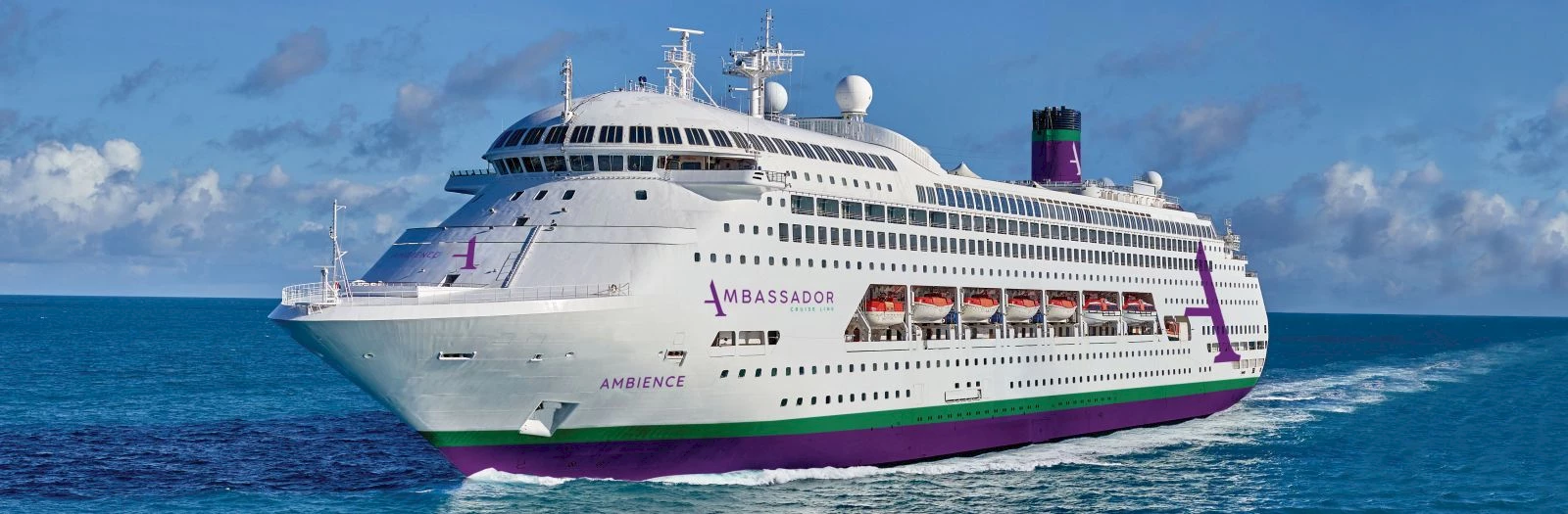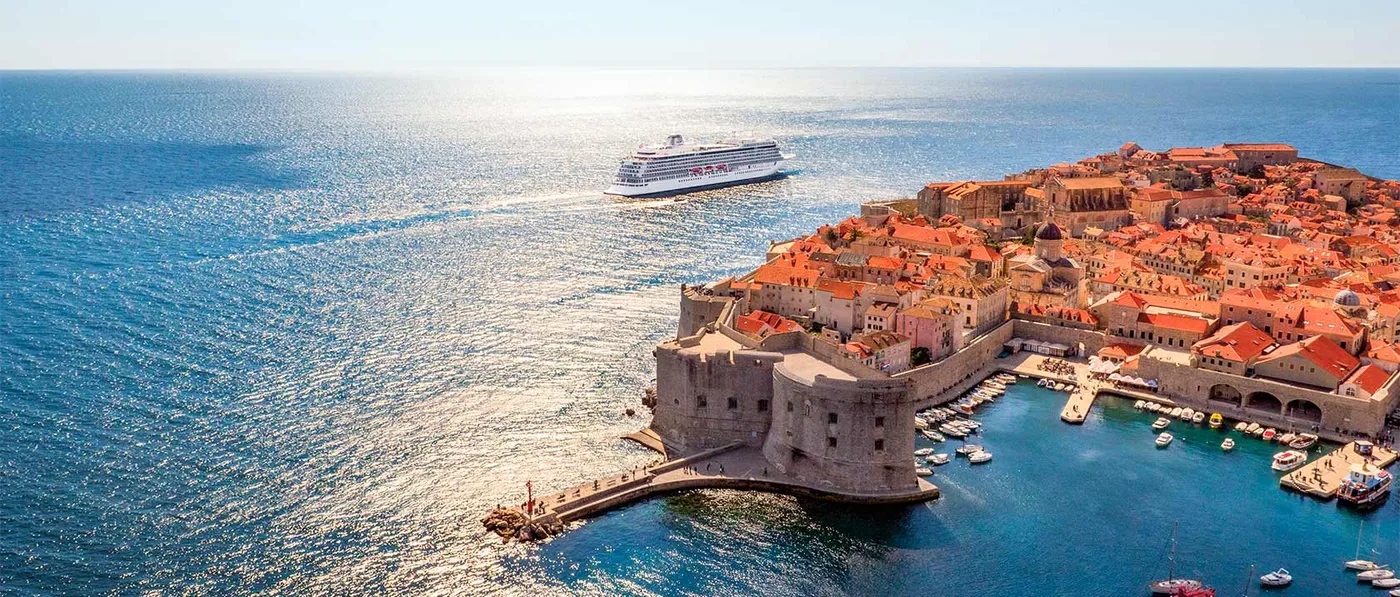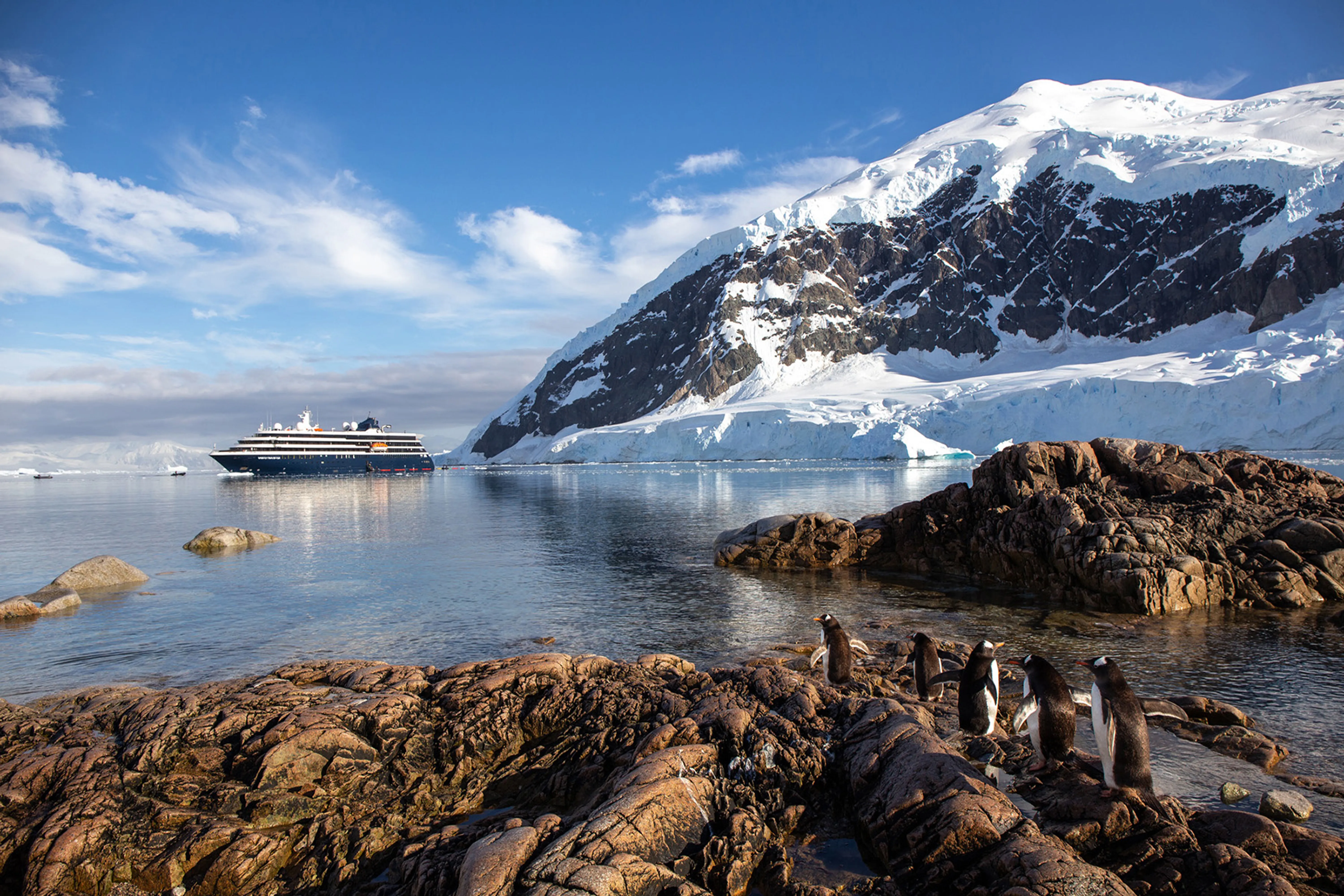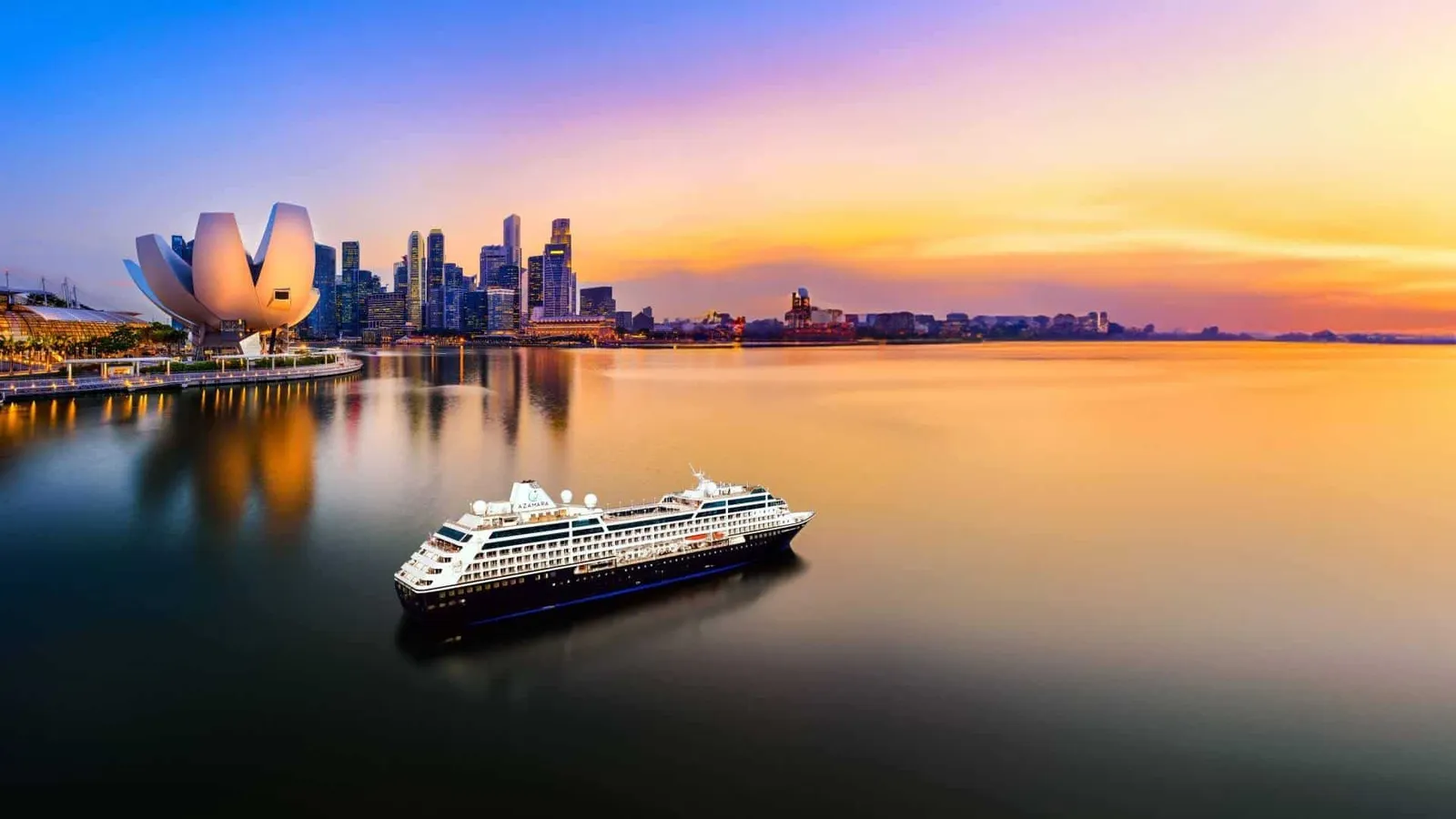
Cunard Line and Viking Ocean Cruises both attract mature, well-travelled couples seeking substance over spectacle — yet one dresses for dinner in a double-height ballroom while the other sails in elegant casual through a snow grotto before dessert. Jake Hower unpacks the formality, inclusions, dining, and Australian accessibility for travellers weighing these two distinctive premium lines.
| Cunard Line | Viking Ocean Cruises | |
|---|---|---|
| Category | Luxury | Premium |
| Rating | ★★★★★ | ★★★★★ |
| Fleet size | 4 ships | 12 ships |
| Ship size | Mid to Large | Small (under 1,000) |
| Destinations | Global | Mediterranean, Scandinavia, Asia, Caribbean |
| Dress code | Formal evenings | Smart casual |
| Best for | Tradition lovers | Destination-focused culturally curious adults |
Viking is the stronger choice for Australian travellers who want a comprehensive all-inclusive fare — shore excursions, speciality dining, Wi-Fi, and thermal spa access included — on a smaller adults-only ship with no formal dress requirements. Viking's annual Sydney homeporting and Companion Fly Free programme make it significantly more accessible since Cunard withdrew Australian homeporting in 2025. Cunard is the right choice for travellers drawn to British maritime heritage, gala evenings, ballroom dancing, and the irreplaceable QM2 Transatlantic Crossing. At Grills level, Cunard delivers butler service and bespoke dining Viking cannot match. For most Australian couples, Viking offers the simpler proposition; for Anglophiles and traditionalists, Cunard is irreplaceable.
The core difference
Cunard Line and Viking Ocean Cruises are both excellent premium lines that attract mature, well-travelled couples who value substance over spectacle. They share a commitment to enrichment programming, quality dining, and civilised onboard atmospheres. They overlap in many of the same sailing regions — the Mediterranean, Northern Europe, world voyages, and occasional Australian waters. Yet the onboard experience could hardly feel more different, and the single most reliable predictor of which line suits a given traveller is a deceptively simple question: do you want to dress for dinner?
Cunard is the most formally dressed cruise line in the world. Founded in 1840 by Sir Samuel Cunard, the line carries 185 years of transatlantic heritage into every voyage. The brand identity is unmistakably British — regal, tradition-steeped, and unapologetically formal. Cunard’s DNA is the golden age of ocean liner travel: Gala Evenings with dinner jackets and floor-length gowns, ballroom dancing with a live eight-piece orchestra in the double-height Queens Room, white-gloved afternoon tea on fine china, and the transformation of the ship each evening into something elevated and ceremonial. The voyage itself is the event. Queen Mary 2 — the only purpose-built ocean liner still in service, carrying the RMS designation and built with 40 per cent more steel than a cruise ship of equivalent size — maintains the only scheduled transatlantic crossing in the world. Four ships carry between 2,061 and 2,996 guests. Each has a distinct character. The Grills experience — Princess Grill and Queens Grill — creates a genuine ship-within-a-ship with dedicated restaurants, exclusive lounges, concierge service, and butler service at the Queens Grill level.
Viking positions itself as “the thinking person’s cruise.” Founded in 1997 by Norwegian entrepreneur Torstein Hagen, Viking expanded from river cruising to ocean cruising in 2015 and has since grown to 11 ocean ships — all built on a philosophy of deliberate consistency. Every vessel has the same deck layout, the same restaurant names, the same cabin categories, and the same public spaces. There is no casino, no children’s programme, no water slides, and no formal nights. The entertainment is the destination itself, supported by a Resident Historian programme, TED Talks screenings, Metropolitan Opera performances, and destination speakers who are genuine experts in the regions being sailed. The base fare includes a shore excursion in every port, all speciality dining, Wi-Fi, beer and wine at lunch and dinner, and complimentary access to the LivNordic Spa thermal suite. Viking’s Scandinavian design — blonde timber floors, floor-to-ceiling glass, reindeer pelts, neutral earth tones — creates a calm environment that feels more boutique hotel than floating ballroom. Ships carry 930 to 998 guests.
Both lines attract couples over 55 who want quality and intellectual stimulation. But Cunard believes the voyage IS the destination — the ship, its traditions, its rituals, and its formality are the experience. Viking believes the destination IS the experience — the ship is a beautifully designed platform that enhances port exploration. Cunard dresses up because the dinner IS a special occasion. Viking does not dress up because the focus is outward, not inward. These are incompatible philosophies, and the dress code is the clearest expression of each.
What is actually included
This is the comparison point that causes the most confusion and, in my experience, the most surprise when clients see the numbers side by side. Both lines market to premium travellers, but the scope of what the fare buys is fundamentally different.
Viking includes in every fare: a private veranda (every cabin has one — no inside staterooms exist on any Viking ship); all dining venues including Manfredi’s Italian, The Chef’s Table five-course tasting menu with wine pairing, and the World Cafe; beer, wine, and soft drinks at lunch and dinner; speciality coffees, teas, and filtered water around the clock; one shore excursion per port (typically a two-to-three-hour walking or panoramic bus tour); basic Wi-Fi on multiple devices; access to the LivNordic Spa thermal suite (sauna, steam room, snow grotto, hydrotherapy pool, cold plunge, and heated tile loungers); a heated main pool with retractable roof; self-service laundry with complimentary detergent; 24-hour room service for all categories; and enrichment lectures including the Resident Historian programme.
Viking does not include: gratuities (approximately US$17 per person per day, charged to the onboard account); cocktails and premium spirits (US$8–$15 per drink, or the Silver Spirits Beverage Package at US$27 per person per night); The Kitchen Table cooking experience (US$180–$260 per person); spa treatments; personal training; and flights or transfers.
Cunard’s Britannia fare includes: accommodation in your assigned stateroom category; breakfast, lunch, and dinner in the Britannia Restaurant (fixed seating at assigned tables); buffet dining in Kings Court or Lido; daily afternoon tea with white-glove service in the Queens Room; Golden Lion pub food (most items); tea, coffee, water, and fruit juice in buffet areas; all entertainment including shows, live music, and Cunard Insights enrichment lectures; pool, gym, and sports court access; and room service breakfast between 7am and 10am.
Cunard’s Britannia fare does not include: all alcoholic and premium non-alcoholic beverages; speciality dining surcharges (US$18.50–$65 per person per visit); Wi-Fi packages; shore excursions (all at extra cost); spa treatments and thermal suite access (US$49–$59 per two-hour session); gratuities (approximately US$17 per person per night for Britannia, US$19 for Grills); and room service outside breakfast hours for Britannia guests (charged since June 2025).
Cunard’s Grills suites narrow the inclusion gap. Princess Grill and Queens Grill guests receive dedicated exclusive restaurants, Grills Lounge and Terrace access, concierge service, 24-hour complimentary room service, and priority embarkation. Queens Grill adds butler service, a complimentary mini-bar with spirits and wine, fresh flowers, and Michelin-starred dining on select voyages. Current Grills promotions include a complimentary drinks package and included service charges on voyages of five nights or more. But even at this level, Wi-Fi and shore excursions remain additional — and the fare for a Queens Grill suite is substantially higher than Viking’s top categories.
The inclusion gap is real and significant at the entry level. The items Viking includes that Cunard charges extra for include shore excursions (saving US$50–$100 or more per port), speciality dining (saving US$20–$65 per visit), Wi-Fi (saving US$10–$20 or more per day), thermal spa access (saving US$49–$59 per session), wine and beer at meals (saving US$30–$60 or more per day), self-service laundry, and 24-hour room service. When comparing fares, Cunard’s Britannia headline price appears lower, but the add-ons accumulate quickly. Viking’s headline price is higher, but the out-of-pocket spend onboard is dramatically lower.
Dining and culinary experience
The dining philosophies of these two lines could hardly be more different — one is hierarchical and tiered, the other egalitarian and all-inclusive.
Cunard’s dining is defined by your stateroom category. Your cabin determines where you eat, who you eat with, and what level of service you receive. Britannia Restaurant guests dine in the main restaurant at fixed tables with assigned sittings — two options, early and late. The multi-course dinner menu changes nightly and is consistently competent, though community reviews describe quality as “variable” between voyages. Britannia Club guests — a step above standard Britannia — dine in a more intimate dedicated restaurant with flexible dining times, no fixed sittings, and a reserved table throughout the voyage. Princess Grill guests receive an intimate single-seating restaurant with enhanced menus and a la carte flexibility. Queens Grill guests — the highest tier — enjoy the most intimate setting with bespoke menus, an “any dish any time” philosophy, and Michel Roux-designed Gala Evening menus on Queen Elizabeth following her 2025 refit.
The critical point: guests cannot cross dining tiers. A Britannia guest cannot dine in the Princess Grill; a Princess Grill guest cannot dine in the Queens Grill. Friends or family travelling in different stateroom categories cannot eat together in their respective main restaurants. This is a hard separation that reinforces the class system Cunard deliberately maintains.
Cunard’s speciality dining carries surcharges across the fleet. Queen Anne offers Sir Samuel’s Steakhouse (US$58.50–$65 for dinner), Aranya Indian cuisine (US$31.50–$35), Tramonto Mediterranean (US$18.50–$20), and Aji Wa Japanese with a seven-course tasting menu at US$62. The older Queens have Steakhouse at The Verandah at US$45 for dinner. Pre-booking saves 10 per cent.
Cunard’s afternoon tea in the Queens Room deserves special mention. Served daily with white-gloved waiters in formal uniforms, fine china, starched linen, silver trays, finger sandwiches, warm scones with clotted cream, and a selection of cakes and pastries — all accompanied by live harp or piano music and sometimes a string quartet. It is widely considered the best afternoon tea at sea and is complimentary for all guests.
Viking’s dining is all-inclusive and egalitarian. Every guest on every ship has equal access to every dining venue regardless of stateroom category. There is no dining class system. The Restaurant is the main dining room with open seating — no assigned tables, no fixed sittings — and a daily-changing menu reflecting the itinerary’s regions, with always-available classics including Norwegian salmon and the Viking steak. Manfredi’s Italian, named after Silversea founder Manfredi Lefebvre, serves housemade pasta, osso buco, and regional Italian wines in an intimate open-kitchen setting. It is included at no surcharge. The Chef’s Table offers a five-course tasting menu with wine pairing that rotates every three days through Asian, French bistro, Norwegian, and thematic menus — also included at no surcharge. Mamsen’s, named after founder Torstein Hagen’s mother, serves Norwegian waffles, open-faced sandwiches, and Scandinavian pastries throughout the day. The World Cafe is an elevated market-style buffet with made-to-order stations, sushi bar, and themed dinner nights. Wintergarden hosts afternoon tea on three-tiered stands with finger sandwiches, scones, and live music. Beer, wine, and soft drinks are included at lunch and dinner in all venues. Complimentary 24-hour room service is available to all guests. The only surcharge venue is The Kitchen Table — a two-part culinary experience at US$180–$260 per person limited to 12 guests.
In my experience, the contrast comes down to this: Viking’s dining is reliably good and consistently the same across the entire fleet — Manfredi’s on Viking Star is the same quality as Manfredi’s on Viking Vela. Cunard’s dining peaks higher at the top end — the Queens Grill bespoke menu service is genuinely exceptional and has no Viking equivalent — but the Britannia experience is more variable, and the surcharges for speciality dining add up quickly. A couple dining at two speciality restaurants on a 7-night Cunard voyage will spend an additional US$90–$130 before gratuities. On Viking, every restaurant every night is included.
Suites and accommodation
The accommodation philosophies reflect each brand’s broader identity — Cunard is hierarchical with a tiered system that explicitly separates passenger classes, while Viking offers a consistent product where every guest gets a balcony.
Cunard’s accommodation hierarchy runs from Britannia Inside (approximately 152–243 square feet) through Britannia Oceanview, Britannia Balcony (approximately 228–472 square feet), Britannia Club Balcony (approximately 248–470 square feet with dedicated dining), Princess Grill Suite (approximately 335–513 square feet with exclusive restaurant and Grills Lounge access), to Queens Grill Suites starting from approximately 484 square feet and reaching 2,249 square feet in QM2’s Grand Duplex. The Grills experience is a genuine ship-within-a-ship: separate dining venues, exclusive lounges and terraces, dedicated concierge, priority everything, and butler service at the Queens Grill level — including unpacking, pressing formal wear, in-suite dining, and daily canapes. This creates a premium enclave while guests still access all ship facilities.
Queen Anne, the newest Cunard ship (2024), expanded Britannia Club staterooms by over 200 per cent compared to the older Queens, with 162 Britannia Club cabins — a clear signal that Cunard recognises demand for the middle tier with flexible dining and enhanced amenities.
Viking’s cabin categories are simpler and more consistent. The Veranda Stateroom (270 square feet including veranda) is the entry level — and crucially, there are no inside cabins on any Viking ship. Every guest gets a private balcony. The Deluxe Veranda (270 square feet, identical layout, better location, adds minibar) is the most popular with 272 per ship. Penthouse Veranda (338 square feet) adds an upgraded minibar with alcoholic beverages, welcome champagne, espresso machine, and priority dining reservations. Penthouse Junior Suite (405 square feet) adds a separate living area, complimentary laundry and dry cleaning, and early stateroom access. Explorer Suite (757 square feet) is the only category with a bathtub. The Owner’s Suite — one per ship, 1,319 square feet — features a personal sauna, wet bar, and kitchenette.
A critical difference: Viking does not offer butler service in any cabin category. The highest suites receive concierge service and enhanced amenities, but there is no dedicated personal butler. Cunard’s Queens Grill delivers a genuine luxury-tier butler experience — and for travellers who value this, it is a decisive advantage that Viking cannot match.
The other critical difference is entry point. Cunard’s inside and oceanview cabins provide a genuinely lower starting price. Viking’s philosophy is that every guest deserves a veranda — there is no economy tier, and the uniformity of product ensures consistency. For budget-conscious travellers willing to forgo a balcony, Cunard starts meaningfully cheaper.
Pricing and value
Comparing headline fares between Cunard and Viking without accounting for inclusions is a reliable way to reach the wrong conclusion. I walk clients through the total cost comparison regularly, and the gap is almost always narrower than it first appears — and sometimes reverses entirely.
Cunard’s directional pricing for a 7-night Mediterranean voyage on Queen Victoria: a Britannia Balcony starts from approximately US$196 per night. A Transatlantic Crossing on QM2 starts from approximately US$170 per night for a Britannia Inside or US$345 per night for a Britannia Balcony. Queens Grill suites are significantly higher — often five times the entry-level fare or more.
Viking’s directional pricing for a 7-night Mediterranean voyage in a Veranda Stateroom: approximately US$350–$450 per night in shoulder season, rising to US$450–$600 or more in peak summer. For 14-night itineraries, per-night rates typically fall to approximately US$300–$400 in shoulder season.
The headline gap looks substantial — but the real-cost comparison tells a different story. For a 7-night Cunard Mediterranean voyage in a Britannia Balcony, add drinks at approximately US$40–$60 per day (US$280–$420 total), one shore excursion per port at approximately US$60–$100 each (US$240–$500 for four to five ports), Wi-Fi at approximately US$15–$20 per day (US$105–$140), one speciality dinner (US$45–$65), a thermal suite session (US$49–$59), and gratuities at US$17 per day (US$119). These add-ons total approximately US$838–$1,303 per person.
A Cunard Britannia Balcony 7-night all-in lands at approximately US$3,400 per person. A Viking Veranda 7-night with gratuities lands at approximately US$3,119 per person. The lines converge — and Viking is often slightly less expensive on an apples-to-apples basis because the headline fare includes so much more.
Cunard’s Grills suites alter this equation. They cost substantially more than Viking’s top suites but deliver butler service, bespoke dining, and exclusive venues that Viking does not match. The value calculation at the top end depends entirely on how much you value those services.
Viking promotions that affect real cost for Australians include the Companion Fly Free programme (saving up to AU$2,500 per couple on international sailings), early booking discounts of up to US$4,000 per couple, and free Silver Spirits packages on select sailings. Cunard periodically offers onboard spending money on Cunard Fare bookings and Grills promotions with complimentary drinks packages. The smartest approach is always to compare total cost for your specific sailing, including every extra you plan to use.
Spa and wellness
Both lines offer quality spa facilities, but the inclusion model creates a clear winner for most travellers.
Viking’s LivNordic Spa is rooted in the Scandinavian wellness tradition of alternating hot and cold treatments and was designed by Stockholm-based consultancy Raison d’Etre. The headline differentiator is that the thermal suite is complimentary for every guest — not reserved for suite passengers or sold as a day pass. The facilities include a hydrotherapy pool with underwater benches, a Finnish sauna, a eucalyptus-scented steam room, heated tile loungers, a cold plunge pool, a relaxation room with ocean views, and Viking’s signature snow grotto — a sub-zero room with gently falling snowflakes that delivers the cold phase of the Nordic bathing cycle. Viking was the first cruise line to feature a snow grotto at sea when it debuted on Viking Star in 2015. Most cruise lines charge US$40–$60 per day for equivalent access. Viking includes it for all 930 guests. The fitness centre, outdoor gym, and most group fitness classes are also complimentary. Spa treatments are at additional cost — a 50-minute massage runs approximately US$139–$209 depending on the treatment.
Cunard’s spa is branded Mareel Wellness and Beauty, developed in partnership with Canyon Ranch. Queen Anne features the most comprehensive facilities: infrared sauna with sea views, Himalayan salt sauna, steam room, cold room, dry sauna, and a private couples suite with steam room and soaker bath. Cryo-body therapy and micro-needling are fleet firsts on Queen Anne. The Aqua Therapy Centre across the fleet includes a hydrotherapy pool, saunas, steam room, ice room, foot spas, and experience showers. However, thermal suite access is charged at US$49 per two-hour session on Queen Victoria and Queen Elizabeth, or US$59 on Queen Mary 2 and Queen Anne. Weekly passes run approximately US$179. All spa treatments carry surcharges — Mareel Massage runs US$179–$209, Aroma Stone Therapy US$199–$299. The gym and pools are complimentary. The Harper’s Bazaar Wellness at Sea programme, launched on Queen Anne, offers wellness packages combining treatments, nutritional menus, and ELEMIS products.
The distinction is clear: Viking gives every guest daily access to a quality thermal suite at no additional cost. Cunard charges per session or per week. For travellers who would use thermal facilities daily — and most guests over 50 do — Viking’s complimentary access represents genuine daily value. Cunard’s Queen Anne spa is the more comprehensive facility with newer treatments like cryo-therapy and micro-needling, but you pay for every visit. Over a 7-night voyage, a guest using the thermal suite daily on Cunard could spend US$170–$413 on access alone. On Viking, that same daily routine costs nothing.
Entertainment and enrichment
Both Cunard and Viking are enrichment-focused lines that prioritise intellectual stimulation over Broadway spectacle. Neither has water slides, high-energy themed parties, or flashy production numbers. But they approach enrichment through fundamentally different philosophies, and the evening atmosphere is where the contrast becomes most vivid.
Cunard’s enrichment programme is broader in format and scale. The Cunard Insights programme is one of the most extensive in cruising — in 2024, more than 430 notable experts delivered over 2,000 exclusive talks fleet-wide, up from 322 speakers the previous year. Speakers include historians, explorers, diplomats, politicians, scientists, authors, filmmakers, and former intelligence agents. The partnership with the Royal Academy of Dramatic Art is unique in the cruise industry, bringing short theatrical productions and acting workshops to selected voyages — Shakespeare performances and dramatic readings that no other line offers. Queen Mary 2 houses the only planetarium at sea in Illuminations, with daily shows under a dome-like projection screen. The Royal Court Theatre stages West End-style production shows. Live bands and musical acts play across multiple lounges, and the casino operates nightly.
But Cunard’s signature evening entertainment is the ballroom. The Queens Room — a grand ballroom with double-height ceiling, crystal chandeliers, and a full-size dance floor — is the social centrepiece of the Cunard experience. On gala evenings, a live eight-piece orchestra plays for guests in evening dress — dinner jackets, ball gowns, champagne. Dance classes are available in ballroom, Argentine tango, and other styles. This is the heart of the Cunard evening, and no other cruise line has a comparable ballroom programme.
Viking’s enrichment programme is more deeply integrated with the destination. The Resident Historian programme is unique in the cruise industry — a university-style curriculum of lectures, roundtable discussions, and daily office hours for one-on-one conversations, all specifically tailored to the itinerary being sailed. Each voyage’s lectures are designed around the ports and regions being visited, creating an academic rigour that sets Viking’s programme apart from typical cruise line talks. Destination Performances bring local musicians and performers aboard at ports — Portuguese fado in Iberia, Italian opera in the Mediterranean, Norwegian folk music in Scandinavia, flamenco in Spain. The Metropolitan Opera “Live in HD” screenings with backstage interviews provide the kind of cultural immersion that no other premium line matches. TED Talks are screened in public spaces and on stateroom televisions. Resident musicians — pianist, guitarist, violinist, cellist — perform classical compositions throughout the ship. Viking Orion and Viking Jupiter feature onboard planetariums.
Viking’s evenings are quieter and more contemplative. The Explorers’ Lounge — a two-storey glass-fronted space at the bow with a library, telescope, and panoramic views — is the signature gathering space. The Living Room at the ship’s centre offers puzzles, board games, and reading nooks. Torshavn is the late-night venue, though “late night” on Viking tends to wind down earlier than on Cunard. There are no production shows in the Cunard sense, no casino, and no gala evenings.
The divide is genuine. Cunard’s entertainment is grander and more traditional — ballroom dancing in evening wear, West End-style shows, casino, champagne in the Queens Room. Viking’s is quieter and more cerebral — enrichment lectures, opera screenings, live chamber music, conversation, and reading. Cunard covers more entertainment modalities; Viking goes deeper on destination-specific content. Both are serious enrichment lines. The difference is between traditional grandeur and modern intellectual calm.
Fleet and destination coverage
The fleet comparison reveals fundamentally different strategies and different approaches to the concept of a ship.
Cunard operates four ships — the Four Queens. Queen Mary 2 (2004, refitted 2016) is the fleet’s crown jewel: 149,215 gross tonnes, 2,695 guests, and the world’s only purpose-built ocean liner still in service. Her hull has a block coefficient of 0.61 versus 0.73 for typical cruise ships, four 70-tonne stabilisers that reduce roll by 90 per cent, and a service speed of 26 knots with a maximum of 30. She was built specifically for North Atlantic crossings in heavy weather — a designation no other ship carries. Queen Anne (2024) is the newest and largest by capacity at 2,996 guests and 113,000 gross tonnes, with 15 dining venues — the most of any Cunard ship. Queen Victoria (2007, refitted 2024) and Queen Elizabeth (2010, refitted 2025) share Vista-class platforms at approximately 90,000 gross tonnes and roughly 2,070 guests each. Each ship has a distinct character — the fleet is deliberately not identical. No confirmed fifth ship is on order as of February 2026.
Viking operates 11 ocean ships with four more on order through 2028. Nine Star-class ships (2015–2023) at 47,800 gross tonnes carry 930 guests each. Two Vela-class ships — Viking Vela (December 2024) and Viking Vesta (July 2025) — at approximately 54,300 gross tonnes carry 998 guests. Four more Vela-class vessels are on order: Viking Mira (June 2026), Viking Libra (December 2026), Viking Astrea (June 2027), and Viking Lyra (November 2028). Viking’s identical-ship strategy means every vessel has the same deck layout, same restaurant names, same cabin categories, and same public spaces. A guest who knows Viking Star knows Viking Saturn knows Viking Vela. Viking also operates two expedition ships (Viking Octantis and Viking Polaris, 378 guests each) and approximately 80 river ships.
The size difference has practical implications. Viking’s 930-guest ships can dock directly in smaller ports — Greenwich on the Thames, Chioggia near Venice, deep into Norwegian fjords — that Cunard’s larger vessels cannot access. Fewer tender situations arise on Viking due to smaller draft and beam. Space ratio is comparable: Viking achieves approximately 51.4 gross tonnes per passenger; QM2 approximately 55.4. Queen Victoria and Queen Elizabeth sit lower at approximately 43.5 gross tonnes per passenger. Crew-to-guest ratio also favours Viking marginally at 1:2 versus approximately 1:2.2 on QM2 and 1:2.3 on the smaller Queens.
Destination coverage overlaps substantially — both lines serve the Mediterranean, Northern Europe, the Caribbean, Alaska, and world voyages. The key differences lie in their signature routes. QM2’s Transatlantic Crossing — seven nights between Southampton and New York — is entirely unique. No other ship makes this voyage on a regular schedule as a transportation service. Viking has nothing comparable. Viking’s cultural immersion approach — the Resident Historian tailoring lectures to every itinerary, destination performances, included excursions — is systematic and consistent across all sailings in a way Cunard does not replicate. Viking Homelands (Stockholm to Bergen, 15 days) and Into the Midnight Sun (London to Bergen, 15 days) are signature itineraries that exemplify this approach.
Where each line excels
Cunard excels in:
- The Transatlantic Crossing. QM2 Southampton to New York remains the only scheduled ocean liner service in the world. Seven consecutive sea days with no port calls, full enrichment programming, afternoon tea, ballroom dancing, and multiple gala evenings. The arrival in New York harbour passing the Statue of Liberty is one of the great travel moments. Viking has nothing equivalent.
- British heritage and formality. For travellers who love dressing for dinner, ballroom dancing with a live orchestra, gala evenings, and the ritual of a bygone era, Cunard is unmatched. The 185-year maritime heritage is authentic, not manufactured.
- The Grills ship-within-a-ship. Queens Grill butler service, bespoke menus, exclusive lounges, and dedicated terraces create a genuine luxury enclave. This is a tier of personal service Viking does not offer.
- Afternoon tea. White-gloved waiters, fine china, starched linen, silver trays, warm scones with clotted cream, and live harp or piano in the Queens Room. It is widely regarded as the finest afternoon tea at sea.
- The RADA partnership. Short theatrical productions and acting workshops from the Royal Academy of Dramatic Art — unique in the cruise industry.
- The QM2 Planetarium. The only planetarium at sea, located in Illuminations with dome-like screen projection.
- Enrichment scale. Over 430 speakers and 2,000 talks delivered across the fleet in 2024 — an enormous programme that covers more ground than Viking’s more targeted approach.
Viking excels in:
- All-inclusive value. Speciality dining, shore excursions, Wi-Fi, thermal spa access, and wine at meals included in every fare — eliminating the mental arithmetic of add-on costs. The headline fare is what you actually pay.
- Cultural enrichment depth. The Resident Historian programme, tailored to each specific itinerary, creates academic-quality content that goes deeper than typical cruise line lectures. Destination Performances bring local artists aboard. The enrichment is systematically destination-integrated in a way no competitor matches.
- Smaller ship intimacy. At 930 guests versus Cunard’s 2,061–2,996, Viking ships feel notably calmer. You recognise faces by day three. Less crowding at the pool, shorter queues, more personal relationships with crew.
- Adults-only atmosphere. The strict 18-plus policy, no casino, and no themed parties create a guaranteed serene environment that couples specifically seek. Cunard welcomes families — Viking guarantees you will not encounter children.
- Scandinavian wellness. The complimentary LivNordic Spa thermal suite — including the snow grotto — is available to every guest daily without booking or payment. Most cruise lines charge US$40–$60 per day for equivalent access.
- Fleet consistency. Know one Viking ship, know them all. This simplifies repeat bookings and eliminates the ship-lottery anxiety that comes with a diverse fleet.
- Australian accessibility. Sydney homeporting, AUD pricing, and the Companion Fly Free programme make Viking dramatically more convenient for Australian travellers than Cunard’s fly-cruise-only model.
Standout itineraries for Australian travellers
Cunard
QM2 Transatlantic Crossing (7 nights, Southampton to New York or reverse). The quintessential Cunard experience and the only scheduled ocean liner service in the world. Seven consecutive sea days with no port calls — a rare experience in modern cruising. Multiple departures year-round. Requires flying to Southampton or New York, but the voyage is irreplaceable and should be on every serious cruise traveller’s bucket list.
QM2 Full World Voyage 2026 (108 nights from Southampton, 11 January 2026). Historic first-ever QM2 Panama Canal transit. Thirty ports across five continents including overnight stays in Los Angeles, San Francisco, Sydney, Hong Kong, Singapore, and Cape Town. Segments bookable from five nights — join in Sydney for the Asian, African, and European legs. Cunard ran two simultaneous world voyages for the first time in 2026, with Queen Anne sailing eastbound.
Queen Elizabeth Alaska from Seattle (7–12 nights, roundtrip Seattle, May–September 2026). Fifteen roundtrip voyages covering Ketchikan, Glacier Bay, Haines, Tracy Arm Fjord, Juneau, and Sitka. Extended voyages up to 42 nights combining Alaska, Caribbean, and the Panama Canal. Described as the “last opportunities” on Queen Elizabeth for Alaska before potential redeployment.
Queen Victoria Mediterranean (14 nights, summer 2026). Queen Victoria is the primary Mediterranean ship with Western, Eastern, and full Mediterranean itineraries from Southampton and European ports. A Cunard Mediterranean voyage combines the formality of gala evenings with the cultural richness of Mediterranean port calls.
Viking
Grand Australia Circumnavigation (32 days, roundtrip Sydney, Viking Orion). A full loop of the Australian coast — a unique offering in the premium segment at this ship size. Included excursions at every port. No need to fly anywhere. The most convenient premium cruise available from Sydney for travellers wanting extended time at sea without international flights.
Australia and New Zealand (15 days, Sydney to Auckland or reverse, Viking Orion). The core Australian season itinerary covering both countries. Included excursion at every port. Viking’s smaller ship size suits New Zealand’s more intimate harbours. Departs December through March annually.
Viking Homelands (15 days, Stockholm to Bergen). Viking’s signature itinerary through the Baltic capitals — the cruise that best showcases the Resident Historian programme, Scandinavian design, and Nordic cultural authenticity. Eight countries, multiple overnights. Accessible from Australia via Companion Fly Free to Stockholm.
Into the Midnight Sun (15 days, London to Bergen). Above the Arctic Circle in summer with Norwegian fjords, Lofoten Islands, Tromso, and the North Cape. Twenty-four-hour daylight and spectacular scenery. A destination that plays to every Viking strength.
Viking World Voyage III (170 days, Fort Lauderdale to Stockholm, departing 22 December 2026 on Viking Sky). Six continents, 41 countries, 82 guided tours, 18 overnight cities. World cruise offers include free business-class airfare and shipboard credits valued at over US$60,000 per couple.
Ship-by-ship recommendations
Cunard
Queen Mary 2 — The ship to book for the Transatlantic Crossing, and the ship most travellers think of when they think of Cunard. There is nothing else like her in the world — a purpose-built ocean liner with a planetarium, kennels, and the presence of a vessel designed to cross the North Atlantic in any weather. Also the ship for world voyage segments through Sydney. The 2016 refit refreshed cabins and added staterooms, but she is a 2004 ship and some areas show their age. Book for the experience, not the hardware.
Queen Anne — The newest Cunard ship (2024) and the most dining-forward with 15 venues including fleet-first Aranya Indian and Aji Wa Japanese restaurants. The most comprehensive Mareel spa with cryo-therapy and micro-needling. A significant expansion of Britannia Club staterooms. If you want the newest Cunard hardware with the broadest dining and wellness options, Queen Anne is the ship. Deployed to Northern Europe and world voyages.
Queen Elizabeth — Freshly refitted in early 2025 at Seatrium Singapore with a new Pavilion Wellness Cafe, refreshed Queens Room, and Michel Roux Gala Evening menus. Now deployed year-round from North America — Alaska from Seattle in summer, Caribbean from Miami in winter. No longer homeporting in Australia.
Queen Victoria — The primary Mediterranean ship. Refitted in 2024 with refreshed interiors across public spaces. Also sails Canary Islands winter sun itineraries from Southampton. At approximately 2,061 guests, she is the most intimate of the four Queens.
Viking
Viking Orion — The primary ship for Australian and New Zealand seasons. If you want to sail Viking from Sydney without flying internationally, Orion is the ship. Also features the onboard planetarium — one of only two Viking ships with this space. Deployed to Australian waters from December to March annually.
Viking Vela or Viking Vesta — The newest ocean ships (2024–2025) and the first of the Vela class. Slightly larger than Star-class siblings with hybrid engines, top-deck solar panels, and pollution-minimising exhaust systems, but the same deck layout and amenities. Book these for the newest hardware in the fleet, primarily deployed to Europe.
Viking Jupiter — The other ship with a planetarium. Primarily deployed to Northern Europe and the Mediterranean. A fine choice for Scandinavian and Baltic itineraries.
Any Star-class ship — Because Viking deliberately builds identical ships, the experience on Viking Star (2015) is functionally the same as Viking Saturn (2023). Crew can transfer between ships without retraining, and every public space, restaurant, and cabin layout is consistent. This means you can book based on itinerary and dates without worrying about ship quality — a genuine strength that no other cruise line offers.
For Australian travellers specifically
This is where the comparison tilts decisively in one direction. The two lines have moved in opposite directions for the Australian market, and the practical implications are significant.
Viking is growing its Australian presence. Viking Orion deploys to Sydney annually during the Austral summer (December to March), making Viking one of the most accessible premium lines for Australian travellers. Sixty-seven sailings are available between February 2026 and March 2028 across the global programme, with 17 touching Australian or New Zealand waters per season. The dedicated Australian website (vikingcruises.com.au) prices in AUD with local phone support. The Companion Fly Free programme from Australian gateways provides economy flights worth up to AU$2,500 per person when booking through Viking Air — available from 14 departure cities including Adelaide, Brisbane, Cairns, Canberra, Darwin, Gold Coast, Hobart, Launceston, Melbourne, Perth, and Sydney. This is a significant benefit that directly reduces the cost of fly-cruise itineraries to Europe, Scandinavia, and beyond. Viking’s brand awareness in Australia is strong, driven by heavy television advertising and the established reputation of Viking river cruises — many Australian ocean cruise guests come to Viking via prior river experiences.
Cunard has withdrawn from Australian homeporting. Queen Elizabeth traditionally homeported in Sydney during the southern summer with an annual Australian season running November to March. Cunard announced that Queen Elizabeth would cease homeporting in Australia from 2026. Her final Australian homeport season concluded in February 2025, and she has been redeployed to year-round North American operations — Alaska from Seattle in summer, Caribbean from Miami in winter. Future Australian access is limited to world voyage segments only. QM2’s 2026 world voyage included a Sydney overnight; Queen Anne visited Sydney, Brisbane, Airlie Beach, Yorkeys Knob, and Darwin during her 2025 world voyage. Cunard states that “world voyages are key and will always include Australia” — but these are limited opportunities, typically once per year per ship, requiring either a long segment booking or precise timing.
The accessibility gap is substantial. For Australian travellers, Viking offers Sydney homeporting with multiple annual sailings, AUD pricing, and the Companion Fly Free programme that reduces fly-cruise costs from any major Australian gateway. Cunard now requires Australians to either fly to Southampton, New York, Seattle, or Miami for most voyages, or book a world voyage segment that happens to pass through Australia. Viking is the dramatically more accessible option.
Industry commentary has noted that Cunard’s formal dress code may have been a factor in limited Australian demand. Cruise Passenger magazine asked “Did Dressing for Dinner Turn Aussies Off Cunard?” — reflecting genuine industry discussion about whether Cunard’s formality clashed with Australian cultural preferences. Whether or not this was the primary reason for the withdrawal, it is worth noting that Viking’s elegant-casual dress code sits more comfortably with the Australian approach to dining out.
For clients who specifically want Cunard, we arrange fly-cruise packages to Southampton or other embarkation ports, and world voyage segments through Sydney when available. But for Australian-based premium cruising without the need for international flights, Viking is the clearer and simpler proposition.
The onboard atmosphere
The atmosphere on these two lines is genuinely different in ways that go beyond amenities and pricing — and in my experience, this is the factor that determines whether a client rebooks.
Cunard’s atmosphere is formal, grand, and socially performative. The interiors evoke the golden age of ocean travel — rich wood panelling, Art Deco flourishes, crystal chandeliers, grand staircases, ornate ceilings, and deep colour palettes of burgundy, navy, and gold. The Queens Room is a double-height ballroom with crystal chandeliers and a full-size dance floor. The Commodore Club has dark leather and mahogany. The aesthetic says “ocean liner heritage” — and it means it. On gala evenings, the ship transforms: guests in dinner jackets and evening gowns descend the grand staircase, champagne flows in the Queens Room, the orchestra strikes up, and the ballroom fills with couples dancing a foxtrot or waltz. There is a theatrical quality to the evening that is entirely deliberate — seeing and being seen is part of the experience. The passenger demographic is predominantly British and Commonwealth, with strong representation from Australia historically, though this may shift with the end of homeporting. Average passenger age is approximately 60–65 on standard voyages, older on world cruises. Cunard attracts Anglophiles, tradition-lovers, and travellers who find the ceremony of dressing for dinner enhances rather than encumbers the experience.
Viking’s atmosphere is calm, intellectual, and quietly refined. The Scandinavian design — blonde timber floors, floor-to-ceiling windows, reindeer pelts draped over furniture, modernist art including works by Edvard Munch, neutral earth tones, and clean geometric lines — creates a space that feels more residential than theatrical. The Explorers’ Lounge at the bow, with two storeys of panoramic glass, a library, and a telescope, sets the cultural tone. The Living Room at the ship’s centre offers puzzles, board games, and reading nooks. Conversations at dinner tend to focus on the day’s port, tomorrow’s itinerary, or the morning’s Resident Historian lecture. The passenger base is older — predominantly 60s to 80s — and almost exclusively couples. The absence of casino noise, children’s activities, and production show announcements creates a quietude that some find deeply restorative and others find too still. Evenings wind down earlier than on Cunard. The ship rewards readers, thinkers, and travellers who are genuinely interested in where they are going.
The atmosphere divide is the most polarising factor in this comparison. Guests who thrive on Cunard’s gala evenings will find Viking’s evenings plain. Guests who love Viking’s easy elegance will find Cunard’s dress code oppressive. Neither group is wrong — they simply value different things from a holiday. Cunard passengers value occasion and ceremony. Viking passengers value simplicity and destination focus. In my 21 years advising travellers, I have found that the clients who love either line love it with an intensity that borders on devotion. The trick is matching the traveller to the atmosphere they will find nourishing rather than constraining.
The bottom line
Cunard and Viking are both strong lines that serve well-travelled, mature couples — but they optimise for fundamentally different priorities, and the right choice depends on what kind of traveller you are.
Choose Viking if you want a culturally rich, adults-only experience where the destination is the main event. Choose it for the all-inclusive model — shore excursions, speciality dining, Wi-Fi, and thermal spa access included in every fare. Choose it for smaller ships at 930 guests that create intimacy and calm. Choose it for the Resident Historian programme, no formal nights, and a consistent fleet where every ship delivers the same product. Choose it for Sydney homeporting and the Companion Fly Free programme from Australian gateways. Accept that entertainment options are limited, that there is no casino, that the passenger demographic skews older, and that the identical-ship philosophy means less variety across the fleet.
Choose Cunard if you want the romance of British maritime heritage, the ritual of gala evenings and ballroom dancing, and the irreplaceable QM2 Transatlantic Crossing. Choose it for the Grills ship-within-a-ship experience — butler service, bespoke dining, exclusive lounges, and a level of personal attention Viking does not offer. Choose it for the world’s finest afternoon tea at sea. Choose it for a broader entertainment programme with West End-style shows, the RADA partnership, and the only planetarium at sea. Choose it for world voyage segments that pass through Sydney. Accept that the Britannia base fare excludes most extras, that Australian homeporting has ended, that the dress code requires packing formal wear, and that flying to distant embarkation ports adds cost and complexity.
For most Australian couples seeking a premium cruise, Viking’s all-inclusive model, Sydney homeporting, and elegant-casual atmosphere deliver a simpler, more accessible proposition. For Anglophiles, ballroom dancers, and travellers who find that dressing for dinner is the point — not the price of admission — Cunard offers an experience no other line in the world can replicate. The question is not which line is better. It is whether you want to pack a dinner jacket or a pair of comfortable slacks — and mean it either way.