Hebridean Island Cruises and Oceania Cruises are almost incomparable — one carries 50 guests around Scotland, the other carries up to 1,200 guests across the world's oceans. But both are positioned as luxury experiences and both appeal to well-travelled Australians. Jake Hower compares these vastly different propositions.
| Hebridean Island Cruises | Oceania Cruises | |
|---|---|---|
| Category | Luxury | Luxury |
| Rating | ★★★★☆ | ★★★★☆ |
| Fleet size | 2 ships | 8 ships |
| Ship size | Yacht (under 50) | Mid-size (1,000-2,500) |
| Destinations | Scotland, British Isles, Norway | Mediterranean, Asia, South Pacific, Caribbean |
| Dress code | Smart casual | Country club casual |
| Best for | Ultra-intimate British Isles enthusiasts | Food-focused culturally curious cruisers |
Hebridean is the ultra-intimate Scottish country house at sea — just 50 guests aboard Hebridean Princess, everything included from single malts to shore excursions to bicycles, exploring lochs and islands inaccessible to larger ships. Oceania is the finest mid-size culinary cruise line afloat — Jacques Pépin's programme across up to ten dining venues, included speciality restaurants, and port-intensive itineraries on ships carrying 684 to 1,250 guests worldwide. These lines serve entirely different purposes. Choose Hebridean for a once-in-a-lifetime Scottish islands experience that is genuinely unlike any other cruise. Choose Oceania for world-class dining, global itineraries, and the best culinary value in luxury cruising.
The core difference
Hebridean Island Cruises and Oceania Cruises are about as different as two luxury cruise lines can be — the comparison is less apples-to-oranges and more apples-to-architecture. But both attract well-travelled Australians who value quality over quantity, and understanding what each delivers helps clarify what kind of cruise holiday you actually want.
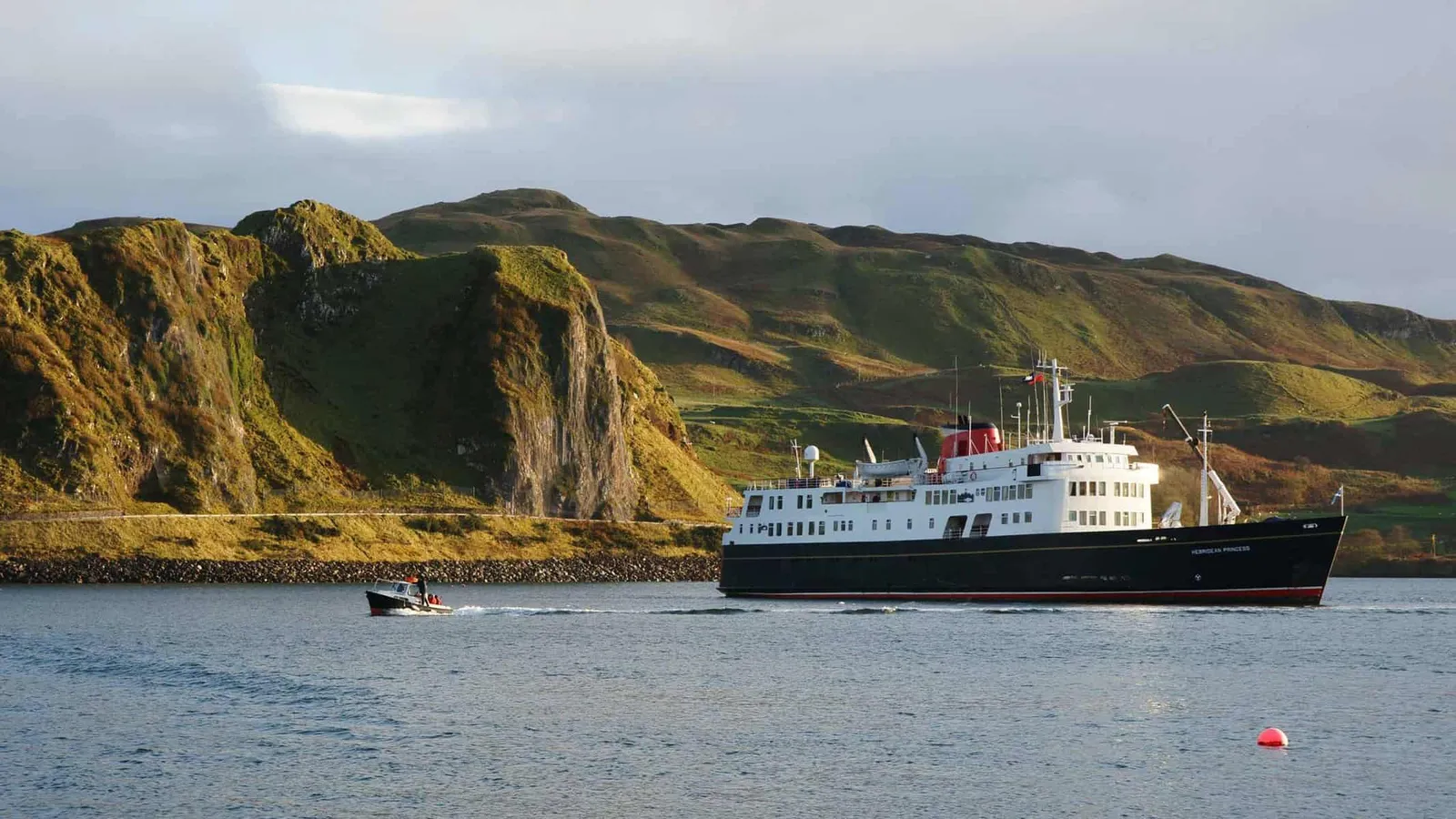
Hebridean is a floating Scottish country house. Hebridean Princess — a former MacBrayne car ferry lovingly converted into what is widely regarded as the smallest luxury cruise ship afloat — carries just 50 guests through Scotland’s remote islands, lochs, and waterways. Tartan furnishings, polished wood, well-stocked bookshelves, a coal fire in the lounge. Dining centres on fine Scottish produce in a single-sitting restaurant where the chef tailors menus to guest preferences. Everything is included: meals, champagne, single malts, shore excursions, bicycles, fishing equipment, and gratuities. Queen Elizabeth chartered her twice for family holidays. Lord of the Highlands (38 guests) operates on the Caledonian Canal and Scottish lochs. The fleet sails Scotland exclusively.
Oceania is the world’s finest mid-size culinary cruise line. Under Jacques Pépin’s executive culinary direction since 2003, the line operates ships carrying 684 to 1,250 guests with up to ten dining venues — all speciality restaurants included without surcharges. The O-class ships feature a professional Culinary Center with twenty-four workstations. The dress code is Country Club Casual at all times. Under Norwegian Cruise Line Holdings alongside Regent and Norwegian, Oceania deploys globally across the Mediterranean, Caribbean, Alaska, Asia, Australia/New Zealand, and increasingly worldwide.
For Australian travellers, these lines serve completely different purposes. Oceania is a versatile global cruise line accessible from Australian ports. Hebridean is a once-in-a-lifetime Scottish pilgrimage. Most travellers will not choose between them — they will do both, at different stages of their travel life.
What is actually included
Hebridean’s all-inclusive model is among the most comprehensive in cruising; Oceania’s is generous but structured differently.
Hebridean includes: all meals prepared from Scottish produce, champagne, wines, spirits including single malt whiskies, shore excursions with entrance fees, expert guides, bicycles and fishing equipment, all gratuities, and use of the ship’s tender for private landings. There is genuinely no bill to settle at the end of the voyage. The only extras are spa treatments (limited aboard) and personal purchases.
Oceania’s “Your World Included” programme covers all speciality restaurant dining without surcharges, shipboard gratuities, unlimited Wi-Fi, speciality coffees, laundry services, and in-stateroom dining. Guests choose one amenity: complimentary wine and beer at lunch and dinner, or a shore excursion credit. Premium spirits, cocktails, spa treatments, and excursions beyond any credit are additional.
The practical difference is substantial on a per-voyage basis. A Hebridean guest never reaches for a wallet. An Oceania guest will accumulate additional costs for drinks, excursions, and spa — potentially AUD $2,000–$5,000 per person on a 14-night voyage depending on consumption.
Dining and culinary experience
The dining comparison pits radical personalisation against unmatched variety.
Hebridean offers a single dining room where the chef prepares menus tailored to guest preferences — dietary requirements, favourite ingredients, even childhood comfort foods if requested. Scottish produce dominates: Loch Fyne oysters, Highland venison, fresh-landed langoustines, properly made porridge at breakfast, and afternoon tea with homemade scones. With 50 guests, the kitchen can accommodate individual requests that would be impossible on a larger ship. The wine list features Scottish-influenced selections alongside French and New World options.
Oceania offers up to ten dining venues per ship. Jacques (French bistro, named for Pépin), Polo Grill (American steakhouse), Red Ginger (pan-Asian), Toscana (Italian), Aquamar Kitchen (wellness), The Grand Dining Room (main restaurant with 270 rotating recipes), Terrace Café, and Waves Grill. The Culinary Center on O-class ships offers hands-on cooking classes at twenty-four individual workstations. Every restaurant except La Reserve and Privée is included.
The comparison is not about quality — both deliver excellent food. It is about scale and style. Hebridean’s single kitchen creates an experience closer to dining in a private home. Oceania’s ten venues create the widest restaurant choice in luxury cruising. Neither approach is superior; they serve different desires.
Suites and accommodation
The accommodation comparison reflects the ships’ wildly different scales and purposes.
Hebridean Princess has 30 cabins ranging from compact singles to the spacious Stateroom accommodation. Cabins vary significantly in size and style — some are intimate with portholes, others more generous with larger windows. Interiors feature tartan soft furnishings, antique-style furniture, and brass fittings. This is not modern luxury — it is country house character. No balconies. The charm lies in the character of the vessel rather than the square footage of the cabin.
Oceania’s O-class ships offer Veranda staterooms from 282 to 291 square feet with private verandas. Penthouse Suites reach 440 square feet. Owner’s Suites span approximately 2,000 square feet. Prestige Tranquility Beds, Bulgari bath amenities, and twice-daily housekeeping. Butler service from Penthouse level upward. R-class ships are tighter at 165 to 216 square feet.
Oceania wins on cabin size, modernity, and amenities at every level. Hebridean wins on character — sleeping aboard the Hebridean Princess feels like staying in a Highland lodge, not a cruise ship. For travellers who value contemporary comfort, Oceania. For those who value heritage atmosphere, Hebridean.
Pricing and value
The pricing gap reflects the fundamental difference between a 50-guest all-inclusive Scottish experience and a global mid-size cruise line.
Hebridean’s per-diem runs approximately GBP $500–$900 per person per night depending on cabin grade and itinerary. A 7-night Scottish Islands voyage costs roughly GBP $4,000–$7,000 per person, all-inclusive. For an Australian couple including business-class flights to Scotland (AUD $10,000–$18,000), pre-cruise hotel, and the voyage: approximately AUD $25,000–$40,000.
Oceania’s per-diem runs approximately AUD $600–$800 per person per night for entry-level Veranda staterooms. A 14-night Mediterranean costs roughly AUD $12,000–$16,000 per person including dining and gratuities. Add flights, drinks, and excursions for the total. Oceania’s Riviera from Sydney requires no international flight.
Oceania is better value per night by a significant margin. Hebridean’s premium buys a radically different experience — 50 guests, complete inclusion, and access to Scotland’s most remote coastline. The value judgement depends entirely on how much you want the Scottish experience.
Spa and wellness
Neither line is a spa-focused product, but the offerings differ in scale.
Oceania’s Canyon Ranch SpaClub operates across the fleet in partnership with the Tucson-based wellness brand. O-class spas span approximately 5,000 square feet with treatment rooms, thalassotherapy pool, steam room, Finnish sauna, and relaxation lounge. Technogym fitness equipment with ocean views. The Aquamar Kitchen restaurant extends wellness into dining.
Hebridean’s wellness offering is minimal — the ship’s scale precludes a dedicated spa facility. The wellness experience is the destination itself: walking on remote island beaches, cycling through Hebridean villages, breathing Atlantic air from the open deck. The ship’s lounge, with its coal fire and single malt selection, provides a different form of restoration.
For dedicated spa facilities, Oceania wins without contest. For the restorative effect of wild Scottish landscapes and absolute tranquillity, Hebridean offers something no spa can replicate.
Entertainment and enrichment
Both lines reject mainstream cruise entertainment — but for entirely different reasons and with entirely different alternatives.
Oceania’s enrichment centres on the Culinary Center — hands-on cooking classes at twenty-four workstations teaching regional cuisines. Guest lecturers cover history, science, and culture. The Martini Bar hosts live piano and cocktail gatherings. Evenings are quiet and social — no production shows, no theatre. Country Club Casual dress at all times.
Hebridean’s enrichment is the voyage itself. Expert guest speakers cover Scottish history, wildlife, archaeology, and culture. Shore excursions visit ancient castles, Neolithic stone circles, Highland distilleries, and bird colonies. The ship’s library is well-stocked. Evenings feature conversation in the lounge, perhaps a local musician or storyteller. With 50 guests, the atmosphere is closer to a house party than a cruise.
The distinction: Oceania makes the kitchen the stage. Hebridean makes Scotland the curriculum. Neither produces any form of staged entertainment.
Fleet and destination coverage
The fleet comparison is stark — a two-ship regional specialist versus a global cruise line.
Hebridean operates two vessels. Hebridean Princess (50 guests) and Lord of the Highlands (38 guests). Both sail Scotland exclusively — the Hebrides, Orkney, Shetland, the Caledonian Canal, and the west coast. No international deployments, no plans to expand beyond British waters. Themed cruises cover wildlife, whisky, walking, art, and Scottish history.
Oceania operates four ships (five with Allura arriving in 2025). Marina and Riviera (1,250 guests each) are the flagships with ten dining venues. Regatta and Insignia (684 guests each) are more intimate. Oceania had 236 Mediterranean cruises in its 2026 programme alone, plus Caribbean, Alaska, Asia, Australia/New Zealand, and world voyages.
The comparison is not meaningful in fleet terms — Oceania’s global reach is incomparably broader. Hebridean’s value lies in accessing a specific destination that no global cruise line can serve with the same intimacy.
Where each line excels
Hebridean excels in:
- Ultra-intimate scale. Fifty guests means the crew know every name, the chef tailors every menu, and the captain adjusts the itinerary to guest interests and weather.
- Scottish exclusivity. Access to lochs, islands, and harbours that no other cruise ship can reach — St Kilda, the Summer Isles, remote Orkney.
- Complete inclusion. Every drink, every excursion, every gratuity included with no exceptions.
- Heritage atmosphere. Tartan furnishings, coal fire, single malts — a floating country house experience unique in world cruising.
Oceania excels in:
- Culinary breadth. Up to ten dining venues with Jacques Pépin’s programme — the widest restaurant variety in luxury cruising, all included.
- Global deployment. Mediterranean, Caribbean, Alaska, Asia, Australia/New Zealand. More itinerary options than any other upper-premium line.
- Value. The lowest per-diem of any luxury line with this calibre of dining.
- Australian accessibility. Riviera sails from Sydney for the 2025–2026 season — no international flight required.
Standout itineraries for Australian travellers
Hebridean Island Cruises
Scottish Islands Discovery (7 nights, Hebridean Princess, multiple departures May–September) — Roundtrip Oban visiting Mull, Skye, the Outer Hebrides, and remote anchorages. All-inclusive with expert guides and shore excursions. The definitive Hebridean experience.
Orkney & Shetland (7–10 nights, Hebridean Princess) — Scotland’s northern archipelagos with Neolithic sites (Skara Brae, Ring of Brodgar), seabird colonies, and Viking heritage. Extended summer daylight.
Whisky-themed voyages (various dates) — Dedicated itineraries visiting Islay, Speyside, and Highland distilleries with tastings and expert commentary. All whisky included.
Oceania
Riviera: Sydney to Bali (14 nights, February 2026) — Oceania’s Australian debut. Sydney departure via Brisbane, Cairns, Darwin to Bali. Ten dining venues, no international flight required.
Riviera: Mediterranean Grand Voyage (28–42 nights, multiple segments) — The best Oceania experience for food-motivated Australians. Sea days between ports allow exploration of all ten restaurants.
Regatta: Polynesian Dreams (15 nights, Honolulu to Papeete) — Intimate R-class format in the South Pacific. Accessible via Air New Zealand from Australian capitals.
Ship-by-ship recommendations
Hebridean
Hebridean Princess (50 guests) — The flagship and the only choice for the full Hebridean experience. Former car ferry converted to country house luxury. Choose for Scottish island itineraries.
Lord of the Highlands (38 guests) — Even more intimate. Operates on the Caledonian Canal and Scottish lochs. Choose for inland Scotland.
Oceania
Riviera (1,250 guests, 2012) — The flagship deployed to Australian waters. Ten dining venues, Culinary Center. The easiest entry point for Australians.
Marina (1,250 guests, 2011) — Sister to Riviera. Identical facilities. Choose based on itinerary.
Regatta (684 guests, 1998) — The most intimate Oceania ship. Fewer dining venues but a devoted following.
Allura (arriving 2025) — Newest ship. Worth watching for introductory pricing.
For Australian travellers specifically
These lines serve Australian travellers in completely different ways — one as an accessible global cruise line, the other as a bucket-list Scottish pilgrimage.
Oceania’s Australian proposition is strong and growing. Riviera’s Sydney debut for 2025–2026 provides a domestic departure point. The NCLH Sydney office handles bookings. The Mediterranean programme — over 230 cruises per season — is accessible via Qantas, Emirates, or Singapore Airlines from Australian gateways. Oceania’s Club loyalty integrates with Norwegian Cruise Line Holdings.
Hebridean’s appeal for Australians is niche but powerful. Australia has a deep cultural connection to Scotland — more Australians claim Scottish heritage than almost any other non-British nation. A Hebridean Princess voyage through the Hebrides, Orkney, or Shetland satisfies a cultural curiosity that no global cruise line can address. The voyage requires flights to Glasgow or Edinburgh (approximately 22–24 hours via the Middle East), but the intimacy and inclusion of the experience reward the journey.
The practical recommendation: These lines complement rather than compete. An Oceania Mediterranean or Australian sailing for culinary cruise excellence, and a Hebridean Princess voyage to Scotland when the ancestral pull becomes irresistible. Both deliver luxury without mega-ship compromises.
The onboard atmosphere
The social environments are as different as the ship sizes suggest.
Hebridean’s atmosphere is a Highland house party. Fifty guests gather in a lounge with a coal fire, single malts, and conversation that deepens over the week. The crew-to-guest ratio ensures personal attention that borders on familial. Dress code is smart casual — tweeds and comfortable shoes rather than formal wear. The passenger base is predominantly British Anglophiles, Scottish history enthusiasts, and nature lovers. The atmosphere is quiet, intimate, and deeply social in the way that only a group of 50 can be.
Oceania’s atmosphere is the Country Club. Average passenger age approximately 55–70, predominantly American and Canadian with growing Australian representation. Country Club Casual dress at all times — no formal nights. The evening energy is conversational: jazz trio, cocktails, lingering dinner. The mid-size format means familiar faces without crowding. There is a casino. The cultural vibe is comfortable, cosmopolitan, and food-obsessed.
The bottom line
Hebridean Island Cruises and Oceania Cruises are not competitors — they serve entirely different purposes for different moments in a travel life. The comparison is worth making only because it clarifies what each line does uniquely well.
Choose Hebridean if Scotland calls to you — the islands, the history, the whisky, the wild Atlantic coastline. Choose it for the most intimate cruise experience available, where 50 guests and a dedicated crew create something closer to a private yacht charter than a conventional cruise. Choose it for complete inclusion without exception. Accept that this is a regional specialist requiring international flights, with compact cabins and no modern spa or dining variety.
Choose Oceania if you want the finest culinary programme at sea at a competitive per-diem. Choose it for up to ten dining venues, global itineraries, Australian departures from Sydney, and the professional Culinary Center. Choose it for the relaxed Country Club Casual atmosphere that makes excellent food the centrepiece of the voyage. Accept that alcoholic drinks require the beverage amenity selection and that the ship carries 684 to 1,250 guests rather than 50.
For most Australian travellers, the answer is not either-or — it is both, for different reasons, at different times.