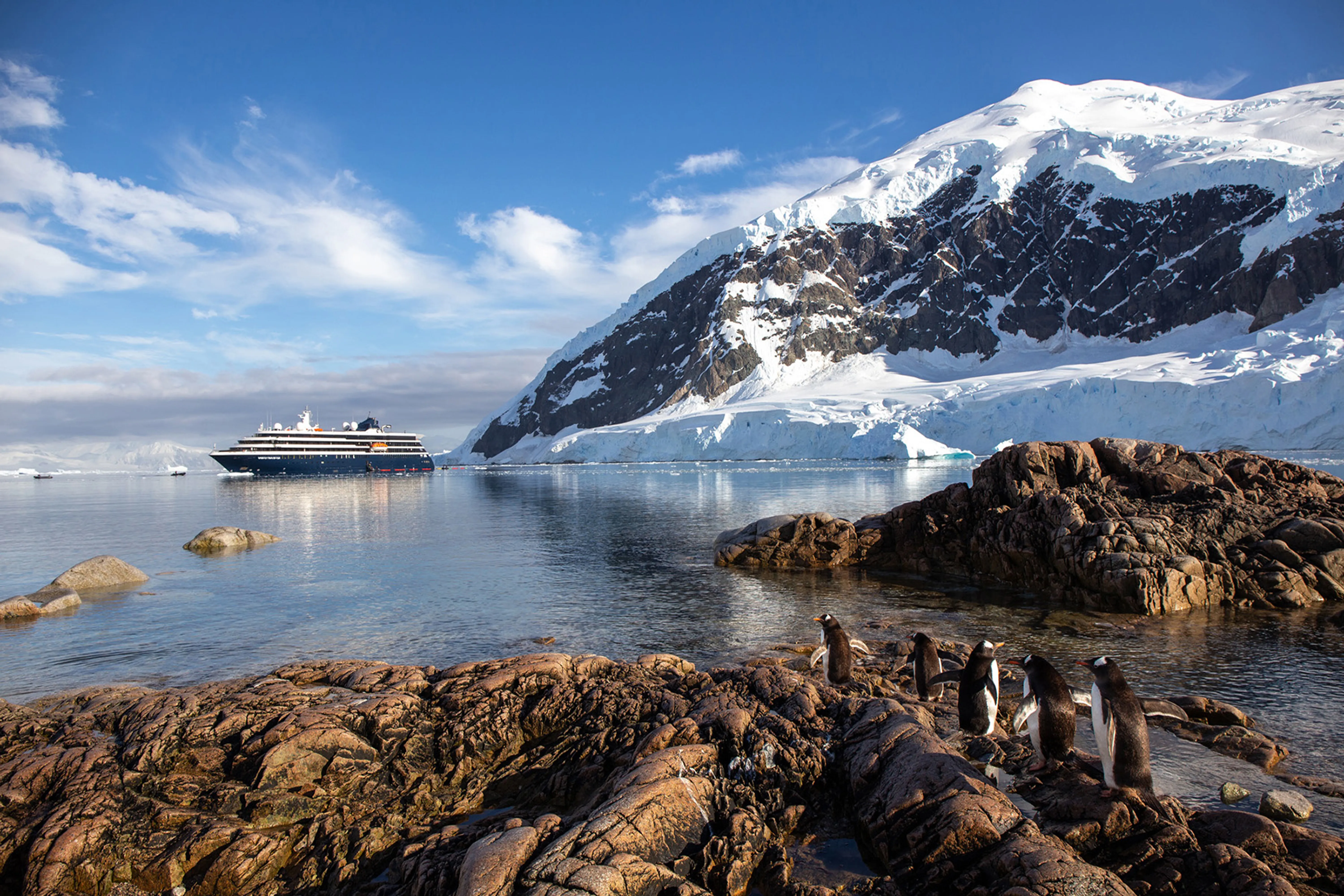
HX Expeditions and Ponant both sail Antarctic and Arctic waters with expedition teams and Zodiac fleets — but they represent fundamentally different visions of what expedition cruising should be. Jake Hower compares their ships, ice capability, dining, inclusions, guide ratios, and total value for Australian travellers choosing between Scandinavian-style accessible expedition and French luxury exploration.
| HX Expeditions | Ponant | |
|---|---|---|
| Category | Expedition | Luxury / Expedition |
| Rating | ★★★★☆ | ★★★★★ |
| Fleet size | 10 ships | 13 ships |
| Ship size | Small (under 1,000) | Small (under 500) |
| Destinations | Norwegian Coast, Arctic, Antarctica, Greenland | Antarctica, Mediterranean, Arctic, South Pacific |
| Dress code | Relaxed | Smart casual |
| Best for | Coastal and expedition nature lovers | French-inspired luxury expedition travellers |
HX Expeditions is the high-volume polar specialist — fifty Antarctic departures per season, hybrid-electric propulsion, an all-inclusive fare covering drinks, Wi-Fi, and gratuities, a dedicated Science Center on every ship, and entry-level pricing from approximately A$13,000 for the Antarctic Peninsula. Ponant counters with the most capable expedition fleet afloat — thirteen ships topped by the PC2 icebreaker Le Commandant Charcot reaching the Geographic North Pole and deep Weddell Sea emperor penguin colonies, Ducasse-curated dining, the Blue Eye underwater lounge, an open bar with Henri Abelé champagne, and Kimberley departures from Australian ports. Choose HX when departure flexibility, entry-level pricing, and science-driven expedition value matter most. Choose Ponant when French culinary finesse, extreme polar capability, intimate ship size, and luxury inclusions justify the premium.
The core difference
HX Expeditions and Ponant both plant their flags in the expedition cruise market, but the similarity ends almost as soon as it begins. These two lines represent fundamentally different philosophies about what it means to explore remote waters — and choosing between them is less about which is “better” and more about which version of expedition cruising matches your temperament, budget, and ambitions.
HX Expeditions is the accessible, science-driven, high-volume polar operator. Tracing its lineage to 1893 and the original Hurtigruten Norwegian coastal steamships, HX (rebranded from Hurtigruten Expeditions in late 2023) operates five expedition ships including the world’s first hybrid battery-powered cruise ships, MS Roald Amundsen and MS Fridtjof Nansen. With approximately fifty Antarctic departures per season — the largest programme of any expedition line — HX puts more people on Antarctic ice than any competitor. Its defining promise is democratised expedition: genuine Zodiac landings, dedicated Science Centers, citizen science partnerships with NASA, NOAA, and the University of Tasmania, and an all-inclusive fare model (since November 2024) that covers drinks, Wi-Fi, gratuities, and expedition activities at a price point significantly below luxury competitors. HX is headquartered in London, now independently owned following a 2025 acquisition by a consortium led by Arini Capital Management and Cyrus Capital Partners, and has recently established a dedicated Australian sales team based in Melbourne. The brand DNA is Scandinavian — clean, functional, sustainability-forward, and unapologetically mid-market.
Ponant is the French luxury expedition line. Founded in 1988 by a group of young French Merchant Navy officers in Nantes, Ponant is now owned by Groupe Artemis — the private holding company of the Pinault family, who also control Kering (Gucci, Yves Saint Laurent, Balenciaga, Bottega Veneta). This luxury parentage is not incidental; it permeates every aspect of the Ponant experience. The fleet of thirteen ships is topped by Le Commandant Charcot — the world’s first and only luxury PC2 icebreaker, capable of reaching the Geographic North Pole, the deep Weddell Sea emperor penguin colonies, and destinations no other passenger vessel can access. French chefs prepare every meal across the fleet, with Alain Ducasse Conseil overseeing menus on Charcot. The Blue Eye underwater lounge on Explorer-class ships is entirely unique in the cruise industry. The open bar pours Henri Abelé Brut champagne. Partnerships with the Explorers Club, Smithsonian Journeys, and National Geographic bring world-class speakers aboard. Ponant operates from its Marseille headquarters and maintains an APAC office in Sydney that contributes approximately 20 per cent of global revenue. The brand DNA is distinctly French — refined, gastronomic, culturally layered, and positioned at the intersection of luxury and genuine expedition capability.
The contrast between these two lines is among the starkest in this comparison series. HX says: you do not need to be wealthy to reach Antarctica, and the science matters more than the champagne. Ponant says: the most extraordinary places on Earth deserve the most extraordinary experience, and there is no reason exploration cannot be accompanied by a Ducasse-crafted dinner and a cheese course. Both are right. The question is which philosophy speaks to you.
Expedition team and guides
The quality and depth of the expedition team shapes every day of a polar voyage. Both HX and Ponant deploy multi-disciplinary teams, but the structures differ considerably — and these differences are amplified by ship size.
HX’s expedition team varies by vessel. The hybrid ships (MS Roald Amundsen and MS Fridtjof Nansen) carry approximately 15 to 20 expedition team members for up to 500 polar passengers, yielding an estimated guide-to-guest ratio of approximately 1:25 to 1:30. MS Fram, at 200 polar passengers, likely carries 10 to 15 guides for a ratio closer to 1:15 to 1:20. These are significantly lower ratios than dedicated small-ship operators, and it is HX’s most visible competitive weakness in the expedition space. Team members include marine biologists, wildlife biologists, ornithologists, glaciologists, historians, photographers, and — uniquely — cultural interpreters such as Niels Sanimuinaq Rasmussen, a Greenlandic Inuit specialist and Master of Ice Camp. HX operates an in-house polar guide training academy (winner of the Princess Royal Training Award in 2024) and has strong leadership credentials, with Tudor Morgan having served as IAATO Chair in 2022. Every voyage includes a professional photographer providing a complimentary digital photo album, and the Science Center hosts photography workshops. German-language simultaneous interpretation is available on many voyages, reflecting HX’s significant German-speaking market.
Ponant’s expedition team on the Explorer and Boreal class ships includes approximately 10 to 12 naturalist guides and experts, yielding a ratio of approximately 1:15 to 1:18 on Explorer-class ships (184 passengers) and approximately 1:19 to 1:22 on Boreal-class ships (264 passengers). Le Commandant Charcot doubles the complement to approximately 20 naturalist guides plus visiting scientists, achieving a ratio of approximately 1:10 to 1:12 — the best in the Ponant fleet by a wide margin. Team disciplines include marine biologists, ornithologists, historians, geologists, botanists, polar specialists, and underwater diving instructors. The defining characteristic of Ponant’s expedition team is its bilingual operation — all briefings, lectures, and landing instructions are delivered in both French and English. This is simultaneously a strength (reflecting genuine French cultural DNA) and a practical consideration (every presentation takes roughly twice as long). Ponant’s approach is more brand-driven than personality-driven; individual expedition leaders are less prominently marketed than the Ponant expedition experience as a whole.
The comparison: Neither line offers the elite guide ratios of dedicated small-ship operators such as Aurora Expeditions (1:8) or Quark Expeditions (1:10). On HX’s hybrid ships, the 1:25 to 1:30 ratio is noticeably stretched — with 500 passengers and 15 to 20 guides, individual attention during landings is inevitably limited. Ponant’s Explorer-class ships, with 184 passengers and 10 to 12 guides, deliver a modestly better ratio but still fall short of the small-ship standard. Ponant’s Charcot, at approximately 1:10 to 1:12, is the strongest proposition from either line. HX’s advantage lies in its dedicated Science Centers and structured citizen science programme, which provide enrichment infrastructure beyond the expedition team itself. Ponant’s advantage lies in its Explorers Club, Smithsonian, and National Geographic partnerships, which periodically bring external experts of extraordinary calibre aboard select voyages.
Ships and expedition hardware
This is where the comparison becomes most dramatic. The gap in expedition hardware between these two lines is not incremental — it is an entirely different tier of capability.
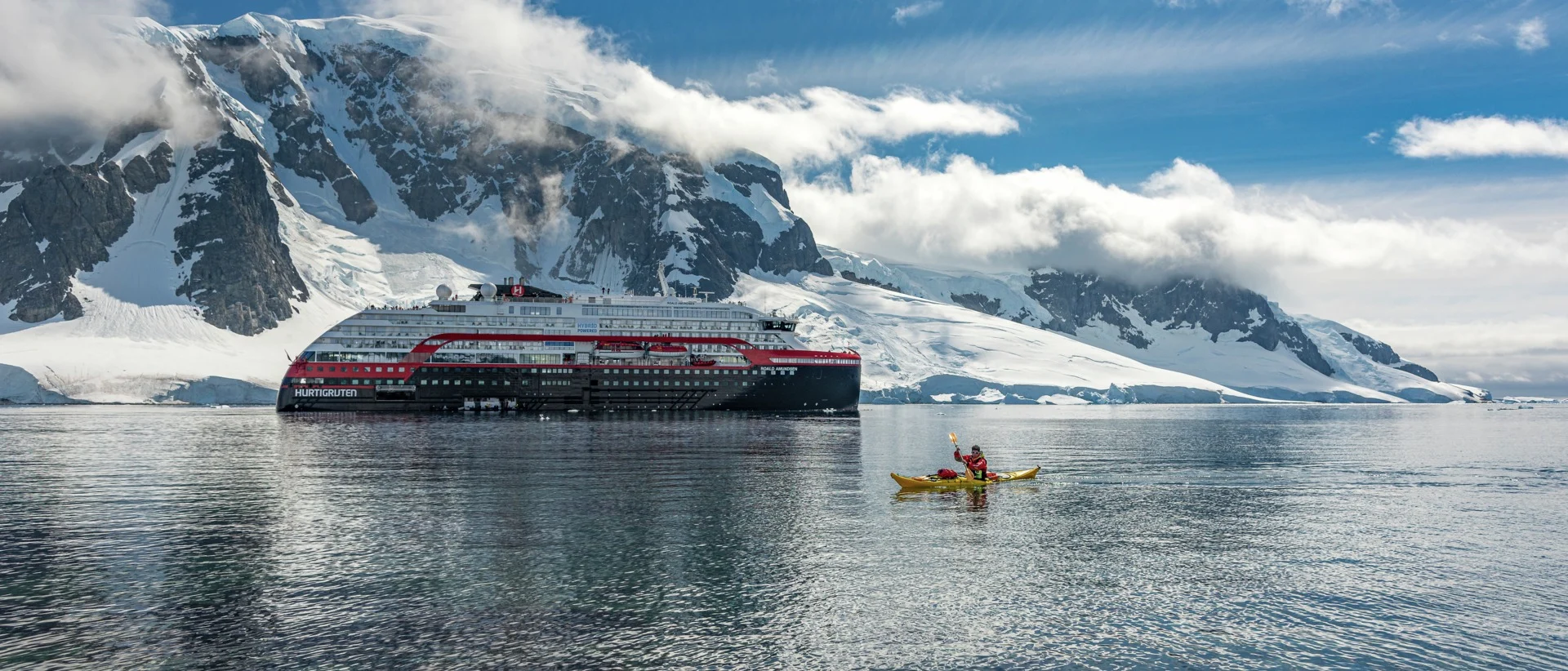
HX’s fleet comprises five vessels. The flagships, MS Roald Amundsen (2019) and MS Fridtjof Nansen (2020), are 20,889-gross-ton hybrid battery-powered ships carrying up to 500 passengers on polar voyages with 265 cabins each. They hold PC6 ice class, suitable for summer and autumn operation in medium first-year ice — standard for Antarctic Peninsula waters. The diesel-electric hybrid system with Rolls-Royce SAVe Cube technology and Corvus Energy lithium-ion battery packs allows 30 to 60 minutes of pure electric operation, reducing CO2 emissions by approximately 20 per cent. MS Fram (2007, refurbished 2025) is the more traditional expedition ship — 200 passengers in polar waters, 11,647 gross tons, with 1B ice class (Finnish-Swedish, stronger than PC6, suitable for solid first-year sea ice). MS Spitsbergen (2009, rebuilt 2016, refurbished 2025) carries 150 expedition passengers with an ice-strengthened hull. MV Santa Cruz II is a 90-guest Galapagos specialist.
The hybrid ships carry approximately 17 inflatable Explorer Boats (Zodiacs) each, deployed from a tender pit on Deck 3 without cranes. HX carries no helicopter, no submarine, and no ROV — but does deploy Blueye underwater drones for live video feeds to the Science Center. Kayak fleets (inflatable Discovery and hard-shell Sea Explorer models), camping equipment (15 insulated tents and bivvy bags per hybrid ship), and snowshoes are available as paid add-ons.
Ponant’s fleet comprises thirteen core vessels across four classes — a fleet diversity that is unmatched in expedition cruising. Le Commandant Charcot (2021) is the crown jewel: a 31,757-gross-ton, 150-metre PC2 icebreaker carrying 200 passengers in Antarctic waters (245 in the Arctic), powered by LNG with a 5 MWh battery pack for silent running. The PC2 hull can break through multiyear ice up to 2.5 metres thick using a Double Acting Ship principle for severe ice conditions. Charcot carries a 4-passenger helicopter (operations and science use only, not passenger excursions), a Sherp all-terrain vehicle, hovercraft, tethered hot-air balloon, snowmobiles, 16 Zodiacs, and two purpose-built scientific laboratories. It has reached the Geographic North Pole, the North Pole of Inaccessibility (first passenger vessel ever, September 2024), and deep Weddell Sea emperor penguin colonies — destinations that are simply impossible for HX’s fleet.
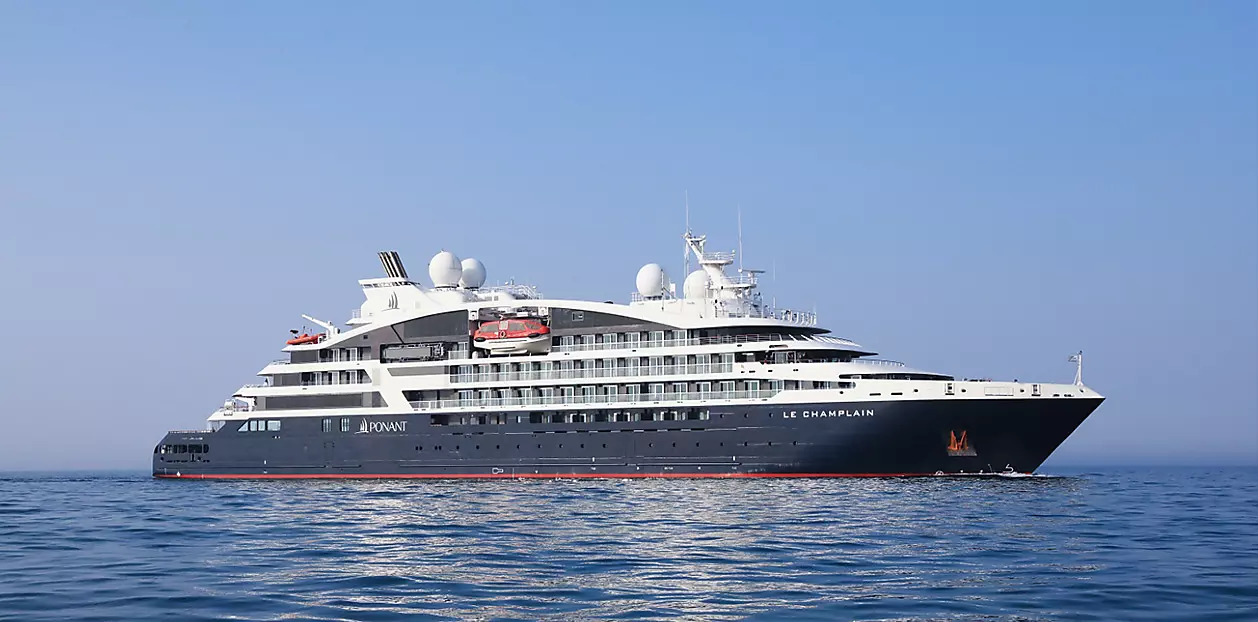
The six Explorer-class ships (2018 to 2020) carry 184 passengers each with Ice Class 1C, suitable for light first-year ice. Each features the Blue Eye underwater lounge — a world-first multi-sensory space 2.5 metres below the waterline designed by French architect Jacques Rougerie, with whale-eye-shaped glass portholes, hydrophone audio, and Body Listening Sofas. The retractable marina platform at the stern enables Zodiac launches, kayaking, and water sports. The four Boreal-class ships (2010 to 2015) carry 264 passengers with Ice Class 1C. Le Ponant is a 32-guest three-masted sailing yacht. The Paspaley Pearl is a 30-guest superyacht added in January 2025 for Kimberley, Raja Ampat, and Papua New Guinea.
The ice-class gap is the defining hardware difference. Ponant’s Charcot at PC2 operates in a category that HX’s entire fleet cannot approach. PC2 means multiyear pack ice, the Geographic North Pole, deep Weddell Sea penetration, and East Antarctic coast access. HX’s PC6 (hybrid ships) and 1B (Fram) are adequate for standard Antarctic Peninsula and Arctic waters, but they cannot reach emperor penguin colonies through heavy sea ice, transit the McClure Strait, or break through to Peter I Island. However, it is important to note that Ponant’s Explorer and Boreal class ships at Ice Class 1C are actually rated lower than HX’s hybrid ships at PC6 — meaning for standard Antarctic Peninsula operations, HX’s newer ships have a slight technical edge in ice navigation over Ponant’s standard fleet. The gap only becomes dramatic when Charcot enters the comparison.
The IAATO capacity distinction is equally consequential. HX’s hybrid ships at 500 passengers fall into IAATO Category C2 — they can make landings, but only 100 passengers may be ashore at any time. This means five rotation groups, extending landing logistics considerably. Ponant’s Explorer-class ships at 184 passengers and Charcot at 200 Antarctic passengers sit within IAATO Category C1, allowing more efficient landing rotations. However, Ponant’s Boreal-class ships at 264 passengers also fall into C2, creating the same rotation challenges. HX’s MS Fram at 200 passengers qualifies for C1. The practical upshot: if efficient Antarctic landings are a priority, Ponant’s Explorer-class ships and Charcot outperform HX’s hybrid ships, but MS Fram and Ponant’s Boreal class are roughly comparable.
Landing experience and shore programme
The on-the-ground expedition experience is where ship size and fleet design translate into tangible differences for passengers.
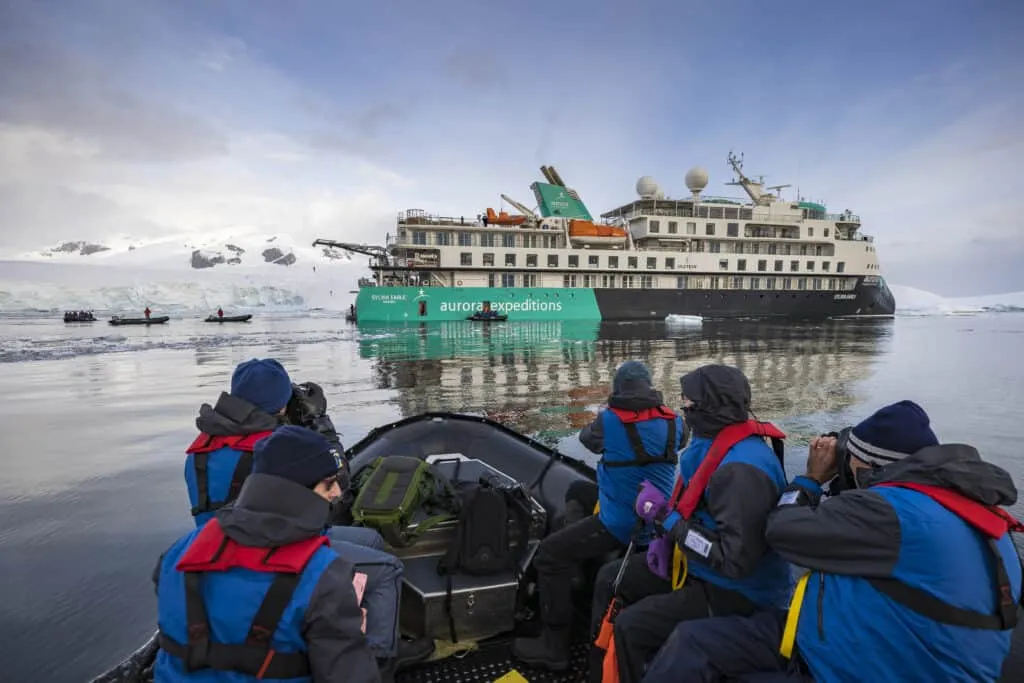
HX’s landing programme on the hybrid ships is structured around the IAATO 100-ashore-at-a-time rule, requiring five rotation groups of approximately 100 passengers each. Zodiac groups of 12 to 16 passengers shuttle to and from landing sites throughout the day. Typically two excursions per day are planned — one water-based (Zodiac cruising, kayaking) and one land-based (hiking, snowshoeing, wildlife observation). The expedition team adjusts plans in real time based on ice conditions and wildlife sightings. On MS Fram, with 200 passengers, only two rotation groups are needed, making the experience significantly more fluid.
Activities included in the HX fare: nature landings, Zodiac cruising, wildlife observation, the Polar Plunge, extended hikes, all lectures and Science Center activities, and citizen science participation. Paid add-ons include Sea Explorer Kayaking (EUR 199), Discovery Kayaking (EUR 129), bivvy bag camping (EUR 350), Amundsen Night tent camping (EUR 429), and snowshoeing. From the 2025-2026 season, booking for kayaking and camping is managed onboard on a first-come-first-served basis.
Ponant’s landing programme on Explorer-class ships benefits from the 184-passenger count sitting just below the IAATO C1 threshold of 200. All passengers can visit a landing site in relatively quick rotations, with Zodiac groups of approximately 10 passengers. Typically one to two landings per day plus Zodiac cruises, with expert-led naturalist guides accompanying each group. Shore excursions include Zodiac landings and cruises, hiking, wildlife observation, polar plunge, and expert briefings — all included.
Le Commandant Charcot adds an extraordinary dimension to the shore programme. The PC2 hull enables access to destinations that are simply impossible for any other luxury vessel: deep into Weddell Sea pack ice to approach emperor penguin colonies at Snow Hill Island, Peter I Island, the East Antarctic coast, and ice-floe research station setups with visiting scientists. Charcot-exclusive activities include tethered hot-air balloon rides for aerial polar views, hovercraft excursions over ice and snow, snowmobile rides, and polar diving (PADI certified). Sea kayaking is available on select itineraries with both lines. Ponant does not offer camping.
The landing quality comparison is nuanced. For standard Antarctic Peninsula operations, Ponant’s Explorer-class ships deliver a more intimate and efficient landing experience than HX’s hybrid ships — fewer passengers, faster rotations, smaller Zodiac groups. HX’s MS Fram is competitive with Ponant’s Explorer class in this regard. But for truly exceptional Antarctic destinations — emperor penguins, deep Weddell Sea, East Antarctic coast — Ponant’s Charcot occupies a category of one. HX’s hybrid ships, constrained by their C2 category and PC6 ice class, simply cannot go where Charcot goes. HX counters with a broader adventure activity menu at accessible price points — camping under the Antarctic sky is a bucket-list experience that Ponant does not offer.
What is actually included
Both lines have moved toward all-inclusive pricing, but the depth and generosity of those inclusions differ in ways that compound over a voyage.
HX’s all-inclusive fare (since November 2024) covers: full-board dining at Aune Restaurant and Fredheim, house wine, beer, spirits, and cocktails throughout the day (excluding premium drinks), complimentary Wi-Fi (Starlink where available), gratuities, all daily expedition landings and Zodiac cruising, an expedition jacket (wind and water-resistant, yours to keep), a reusable water bottle, rubber boot and trekking pole loan, a professional digital photo album, all lectures and Science Center access, and citizen science participation. Not included: international flights to the embarkation port (except charter flights Buenos Aires to Ushuaia on Antarctic voyages), travel insurance, optional paid activities (kayaking, camping, snowshoeing), premium drinks, spa treatments, Restaurant Lindstrom surcharge for non-suite guests, and laundry. Most Antarctic itineraries include a pre-cruise night at a 5-star Buenos Aires hotel and charter flights to Ushuaia.
Ponant’s all-inclusive fare covers: all meals at all onboard restaurants (breakfast, lunch, dinner, 24-hour room service), an open bar including wines, spirits, beer, Henri Abelé Brut champagne, cocktails, soft drinks, and mineral water at all times, a daily-restocked minibar in every stateroom, unlimited Wi-Fi (Starlink-enhanced on Charcot), all Zodiac excursions and shore landings, daily expert-led lectures, a polar parka (yours to keep) on polar voyages, expedition boots on loan, onboard entertainment and enrichment, and port taxes. Not included: international flights (unless specified in a package such as Kimberley Fly, Stay and Cruise or Antarctic Buenos Aires-Ushuaia charter flights), travel insurance, gratuities (optional, recommended EUR 10 to 12 per person per day), some optional activities (kayaking and diving may carry supplements), personal laundry (free for upper loyalty tiers), spa treatments, and a small selection of ultra-premium wines and spirits.
Where Ponant’s inclusions exceed HX’s: The open bar with champagne and a restocked minibar in every stateroom is a genuinely superior inclusion — HX includes house-level drinks but not champagne and not a minibar. Ponant’s 24-hour room service is included; HX does not prominently feature room service as an inclusion. Ponant includes port taxes in the fare. The overall beverage programme — from the Henri Abelé champagne at the bar to the curated French wine list at dinner to the minibar waiting in the stateroom — creates a different daily atmosphere. On Ponant, you never think about what a drink costs. On HX, the vast majority of drinks are included, but the ultra-premium tier and the minibar are not.
Where HX’s inclusions offer distinct value: HX includes a professional digital photo album from the onboard photographer — a tangible memento of the voyage. HX’s Science Center access and structured citizen science programme are unique enrichment inclusions. The all-inclusive fare on HX ships represents significantly better value per dollar spent, given the lower base fare. Gratuities are included in HX’s fare (not included in Ponant’s, though Ponant positions tipping as optional). For a traveller comparing the total out-of-pocket cost, HX’s fare includes more at a lower absolute price; Ponant’s fare includes more at a higher absolute price, with the champagne, minibar, and room service justifying the premium.
Destination coverage and itinerary depth
HX’s destination coverage is broad across expedition regions. Ponant’s is broader still — and at the extremes, incomparable.
HX’s Antarctic programme is the largest in the industry — approximately fifty departures per season across three ships (MS Roald Amundsen, MS Fridtjof Nansen, MS Fram). Itineraries range from 12-day Highlights of Antarctica to 17-day Antarctic Circle crossings to 22 to 24-day South Georgia and Falklands combinations. All Antarctic voyages depart from Buenos Aires with charter flights to Ushuaia. HX does not offer a Fly-the-Drake option. Beyond Antarctica, HX sails to Svalbard, Greenland (the largest-ever Greenland season for 2025-2026), Arctic Canada, the Northwest Passage, Alaska, the Galapagos (year-round on MV Santa Cruz II), West Africa (Cape Verde and the Bissagos Islands — HX is the sole cruise line offering this), South America, Iceland, and the British Isles. HX does not sail in Australian waters or the Kimberley.
Ponant’s destination coverage spans every expedition region and extends far beyond the poles. In Antarctica, the Explorer and Boreal class ships offer classic Peninsula voyages from Ushuaia (10 to 13 nights), South Georgia and Falklands combinations, and sub-Antarctic islands. Le Commandant Charcot opens an entirely separate tier: emperor penguins of the Weddell Sea through heavy pack ice, Peter I Island, East Antarctic coast (Adelie Land, Wilkes Land, Shackleton Ice Shelf, Queen Mary Land), Ross Sea itineraries, and a planned 62-day Antarctic circumnavigation departing January 2028. In the Arctic, Charcot sails to the Geographic North Pole (five departures scheduled for 2026), deep Greenland, and the Northwest Passage — including the first transit of the McClure Strait. The standard fleet covers Svalbard, Greenland, Iceland, Alaska, the Mediterranean, Northern Europe, the Caribbean, Japan, Central America, French Polynesia, and Papua New Guinea. Critically for Australian travellers, Ponant deploys ships to the Kimberley between Broome and Darwin (16 departures in the 2026 season), and Le Commandant Charcot made its Australian debut in Hobart in February 2026 for East Antarctic itineraries.
The Charcot-only destinations are transformative. The Geographic North Pole, the North Pole of Inaccessibility, deep Weddell Sea emperor penguin colonies, Peter I Island, the East Antarctic coast from Hobart, and the McClure Strait — these destinations are unreachable by any other luxury passenger vessel. HX cannot access any of them. For travellers whose ambition extends beyond the standard Antarctic Peninsula, Ponant’s Charcot is the only option at this level of comfort.
For Australian travellers, Ponant’s domestic departures are a significant differentiator. The Kimberley seasons between Broome and Darwin, the Paspaley Pearl superyacht for ultra-intimate Kimberley voyages, and Charcot’s Hobart departure for East Antarctica all offer itineraries accessible without long-haul flights to South America. HX has no Australian port calls and no ships deployed to Australian waters — every voyage requires international travel.
Cabins and accommodation
The cabin experience reflects the broader positioning of each line — HX offers practical Scandinavian comfort at expedition pricing; Ponant offers French-designed luxury at premium pricing.
HX’s cabin range on the hybrid ships spans 265 outside-facing cabins with no inside cabins. All passengers enjoy natural light. Fifty per cent of cabins have private balconies. Categories range from Polar Outside (17 to 23 square metres, windows, sitting area) to Extra-Large Suites (46 to 48 square metres, forward-facing with sweeping views). Arctic Superior cabins occupy the mid-range at 15 to 27 square metres with various balcony configurations. Interiors feature Scandinavian design with natural materials — granite, oak, birch, and wool. Suite guests receive complimentary fine dining at Restaurant Lindstrom, priority embarkation, and enhanced amenities. MS Fram (post-2025 refurbishment) and MS Spitsbergen also offer inside cabins at lower price points, making them HX’s most accessible ships. There are no dedicated solo cabins on any HX vessel.
Ponant’s cabin range is uniformly more spacious and more luxurious. On Explorer-class ships, all 92 staterooms have private balconies — there are no inside cabins and no porthole-only cabins. Entry-level Prestige Staterooms offer 18.5 square metres of interior with a 4-square-metre balcony. Suites escalate through Deluxe (27 square metres), Privilege (36 square metres with butler service), Grand Deluxe (45 square metres), to the Owner’s Suite (54 square metres plus 8.5-square-metre balcony). On Le Commandant Charcot, all 135 staterooms have private balconies, with entry-level Prestige Staterooms at 20 square metres and 5-square-metre balcony. The apex is the Owner’s Suite — 115 square metres of interior with a staggering 185-square-metre private terrace featuring a Jacuzzi, personal telescope, separate dining room, dressing room, and master plus guest bathrooms. It is the most extravagant suite in expedition cruising. Butler service is available from Privilege Suite level and above.
The comparison at every level favours Ponant on space and finish. Ponant’s entry-level Prestige Stateroom at 18.5 square metres with a guaranteed private balcony compares favourably to HX’s Polar Outside at 17 to 23 square metres with windows only (no balcony at entry level). At the suite level, the gap widens dramatically — Ponant’s Owner’s Suite on Charcot at 115 square metres plus 185-square-metre terrace versus HX’s largest suite at 46 to 48 square metres. The design aesthetic also differs: HX delivers clean Scandinavian minimalism with natural materials; Ponant delivers French luxury interiors by designers including Jean-Philippe Nuel and Jean-Michel Wilmotte, with polar-inspired whites and blues in public areas and warmer tones in staterooms. Both approaches are well-executed for their respective positioning — HX’s cabins are extremely comfortable for an expedition ship, while Ponant’s feel like a Parisian boutique hotel that happens to be sailing through ice.
Pricing and value
The pricing difference between HX and Ponant is substantial — and understanding what each dollar buys requires looking beyond the headline fare.
HX’s directional pricing for a standard 12-day Highlights of Antarctica voyage on the hybrid ships starts from approximately A$13,000 to A$14,000 per person for a Polar Outside cabin, working out to roughly A$1,100 to A$1,500 per person per day. Flight-inclusive packages from Buenos Aires with charter flights to Ushuaia start from approximately A$14,000 for 15 days. A 17-day Antarctic Circle voyage starts from approximately A$17,000. International flights from Australia add approximately A$2,000 to A$4,000 return to Buenos Aires via Santiago or Auckland. HX runs Wave Sale promotions (December to March) with savings of up to USD 4,000 per person, and Black Friday sales offering up to 40 per cent off select sailings. Shoulder season departures in November and March offer the best value.
Ponant’s directional pricing for a standard 10 to 11-night Explorer-class Antarctic Peninsula voyage starts from approximately A$11,000 to A$13,000 per person for an entry-level Deluxe Stateroom with balcony, including Buenos Aires hotel night and charter flight to Ushuaia on most sailings. This translates to approximately A$1,100 to A$1,300 per person per day. Le Commandant Charcot Antarctic voyages (such as the 14-night Emperor Penguins of the Weddell Sea) start from approximately A$18,000 to A$22,000 per person. North Pole voyages on Charcot start from approximately USD 46,450 per person. Kimberley Fly, Stay and Cruise packages start from A$13,670. Early-bird savings of up to 30 per cent are available on advance bookings.
The headline surprise: On a standard Antarctic Peninsula voyage, Ponant’s entry-level fare is not dramatically higher than HX’s — and in some cases may be comparable or even slightly lower per night. This is counterintuitive given Ponant’s luxury positioning, but it reflects the competitive dynamics of the Antarctic market and Ponant’s aggressive pricing strategy for Explorer-class ships. The gap widens significantly for Charcot itineraries, where the unique destinations and PC2 capability command a substantial premium.
The value analysis beyond the headline fare: HX’s all-inclusive fare includes gratuities (Ponant’s does not — add EUR 10 to 12 per person per day optionally). Ponant’s open bar includes champagne and a daily-restocked minibar (HX’s does not). Ponant’s every stateroom comes with a private balcony (HX’s entry-level does not). Both include Buenos Aires hotel nights and charter flights on most Antarctic sailings. Both include a parka and boots. When factoring in the cabin quality differential, the balcony inclusion, and the champagne bar, Ponant’s fare represents more luxury per dollar at the entry level than a simple price comparison suggests. HX’s fare represents more expedition per dollar — more departures to choose from, included citizen science, and a lower barrier to entry for first-time Antarctic travellers.
Solo traveller pricing: Ponant has waived the single supplement on over 160 voyages across all destinations — a policy that is genuinely industry-leading for luxury expedition and represents extraordinary value for solo travellers. HX releases a limited number of no-supplement cabins on select sailings and charges solo supplements starting from 25 per cent — well below the industry norm of 50 to 100 per cent but not as generous as Ponant’s broad waiver. Neither line offers dedicated solo cabin categories.
Onboard enrichment and science
Both lines invest in intellectual enrichment, but the nature of that investment reflects their respective identities — HX builds from internal science infrastructure, Ponant from external prestige partnerships.
HX’s enrichment programme centres on its Science Center — a dedicated physical space on every expedition ship (new or upgraded on Fram and Spitsbergen in 2025) featuring microscopes, touch screens, digital technology, and Blueye underwater drones providing live underwater footage. The Science Center is the heart of the onboard expedition programme, hosting workshops in photography, biology, and arts and crafts. Citizen science runs on every voyage with at least one programme active: eBird and iNaturalist (wildlife sightings), HappyWhale (whale migration tracking via fluke photography), FjordPhyto (phytoplankton sampling), Secchi Disk Programme (water clarity measurement), and partnerships with NASA, NOAA, and the University of Tasmania’s Institute for Marine and Antarctic Studies. The 2025-2026 Antarctic season targets 1,100-plus cabins donated to science, 20-plus projects supported, and 16,000-plus data submissions. Daily lectures from expedition team members cover wildlife, culture, history, geology, and glaciology, with multilingual interpretation available.
Ponant’s enrichment programme draws on external partnerships of extraordinary calibre. The Explorers Club partnership (established 2024, expanding to 21-plus voyages globally) brings scientists, filmmakers, authors, photographers, and explorers aboard — including mountaineer Peter Hillary and filmmaker John Heminway. The Smithsonian Journeys partnership (renewed annually, now in its fourth year) places Smithsonian Journeys Experts on 30 itineraries per year — geologists, museum curators, archaeologists. National Geographic branding appears on select Charcot voyages. PONANT Science Expedition Grants, in collaboration with the Explorers Club, offer scientists multi-week research berths aboard Charcot. On Charcot itself, the two purpose-built laboratories and capacity for up to 20 visiting scientists per voyage create a genuine research vessel environment — in a recent season, 70 scientists participated across Charcot voyages with 23 different research projects. Citizen science on the wider fleet is less formalised than HX’s structured programme.
The comparison: HX’s citizen science programme is more accessible and more consistently delivered — every passenger on every voyage can participate in structured data collection, and the Science Center provides a daily focal point for engagement. Ponant’s enrichment is more prestigious but more unevenly distributed — a Charcot voyage with Explorers Club speakers and 20 visiting scientists is an extraordinary intellectual experience; a standard Boreal-class Mediterranean sailing has far less science depth. For Australian travellers specifically seeking science-driven expedition, HX delivers the more reliable day-to-day enrichment programme across its entire fleet. For travellers willing to select specific Ponant departures featuring Explorers Club, Smithsonian, or National Geographic programming, the enrichment ceiling is higher.
Dining on expedition
This is where the gap between HX and Ponant is widest. Dining is Ponant’s core differentiator and HX’s most frequently noted area for improvement.
HX’s dining programme on the hybrid ships comprises three venues: Restaurant Aune (main dining — buffet breakfast and lunch, plated dinner, Scandinavian-influenced with global fusion), Restaurant Lindstrom (fine dining — included for suite guests, surcharge for others, named after chef to Norwegian polar explorers, intimate setting with premium wine pairings), and Fredheim (casual snacks and informal meals). MS Spitsbergen adds the Brygge Bistro from its 2025 refurbishment. The cuisine follows HX’s “Norway’s Coastal Kitchen” programme emphasising local and sustainable sourcing — fresh seafood, reimagined Nordic classics, and menus that change daily to reflect the voyage region. The dress code is relaxed even in Lindstrom. HX does not have a celebrity chef partnership. Community reviews consistently rate the food as “very good” for an expedition line, with the buffet format at breakfast and lunch being the most common critique from passengers accustomed to luxury expedition standards.
Ponant’s dining programme is a generation apart. On Le Commandant Charcot, the NUNA restaurant — the first Alain Ducasse restaurant at sea — serves contemporary French and international a la carte cuisine for breakfast, lunch, and dinner, all included in the fare at no surcharge. This is a genuinely remarkable inclusion: shore-side Ducasse restaurants command several hundred dollars per person. Sila offers elegant buffet and themed dinners, and Inneq provides casual grilling adjacent to the Blue Lagoon pool. On Explorer-class ships, Le Nautilus serves French and European cuisine with open seating and outdoor tables in warm climates, while Le Nemo offers poolside casual dining with a daily changing grill menu. On all Ponant ships, French chefs prepare classically trained French meals — this is not French-influenced cooking but genuine French cuisine with correct technique, quality ingredients, a cheese course at dinner, fresh butter croissants at breakfast, and a curated French wine list. The Henri Abelé Brut champagne is the house pour.
The comparison is straightforward. Ponant’s cuisine is exceptional by any cruise line standard and unmatched in the expedition sector. HX’s cuisine is solid, reliable, and appropriate for its price point but does not aspire to the same level. The buffet breakfast and lunch on HX versus the fully plated service on Ponant is a daily experiential difference. The Ducasse connection on Charcot versus no chef partnership on HX is a categorical distinction. The French wine programme, the cheese course, the champagne pour — these details accumulate across a voyage into a fundamentally different dining experience. For travellers who regard food as a significant component of the overall expedition, Ponant justifies its premium in the restaurant alone. For travellers who view food as fuel between Zodiac excursions, HX delivers good meals without the added cost of haute cuisine.
Standout itineraries for Australian travellers
HX Expeditions
Highlights of Antarctica (12 days, Buenos Aires with charter flight to Ushuaia, MS Roald Amundsen or MS Fridtjof Nansen) — The entry-level Antarctic expedition with HX’s all-inclusive fare, hybrid-electric propulsion, and Science Center enrichment. Two excursions per day on the Peninsula. From approximately A$13,000 per person. The most accessible way to reach Antarctica with a reputable operator. Fly Sydney or Melbourne to Buenos Aires via Santiago (approximately 14 to 16 hours with connections).
Antarctic Circle (17 days, various ships) — Crosses latitude 66 degrees 33 minutes south for deeper Peninsula exploration, the Lemaire Channel, and more remote landing sites with fewer other ships. More adventurous than the standard Highlights voyage, approximately 25 to 40 per cent more expensive. From approximately A$17,000. Best suited to travellers who have the time and want to push beyond the popular landing sites.
Antarctica, South Georgia and Falkland Islands (22 to 24 days, various ships) — The comprehensive southern ocean expedition combining the Peninsula with South Georgia’s king penguin colonies and elephant seals, and the Falklands’ British character. A significant time commitment — allow four weeks including travel from Australia — but the wildlife diversity is unmatched. From approximately A$20,000.
Galapagos Islands (4, 8 nights, MV Santa Cruz II, year-round from Guayaquil or Quito) — An entirely different proposition from the polar programme. The 90-guest MV Santa Cruz II is purpose-built for the Galapagos National Park. Three itinerary types cover northern and western islands with back-to-back options. No polar clothing required. Accessible from Australia via Los Angeles or Dallas to Guayaquil.
Svalbard in Spring: Return of the Sun (MS Spitsbergen) — A unique Arctic itinerary exploring western Svalbard as it emerges from polar winter. Polar bears, Arctic terns, whales, and walruses in the most intimate HX ship (150 passengers). From Longyearbyen, reachable from Australia via Oslo.
Ponant
Antarctic Peninsula (10 to 13 nights, Explorer-class ship from Ushuaia) — Ponant’s standard Antarctic offering aboard a 184-passenger Explorer-class ship with the Blue Eye underwater lounge, all-balcony staterooms, French cuisine, and open bar with champagne. Buenos Aires hotel night and charter flight included. From approximately A$11,000 per person. The most refined standard Antarctic Peninsula experience available.
Emperor Penguins of the Weddell Sea (approximately 14 nights, Le Commandant Charcot from Punta Arenas) — The voyage that no other luxury ship can operate. Charcot’s PC2 hull breaks through heavy Weddell Sea pack ice to reach the emperor penguin colony at Snow Hill Island. Ducasse dining, tethered hot-air balloon rides, and hovercraft excursions included. From approximately A$18,000. A genuine once-in-a-lifetime expedition.
Geographic North Pole (approximately 15 nights, Le Commandant Charcot from Longyearbyen, July to August) — The ultimate polar expedition. Charcot is the only luxury vessel to have reached 90 degrees North. Five departures scheduled for 2026. From approximately USD 46,450 per person. Routing from Australia via London or Oslo to Longyearbyen.
Kimberley: Broome to Darwin (10 nights, Le Jacques-Cartier or Le Soléal, May to September) — The closest Ponant expedition to home for Australian travellers. Zodiac excursions to waterfalls, ancient rock art, and Kimberley wildlife. Blue Eye lounge on Le Jacques-Cartier. Fly, Stay and Cruise package from A$13,670 including flights from Australian cities. Sixteen departures in the 2026 season.
East Antarctica from Hobart (Le Commandant Charcot) — Charcot’s Australian debut in February 2026 linked Hobart to East Antarctic itineraries via Adelie Land, Wilkes Land, Shackleton Ice Shelf, and Queen Mary Land. Future Hobart departures for deep East Antarctic exploration would be transformative for Australian travellers — eliminating the South American routing entirely for the most remote Antarctic destinations.
For Australian travellers specifically
Getting to the ship: For HX’s Antarctic voyages, Australian travellers fly to Buenos Aires — typically Sydney or Melbourne to Buenos Aires via Santiago, Chile (Qantas or LATAM, approximately 18 to 22 hours total, both oneworld alliance carriers for Qantas Frequent Flyer point earning) or via Auckland (LATAM direct to Santiago, then onward). HX includes a pre-cruise night at a 5-star Buenos Aires hotel and charter flights to Ushuaia on most Antarctic itineraries. Budget A$2,000 to A$4,000 for return international airfare. For Ponant’s standard Antarctic voyages, the routing is identical — Buenos Aires with similar inclusions. The significant difference is Ponant’s domestic Australian options: Kimberley voyages depart from Broome and Darwin (reachable on domestic flights), and Charcot’s Hobart departure requires nothing more than a Jetstar or Qantas domestic connection. For Arctic voyages with either line, routing goes through European hubs to Longyearbyen, Reykjavik, or other ports — 22 to 24-plus hours from Australia.
Australian office presence: Ponant has maintained an APAC headquarters in North Sydney since late 2013, with the region contributing approximately 20 per cent of global revenue. The office is led by CEO Asia Pacific Deb Corbett and offers Australian-dollar pricing, domestic Discovery Sessions across five cities, and a Kimberley Fly, Stay and Cruise programme designed specifically for the Australian market. Contact via 1300 737 178 or [email protected]. HX established a dedicated Australian and New Zealand sales team in March 2025, with a Guest Excellence team based in Melbourne operating Monday to Friday, 8am to 6pm AEST. Approximately 70 per cent of HX’s Asia-Pacific bookings come through travel advisors. The Australian website is travelhx.com/en-au/ with AUD pricing. Both lines have local support, but Ponant’s decade-longer Australian presence and deeper market integration give it a structural advantage for Australian travellers seeking local service.
Travel insurance: Standard travel insurance policies often exclude Antarctic and expedition cruise activities. Specialist expedition insurance with adequate medical evacuation coverage is mandatory for both lines. Neither Antarctica nor the deep Arctic has nearby hospital facilities — evacuation can take 72-plus hours. Ensure your policy covers helicopter evacuation from polar regions, trip cancellation at the full fare value, and the specific activities you plan to undertake (kayaking, camping, diving).
Pre and post extensions: Both Ushuaia and Buenos Aires serve as gateways to Patagonia — Torres del Paine, Perito Moreno Glacier, and the Lake District are natural extensions. Buenos Aires offers cultural immersion before or after the voyage. For Ponant’s Kimberley voyages, Broome and Darwin are natural gateways to Western Australia’s north and the Northern Territory. For Ponant’s Hobart departures, Tasmania itself is the extension — Cradle Mountain, the Tarkine, and Bruny Island before boarding. These extensions transform the expedition from a cruise into a comprehensive journey, and Ponant’s Australian departure options create particularly convenient combinations.
The onboard atmosphere
The daily feel of life aboard these two lines could hardly be more different — and atmosphere is often what passengers remember most vividly.
HX’s atmosphere is Scandinavian, relaxed, and egalitarian. On the hybrid ships, 500 passengers create a mid-sized expedition community — large enough to find quiet corners but too large for the “everyone knows your name by day two” intimacy of smaller ships. The expedition team mingles with guests at meals and in the Science Center. The daily rhythm revolves around morning and afternoon excursions, expedition briefings, lectures, and citizen science activities. Evenings are low-key — drinks at the bar, reviewing the day’s photographs, attending a lecture. There is no production entertainment, no casino, no formal nights. The dress code is relaxed at all times, including at Restaurant Lindstrom. The passenger demographic on Antarctic voyages is predominantly 40-plus, well-travelled, and internationally diverse with significant German-speaking and English-speaking contingents. HX is not a party ship, not a social whirl, and not a fashion parade — it is a floating basecamp for expeditions, and the onboard hours are the recovery time between them. On MS Fram, with 200 passengers, the atmosphere is noticeably more intimate and more closely resembles the small-ship expedition experience.
Ponant’s atmosphere is distinctly French, culturally refined, and effortlessly elegant. With 184 passengers on Explorer-class ships or 200 on Charcot’s Antarctic sailings, the atmosphere is intimate by any cruise standard. The French cultural DNA permeates daily life — French officers on the bridge, French chefs in the galley, bilingual announcements in French and English, a cheese course at dinner, croissants at breakfast, and Henri Abelé in the glass. The design aesthetic is understated French elegance — more Parisian boutique hotel than expedition basecamp. The Soiree Blanche (White Party) on warmer-water itineraries sees guests dress all-white for deck parties. Gala evenings (one or two per sailing) call for casual chic — dark suit or blazer for men, cocktail dress for women. French passengers tend to dress more formally than Anglo guests, and Australian travellers should pack at least one smart outfit to avoid feeling underdressed at dinner. The passenger mix skews French and European, with a growing Australian contingent, and the average age is early sixties. Approximately 50 per cent of passengers may be French on some sailings, meaning social conversations in the lounge may naturally occur in French. This is either charming or isolating depending on your perspective. The evening atmosphere is refined and conversational — live music in the Main Lounge, cocktails in the Blue Eye, quiet contemplation at the Observatory Lounge — not a party atmosphere but a shared experience of travel, gastronomy, and exploration.
The atmosphere gap is cultural as much as operational. HX feels like a well-run Scandinavian expedition company that happens to be a ship. Ponant feels like a French luxury hotel that happens to sail to extraordinary places. Both create communities of shared adventure — the early morning wildlife announcements, the collective awe at a glacier calving, the post-landing stories traded over drinks. The question is whether you want those drinks to be a beer in a parka or a champagne in a blazer. Neither is wrong.
The bottom line
HX Expeditions and Ponant represent two fundamentally different answers to the same question: how should expedition cruising work? Their respective philosophies — Scandinavian accessibility versus French luxury — produce such different onboard experiences that choosing between them is less about comparison and more about self-knowledge.
Choose HX when you want the widest selection of Antarctic departure dates (fifty per season, no other line comes close), a genuine science-driven expedition programme with dedicated Science Centers and structured citizen science on every voyage, hybrid-electric propulsion and sustainability credentials that are industry-leading, an all-inclusive fare that covers drinks, Wi-Fi, and gratuities at a price point from approximately A$13,000 for the Antarctic Peninsula, and the flexibility of MS Fram for a more intimate 200-passenger expedition experience. Accept that the hybrid ships carry 500 passengers with extended landing rotations, that the guide-to-guest ratio is stretched at 1:25 to 1:30, that the dining is solid but not refined, and that HX has no Australian port departures and no Kimberley operations. HX delivers democratic expedition — the belief that Antarctica should be accessible to the many, not reserved for the few.
Choose Ponant when you want the most capable expedition vessel afloat (Le Commandant Charcot’s PC2 hull reaches destinations no other luxury ship can access), French cuisine that sets the standard for the entire expedition sector (Ducasse on Charcot, classically trained French chefs across the fleet), an all-inclusive open bar with champagne and a daily-restocked minibar, the Blue Eye underwater lounge (entirely unique in the industry), intimate ship sizes (184 on Explorer class, 200 on Charcot in Antarctic waters), Explorers Club and Smithsonian enrichment partnerships, and Australian departure options from Broome, Darwin, and potentially Hobart. Accept that Ponant’s premium pricing reflects its luxury positioning, that bilingual French-English briefings double the length of every presentation, that the Boreal-class ships are ageing, and that the 1C ice class on Explorer and Boreal ships is actually lower than HX’s PC6 for standard polar operations. Ponant delivers the conviction that the world’s most extraordinary destinations deserve the world’s most extraordinary experience — and that a cheese course at 65 degrees south is not a contradiction but a civilised necessity.
For the Australian traveller weighing both options, the practical question may be the most clarifying: if you want to reach Antarctica for the first time at the most accessible price point with the most departure flexibility, HX is the logical choice. If you want expedition cruising that feels like an event rather than an activity — where the journey itself is as memorable as the destination — Ponant is the line that will linger longest in memory. And if your ambition extends to the Geographic North Pole, deep Weddell Sea emperor penguins, or the East Antarctic coast from an Australian port, there is no choice at all. Only Ponant’s Charcot can take you there.