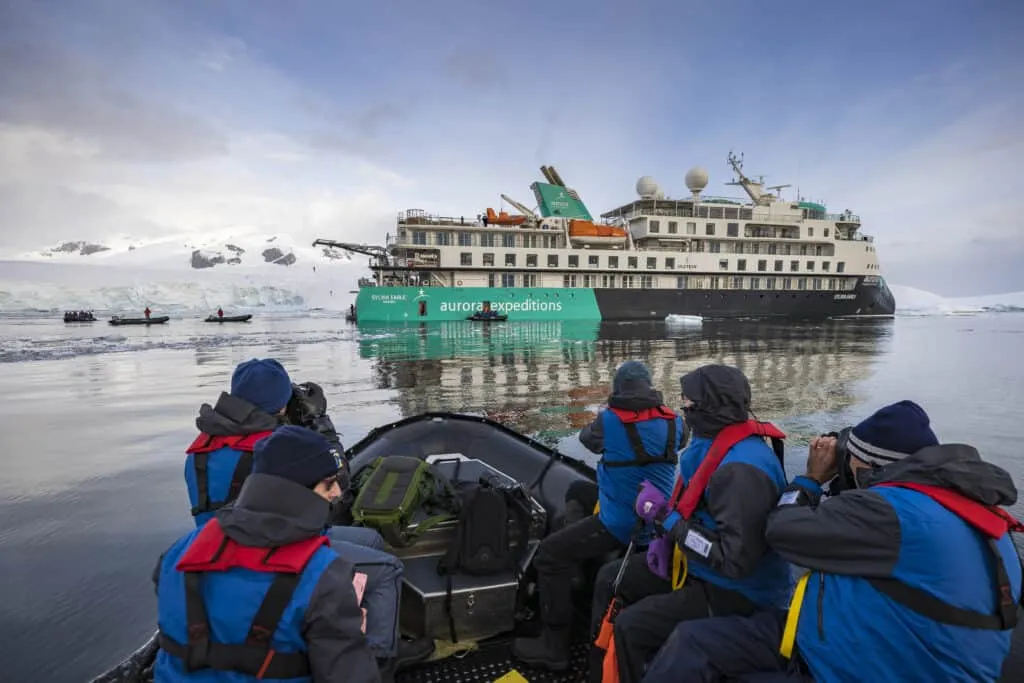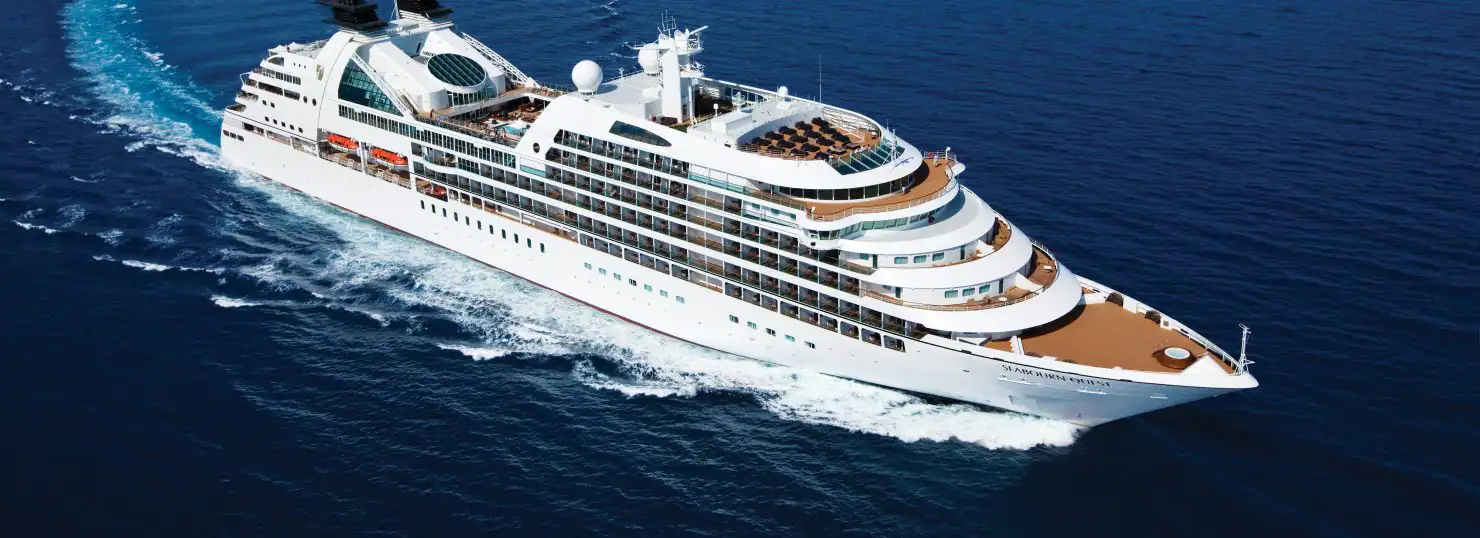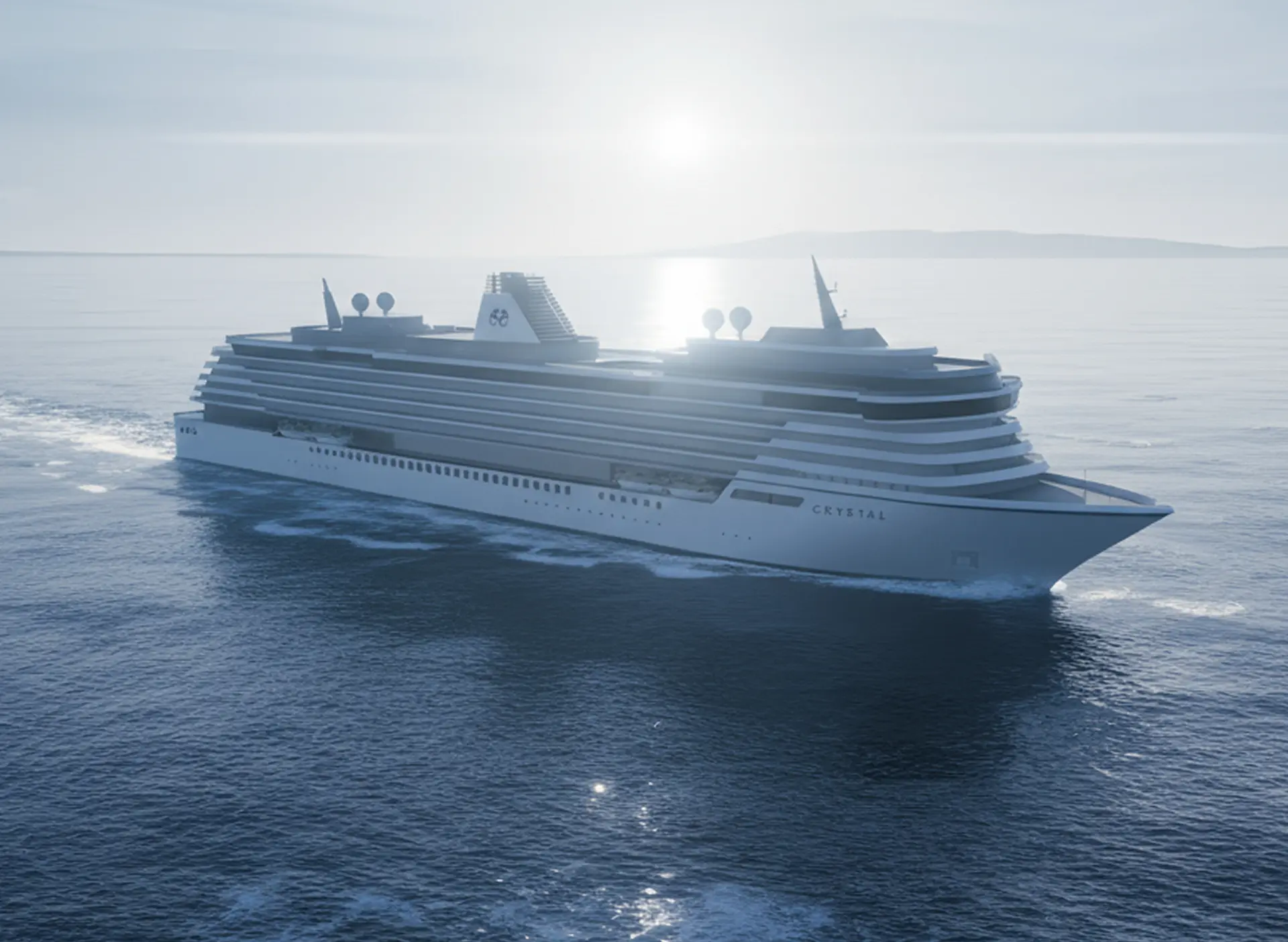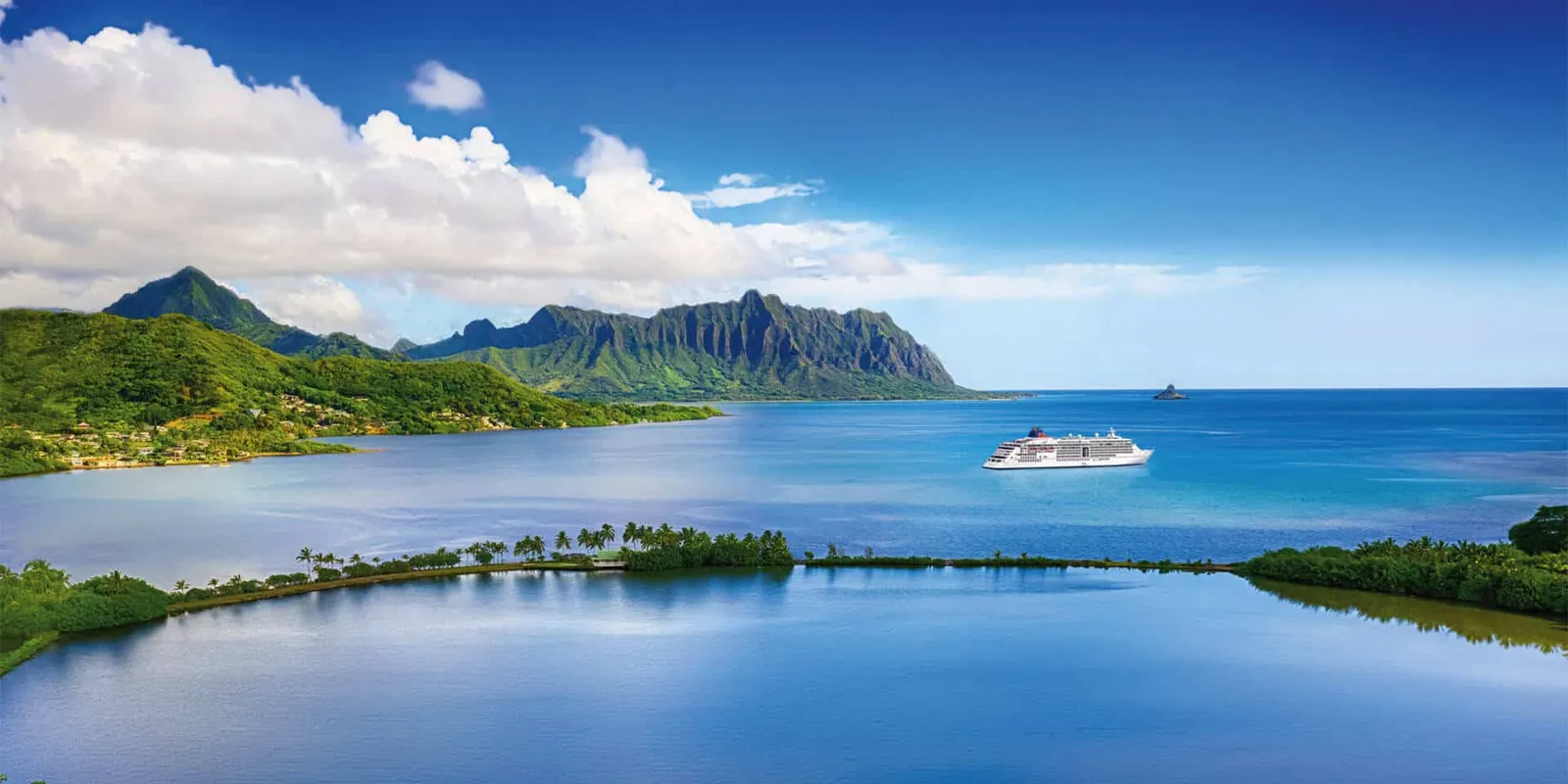
HX Expeditions and Seabourn sit at opposite ends of the expedition cruise spectrum — one built on Norwegian heritage and accessible pricing, the other on ultra-luxury service and Adam Tihany interiors. Jake Hower compares their ships, expedition teams, landing logistics, inclusions, and value for Australian travellers weighing adventure-first against luxury-first expedition cruising.
| HX Expeditions | Seabourn | |
|---|---|---|
| Category | Expedition | Expedition / Ultra-Luxury |
| Rating | ★★★★☆ | ★★★★★ |
| Fleet size | 10 ships | 5 ships |
| Ship size | Small (under 1,000) | Small (under 1,000) |
| Destinations | Norwegian Coast, Arctic, Antarctica, Greenland | Mediterranean, Caribbean, Antarctica, Northern Europe |
| Dress code | Relaxed | Casual elegance |
| Best for | Coastal and expedition nature lovers | Ultra-luxury intimate ship enthusiasts |
HX Expeditions is the accessible expedition line — five ships including the world's first hybrid battery-powered cruise vessels, the largest Antarctic programme by departure count, an all-inclusive fare from approximately AUD 1,100 per day, citizen science partnerships with the University of Tasmania, and a genuine Scandinavian expedition ethos. Seabourn counters with 264-passenger purpose-built luxury ships, all-suite all-veranda accommodation, Swarovski binoculars loaned to every cabin, complimentary premium spirits and fine wines, and the most refined onboard experience in expedition cruising. Choose HX when you want maximum Antarctic departures, hybrid propulsion, real science programmes, and the best value per expedition day. Choose Seabourn when you want ultra-luxury comfort, an all-suite ship, the Kimberley coast from Australian ports, and a service standard where staff know your name by dinner on day one.
The core difference
HX Expeditions and Seabourn represent the two poles of expedition cruising — one prioritises access, value, and science; the other prioritises luxury, service, and refinement. They share the same ice. They visit the same penguin colonies. But the experience of standing on Antarctic rock in an HX expedition jacket and the experience of standing on that same rock in a Helly Hansen PolarShield parka loaned by Seabourn are separated by several hundred dollars per day and fundamentally different philosophies about what an expedition should feel like when you return to the ship.
HX Expeditions traces its lineage to 1893 and Norway’s original coastal steamships. The first purpose-built expedition ship, MS Fram, launched in 2007, and the company introduced the world’s first hybrid battery-powered cruise vessels — MS Roald Amundsen in 2019 and MS Fridtjof Nansen in 2020. Following a protracted period of financial restructuring, HX separated from the Hurtigruten coastal brand in early 2025 and is now owned by a consortium led by Arini Capital Management, Cyrus Capital Partners, and Tresidor Investment Management. The company operates five expedition ships, runs approximately 50 Antarctic departures per season — the largest programme in the industry — and transitioned to an all-inclusive fare model in November 2024. HX is not a luxury line. It is an expedition line that happens to be comfortable, with a Scandinavian design ethos, genuine science credentials, and pricing that makes Antarctica accessible to a broader audience than any luxury operator can reach.
Seabourn was founded in 1986 as a yacht-like ultra-luxury cruise brand and has been a wholly owned subsidiary of Carnival Corporation since 2001. The expedition division launched with Seabourn Venture in 2022 and Seabourn Pursuit in 2023 — purpose-built 264-passenger ships designed by Adam Tihany to combine genuine expedition capability with the service standards that define the Seabourn ocean brand. Every cabin is a veranda suite. Every drink is complimentary — including premium spirits and fine wines. Gratuities are covered. Swarovski binoculars are loaned to every cabin. The expedition team is expert and professional. But the primary proposition is not adventure intensity — it is the experience of exploring remote coastlines from the most luxurious expedition platform afloat, then returning to marble-lined bathrooms, heated floors, and complimentary caviar. Persistent industry rumours about Carnival Corporation’s long-term commitment to the Seabourn brand — including fleet sales and the recent departure of the previous president to competitor Lindblad Expeditions — add a note of uncertainty, though back-to-back Best Expedition Cruise Line awards from Conde Nast Traveller in 2024 and 2025 suggest the product itself remains strong.
The choice between HX and Seabourn is not a close call on expedition versus luxury — it is one of the widest gaps in this comparison series. If you want the best value for expedition days in Antarctica, the most departure dates to choose from, hybrid propulsion, and genuine citizen science participation, HX is the line. If you want ultra-luxury accommodation, the finest dining programme in expedition cruising, a 1:11 guide ratio on a 264-passenger ship, and the Kimberley coast from Australian ports, Seabourn is the line. The price difference — roughly AUD 700 per person per day — reflects a genuinely different product, not just a different marketing position.
Expedition team and guides
The expedition team is the soul of any polar voyage, and both HX and Seabourn invest meaningfully in theirs — though the structural differences in team size relative to passenger count are significant.
Seabourn’s expedition team numbers approximately 23 specialists per ship, sailing with 264 guests. This yields a guide-to-guest ratio of approximately 1:11 — among the best in the luxury expedition segment and comfortably ahead of HX’s larger ships. The team includes ornithologists, marine biologists, historians, oceanographers, geologists, and photographers, many holding advanced degrees and decades of polar field experience. Notable leaders for the 2025-2026 Antarctic season include Luciano Bernacchi with over 15 years of polar experience, Brent Houston with 400-plus expeditions and specialist penguin knowledge, and Robert Egelstaff, a world-renowned expedition canoeist. Team members routinely dine with guests and mingle in the Expedition Lounge — the intimacy of 264 passengers enables meaningful personal connections with the experts. The team also leads fireside chats, daily briefings, and enrichment lectures that go well beyond scripted presentations.
HX’s expedition team comprises approximately 15 to 20 specialists on the hybrid ships (MS Roald Amundsen and MS Fridtjof Nansen), which carry up to 500 passengers on polar voyages. This produces an estimated guide-to-guest ratio of 1:25 to 1:30 — significantly lower than Seabourn’s 1:11. On MS Fram, which carries 200 passengers in polar waters, the ratio improves to roughly 1:13 to 1:15, approaching Seabourn’s figure. HX’s team includes marine biologists, glaciologists, ornithologists, social anthropologists, archaeologists, photographers, and cultural interpreters — a broad range of disciplines. The company operates an in-house polar guide training academy that won the Princess Royal Training Award in 2024, and Tudor Morgan, one of HX’s most experienced expedition leaders, previously served as IAATO Chair. A distinguishing feature is HX’s cultural interpreter programme — specialists like Niels Sanimuinaq Rasmussen, who leads Greenlandic Inuit cultural programming — reflecting HX’s strong Arctic and Indigenous heritage focus.
The practical difference is real. On a shore landing, Seabourn’s 1:11 ratio means smaller groups per guide, more individual attention during wildlife encounters, and more opportunity for one-on-one conversation with specialists. On HX’s hybrid ships, the 1:25 to 1:30 ratio means larger groups and less direct guide interaction per landing — though the quality of individual team members is not in question. HX’s training programme is rigorous, and reviews consistently praise the expedition team as a strength. The distinction is structural, not qualitative: Seabourn simply puts more guides against fewer guests. For travellers who choose HX and want a better ratio, MS Fram is the ship to target.
Ships and expedition hardware
The ships define the expedition experience, and these two fleets could hardly be more different in philosophy — one built for maximum reach and value, the other for maximum comfort and refinement.
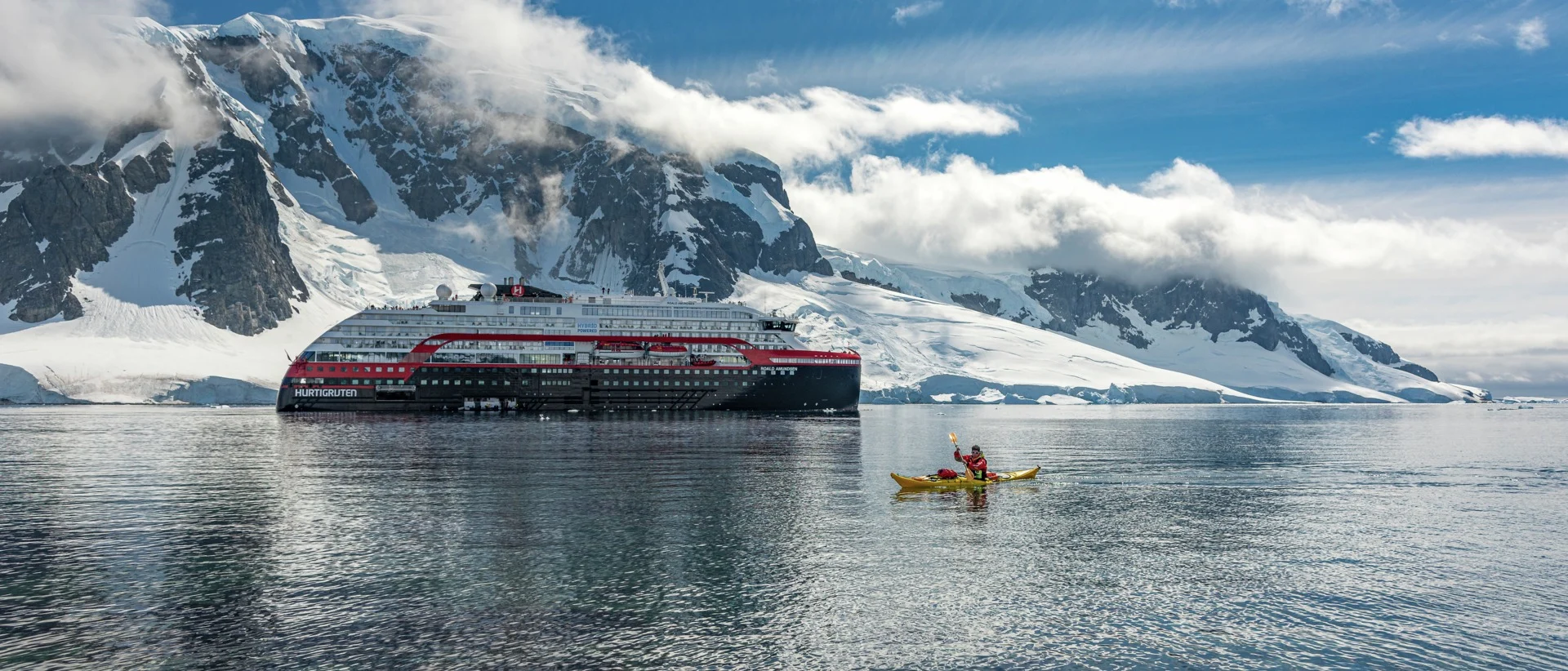
HX’s fleet of five ships spans a wide range. The two hybrid ships — MS Roald Amundsen and MS Fridtjof Nansen — are 20,889 GT vessels carrying up to 500 passengers on polar voyages, powered by a diesel-electric hybrid system with Rolls-Royce SAVe Cube technology and Corvus Energy lithium-ion battery packs capable of 30 to 60 minutes of pure battery operation. These were the world’s first hybrid battery-powered cruise ships, reducing CO2 emissions by approximately 20 per cent compared to conventional diesel. They hold PC6 ice class and carry 17 Explorer Boats (Zodiacs) each, deployed from a tender pit on Deck 3 — no crane required. MS Fram (11,647 GT, 200 polar passengers, ice class 1B) is HX’s most capable ice vessel and the preferred ship for experienced polar travellers. MS Spitsbergen (7,344 GT, 150 expedition passengers) serves technical Arctic itineraries. MV Santa Cruz II operates year-round in the Galapagos. Both MS Fram and MS Spitsbergen received EUR 7 million in refurbishments in 2025, including new Science Centres.
Seabourn’s two expedition ships — Venture and Pursuit — are identical 23,615 GT sisters built by T. Mariotti in Italy and launched in 2022 and 2023 respectively. They carry 264 passengers in 132 all-veranda suites. Both hold PC6 ice class, matching HX’s hybrid ships for ice capability. Propulsion comes from two ABB Azipod units providing 360-degree manoeuvrability with lower vibration than conventional shaft-driven systems. Each ship carries 24 large-capacity Zodiac RIBs — enough to carry all passengers simultaneously. The Zodiacs are stowed on the top deck rather than at water level, which slows deployment compared to HX’s tender-pit system but does not materially affect expedition scheduling.
The submarine programme — gone. Seabourn’s two custom-built submersibles per ship were a headline differentiator since before launch. Each carried six guests to depths of 300 metres for 40 to 45 minutes at US$900 to US$1,000 per dive. In February 2026, Seabourn confirmed the programme would end by early March 2026, citing low guest uptake, operational complexity, and evolving regulatory restrictions. No replacement has been announced. This removes a unique selling point that once separated Seabourn’s expedition hardware from every competitor except Scenic Eclipse.
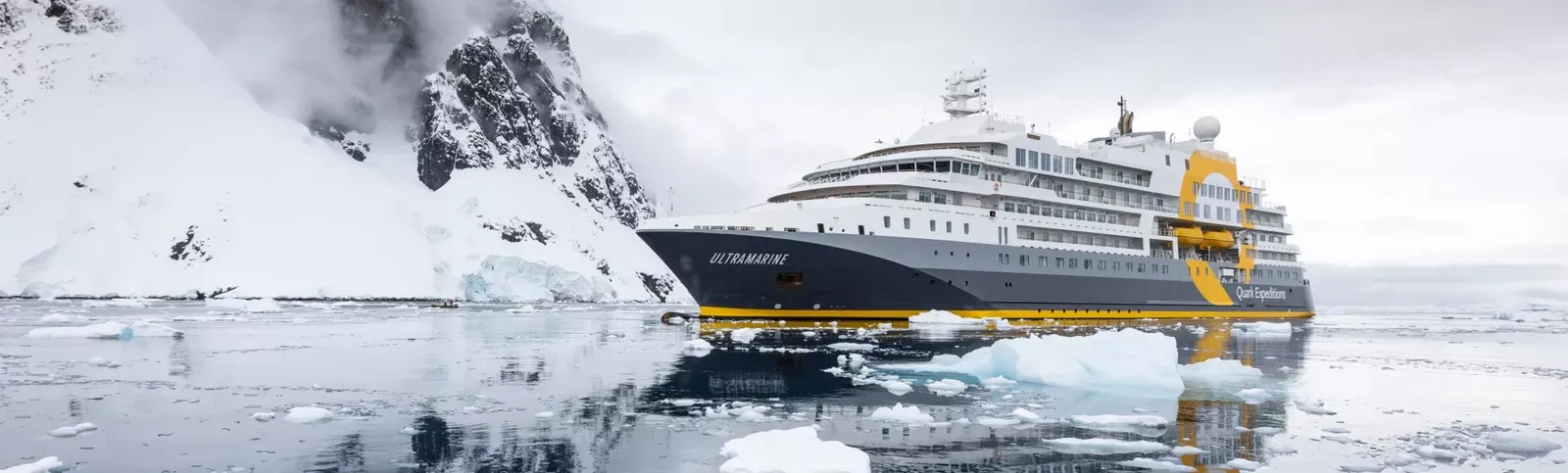
Neither line carries helicopters — unlike Quark’s Ultramarine (twin Airbus H145s) or Scenic Eclipse (twin helicopters plus submarine). Neither carries ROVs as guest-facing equipment. HX carries Blueye underwater drones for live video feeds to Science Centre screens — a modest but practical alternative. Both lines carry kayaks: HX offers inflatable Discovery Kayaks (EUR 129 per person) and hard-shell Sea Explorer Kayaks (EUR 199 per person) as paid add-ons. Seabourn carries eight double kayaks per ship at approximately US$199 to US$250 per session — also a paid add-on, and a common criticism on a luxury product where guests expect more to be included. HX additionally offers Antarctic camping in bivvy bags (EUR 350) or insulated tents (EUR 429), plus snowshoeing — activities Seabourn does not offer.
The hardware summary: HX offers more ships, more departure dates, hybrid propulsion, and a broader activity menu. Seabourn offers a more refined ship with superior manoeuvrability, Swarovski binoculars loaned to every cabin, a Cineflex bow camera live-streaming to suites, and a level of onboard fit-out that reflects a purpose-built luxury vessel rather than a purpose-built expedition vessel. Neither has the helicopter or submarine hardware that defines the most hardware-intensive expedition competitors.
Landing experience and shore programme
Both lines deliver the core expedition promise — Zodiac landings, expert-guided wildlife encounters, and daily shore excursions — but ship size creates fundamentally different landing logistics.
IAATO Category C2 constraints apply to both lines’ larger ships. Under IAATO regulations, vessels carrying 201 to 500 passengers may conduct landings, but only 100 guests may be ashore at any time. HX’s hybrid ships at 500 passengers require five rotation groups of approximately 100 — while one group is ashore, the others cycle through Zodiac cruising, onboard activities, and waiting. This extends the total landing window significantly and reduces individual time ashore per rotation. Seabourn’s ships at 264 passengers require three rotation groups — a materially faster cycle. The difference is not trivial: on a typical two-landing day, HX’s hybrid ship passengers may spend 30 to 60 minutes less ashore per landing than Seabourn passengers, and the queuing and scheduling feel more managed.
HX’s MS Fram at 200 passengers falls into the more desirable IAATO Category C1 (under 200 passengers), where all passengers can land in rapid Zodiac rotations without the 100-person cap creating bottlenecks. For HX travellers who prioritise shore time, MS Fram is the ship to choose — and its 2025 refurbishment makes it a genuinely competitive vessel.
Seabourn’s landing programme features early starts — landings can begin as early as 7:00 AM to maximise time for all rotation groups. Zodiac cruises run 90 to 120 minutes per excursion with naturalist drivers who double as wildlife interpreters. Activities included in the fare cover Zodiac cruises, nature walks, guided hikes, snorkelling in appropriate destinations, and the polar plunge. Paid add-ons include kayaking (approximately US$199 to US$250 per session) and the now-discontinued submarine dives. Seabourn does not offer camping, snowshoeing, or extensive adventure activities — the shore programme is observation and interpretation focused rather than adrenaline focused.
HX’s landing programme typically delivers two excursions per day — one water-based (Zodiac cruising, kayaking) and one land-based (hiking, wildlife observation, snowshoeing). Included activities cover all landings, Zodiac cruising, extended hikes, the polar plunge, and all lectures and Science Centre activities. Paid add-ons include sea kayaking, Antarctic camping, and snowshoeing. The broader activity menu — particularly camping and snowshoeing — gives HX an edge in adventure diversity, even if the landing rotation logistics on the hybrid ships are less efficient than Seabourn’s.
The practical landing comparison: Seabourn passengers on a 264-passenger ship will generally spend more time ashore per day than HX passengers on a 500-passenger hybrid ship. HX passengers on MS Fram will have a comparable or slightly better landing experience to Seabourn, given the smaller passenger count and C1 category status. For travellers who prioritise maximising time on Antarctic rock, Seabourn’s smaller passenger count is a structural advantage over HX’s hybrid ships — one that no amount of expedition team enthusiasm can fully overcome.
What is actually included
Both lines operate all-inclusive fare models, but the composition and calibre of those inclusions differ — and the differences reflect the price gap.
HX’s all-inclusive fare (from November 2024) covers full-board dining at Restaurant Aune and Fredheim, house wine, beer, spirits, and cocktails throughout the day, complimentary Starlink Wi-Fi, gratuities, all daily expedition landings and Zodiac cruising, an expedition jacket (wind and water-resistant, yours to keep), a reusable water bottle, rubber boot and trekking pole loans, a professional digital photo album from the onboard photographer, and full access to lectures, the Science Centre, and citizen science programmes. Not included: international flights, travel insurance, paid activities (kayaking from EUR 129, camping from EUR 350, snowshoeing), premium drinks, spa treatments, Restaurant Lindstrom surcharge for non-suite guests, and laundry. Antarctic voyages include charter flights between Buenos Aires and Ushuaia and one pre-cruise night at a five-star Buenos Aires hotel.
Seabourn’s all-inclusive fare covers all dining across every restaurant with no surcharges, premium spirits and fine wines at all bars at all times, welcome champagne and an in-suite bar stocked to personal preferences, complimentary caviar throughout the voyage, gratuities, Starlink Wi-Fi, all Zodiac excursions and guided shore activities, a Helly Hansen PolarShield two-in-one parka (gifted, yours to keep), a Helly Hansen WaterShield waterproof backpack (gifted), boot loans, Swarovski Optik binoculars on loan for the voyage, pre-cruise hotel stay in Buenos Aires for Antarctic voyages, charter flights Buenos Aires to Ushuaia, open bridge access, entertainment, live music, and Dr. Andrew Weil wellness classes. Not included: kayaking (approximately US$199 to US$250 per session), helicopter flights on Kimberley voyages, the Image Masters photography masterclass (US$1,500 to US$1,850), spa treatments beyond complimentary wellness classes, and laundry (complimentary for Gold-tier loyalty members).
Where the inclusions diverge: Seabourn’s drinks programme is a step above — premium spirits and fine wines versus HX’s house selection. Seabourn gifts a Helly Hansen parka and backpack versus HX’s expedition jacket. Seabourn loans Swarovski binoculars to every cabin — a thoughtful inclusion worth several hundred dollars in rental value. Seabourn’s dining has no surcharges at any venue; HX charges a supplement for non-suite guests at Restaurant Lindstrom. Seabourn includes complimentary caviar throughout the voyage — an ultra-luxury signature touch.
HX counters with a broader included activity programme — all expedition landings and Zodiac cruising are included on both lines, but HX’s expedition jacket and complimentary professional photo album are meaningful inclusions. HX also offers camping and snowshoeing as paid add-ons that Seabourn does not offer at all. And HX’s citizen science programme — genuinely participatory, running on every voyage — is an enrichment inclusion that Seabourn simply does not match.
The net picture: Seabourn includes more luxury. HX includes more adventure. Both cover the expedition essentials. The question is whether the difference in inclusions — premium versus house spirits, Swarovski binoculars versus standard observation, caviar versus none — justifies the approximately AUD 700 per day price gap. For some travellers, emphatically yes. For others, the HX fare buys the same Antarctic Peninsula at a fraction of the cost.
Destination coverage and itinerary depth
Both lines operate in polar waters and warm-water expedition regions, but the geographic scope and seasonal deployment differ in ways that matter for Australian travellers.
HX’s destination coverage is the broadest of any expedition line by departure count. Antarctica accounts for approximately 50 departures per season — the industry’s largest programme — with itineraries spanning 12-day Peninsula highlights, 17-day Antarctic Circle crossings, and 22 to 24-day South Georgia and Falklands combinations. Three of five fleet ships deploy south for the austral summer. Arctic coverage includes Svalbard (HX’s largest-ever Greenland programme for 2025-2026, with a fourth ship added), Greenland, Iceland, Arctic Canada, and Northwest Passage crossings. Alaska receives expedition-style sailings distinct from mainstream cruising. Year-round Galapagos operations run aboard the 90-passenger MV Santa Cruz II. West Africa — Cape Verde and the Bissagos Islands — makes HX the sole cruise line servicing this region. Atlantic repositioning voyages, South America coastal itineraries, and British Isles cruises round out the programme.
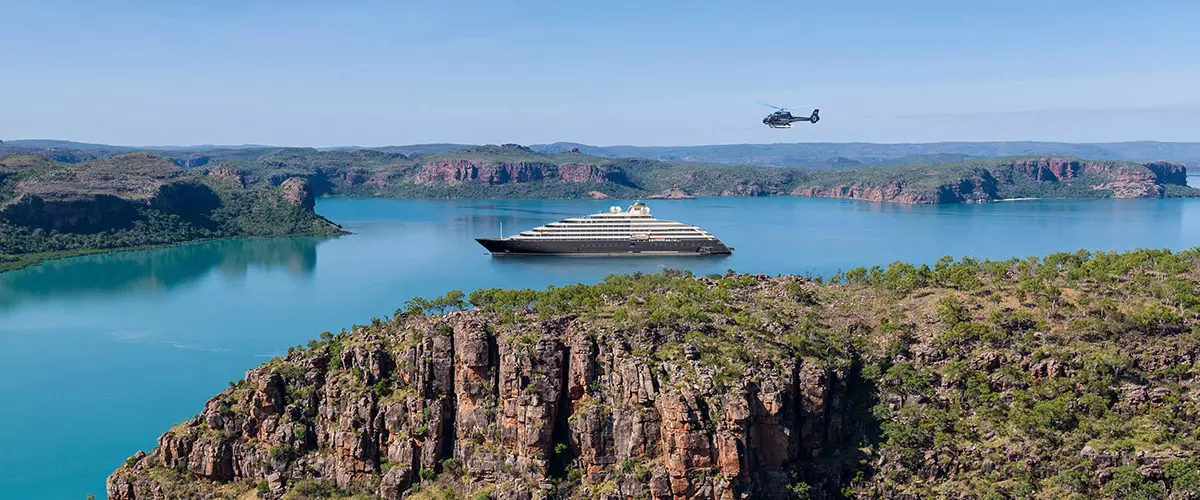
Seabourn’s expedition destinations are more focused. Antarctica receives both ships during the austral summer, with 16-plus departures for 2025-2026 and 19 planned for 2026-2027 — substantially fewer than HX but still a committed programme. Itineraries include 12-day Peninsula voyages, 14-day explorations, and 22-day combinations with South Georgia and the Falklands. The Kimberley coast is Seabourn’s standout Australian product — Seabourn Pursuit operates 10-day voyages between Broome and Darwin during the May to September dry season, with an expanded 8-departure season for 2026 and 4 confirmed for 2027. Arctic coverage includes Svalbard, Iceland, Greenland, and ambitious Northwest Passage crossings — 24 days between Greenland and Alaska, with complimentary economy airfare included on select 2026 sailings. The South Pacific features Easter Island, Raja Ampat, Vanuatu, and Samoa. An 82-day “Across Three Continents” voyage departing Broome in September 2026 combines Oceania and Antarctica in a single epic sailing.
The critical difference for Australian travellers: the Kimberley. Seabourn operates in Australian waters. HX does not. Seabourn Pursuit’s Kimberley season — departing from Broome and Darwin, accessible via domestic flights from any Australian capital city — is the most accessible expedition product for Australian travellers across either line. No international flights, no jet lag, no Drake Passage. Starting from AUD 17,799 per person for a 10-day voyage, the Kimberley represents Seabourn’s strongest Australian proposition. HX has no equivalent — no Australian port departures, no Kimberley operations, no Australian domestic deployment whatsoever. For Australian travellers who want expedition cruising without leaving the country, Seabourn is the only choice between these two lines.
Neither line offers a Fly-the-Drake option. Both lines sail the Drake Passage for all Antarctic voyages. HX includes charter flights between Buenos Aires and Ushuaia but requires the full two-day Drake crossing by sea. Seabourn likewise includes Buenos Aires to Ushuaia charter flights with the sea crossing. If skipping the Drake is a priority, neither line accommodates — consider Quark or Aurora, both of which offer charter flight alternatives.
Cabins and accommodation
The accommodation gap between HX and Seabourn is the single most visible expression of the price difference — and it is substantial.
Seabourn’s 132 suites are all-veranda, all ocean-front. Every cabin on Venture and Pursuit is technically a suite, designed by Adam Tihany with the luxury lodge aesthetic that defines the ships. The entry-level Veranda Suite (33 square metres including a 7-square-metre veranda) features a marble-lined bathroom with heated floors, a separate bathtub — genuinely appreciated after cold Antarctic landings — and an in-suite clothes dryer that is arguably the most practical luxury feature on any expedition ship. Walk-in closets, in-suite bars stocked to personal preferences, and queen or twin bed configurations are standard. The range ascends through Panorama Veranda Suites (39 square metres with a soaking tub beside floor-to-ceiling windows), Penthouse Suites (49 square metres with separate bedroom and Nespresso machine), to the extraordinary Grand Wintergarden Suite — a 130-square-metre two-storey apartment with a guest bedroom, two verandas, and a Swarovski spotting scope. Premium suites include Bang and Olufsen sound systems, LG OLED televisions, and butler service.
HX’s cabin range is broader and more accessible. On the hybrid ships (265 cabins each), all cabins are outside-facing — no inside cabins — and 50 per cent have private balconies. Polar Outside cabins start at 17 to 23 square metres with windows and a sitting area. Arctic Superior cabins range from 15 to 27 square metres with most featuring private balconies. Expedition Suites range from 19 to 48 square metres, with the top-tier Extra-Large Suite Forward offering sweeping views and a balcony. Interiors feature Scandinavian design with natural materials — granite, oak, birch, and wool. On MS Fram and MS Spitsbergen, inside cabins are available as the most economical option. MS Spitsbergen offers cabins as small as 9 square metres — purpose-built budget expedition accommodation.
The comparison at entry level: Seabourn’s entry Veranda Suite at 33 square metres with marble bathroom, heated floors, bathtub, clothes dryer, and veranda is a materially different product from HX’s Polar Outside cabin at 17 to 23 square metres with a window and standard amenities. The Seabourn suite would not be out of place in a boutique hotel. The HX cabin is a comfortable expedition berth. Both serve their purpose — you will spend most of your time on deck or ashore — but if the cabin experience matters to you, the gulf is wide.
The practical expedition features: Seabourn’s in-suite clothes dryer is an expedition game-changer — returning from a wet Zodiac landing and throwing damp layers into a dryer rather than draping them over every surface changes daily comfort significantly. The separate bathtub — after hours in cold Antarctic air — is a luxury that expedition travellers learn to value. HX’s cabins are well-designed for expedition use with good storage and Scandinavian aesthetics, but they lack these luxury-specific touches.
Solo travellers: Neither line offers dedicated solo cabins as a standard category. HX releases limited cabins with no single supplement on select near-term departures, with standard solo supplements starting from 25 per cent — competitive against the industry norm. Seabourn’s standard single supplement is 200 per cent of the double-occupancy fare — meaning a solo traveller pays the full cabin price — with reduced supplements of 125 per cent available on select voyages. For solo travellers, HX’s pricing structure is dramatically more favourable.
Pricing and value
The price gap between HX and Seabourn is one of the widest in expedition cruising, and it compounds over longer voyages.
HX’s directional pricing for a 12-day Highlights of Antarctica voyage starts from approximately AUD 13,355 per person for a Polar Outside cabin on MS Roald Amundsen, rising to approximately AUD 18,900 for an Expedition Suite. This works out to roughly AUD 1,100 to AUD 1,575 per person per day. A 17-day Antarctic Circle voyage starts from approximately AUD 17,000. Flight-inclusive packages from Buenos Aires (with charter to Ushuaia) start from around AUD 13,977 for 15 days. International flights from Australia are additional — typically AUD 2,000 to AUD 4,000 return to Buenos Aires.
Seabourn’s directional pricing for a 12-day Great White Continent voyage on Seabourn Venture starts from approximately AUD 21,504 per person for an entry-level Veranda Suite, rising to AUD 50,879 for a Wintergarden Suite. This works out to roughly AUD 1,792 to AUD 4,240 per person per day. A 22-day South Georgia and Falklands voyage starts from approximately AUD 47,999 per person. Charter flights and Buenos Aires hotel are included, as with HX.
The per diem comparison: At entry level, HX costs approximately AUD 1,100 per day; Seabourn costs approximately AUD 1,800 per day. The difference of roughly AUD 700 per day amounts to AUD 8,400 on a 12-day voyage and AUD 15,400 on a 22-day voyage. Over a couple travelling together on the 22-day itinerary, the gap exceeds AUD 30,000. This is not a marginal pricing difference — it represents a fundamentally different market segment.
What the price gap buys: Seabourn’s premium delivers a materially different product — all-suite accommodation with marble bathrooms and bathtubs, premium spirits rather than house drinks, a 1:11 guide ratio versus 1:25 to 1:30, 264 passengers versus 500, Swarovski binoculars, Helly Hansen parka and backpack, complimentary caviar, Adam Tihany interiors, and service where staff learn your name within 48 hours. Whether this is worth AUD 700 per day depends entirely on personal priorities.
The Kimberley value equation: Seabourn’s 10-day Kimberley voyage from AUD 17,799 per person represents a different calculation entirely — no international flights required, no Drake Passage, and a destination HX cannot reach. For Australian travellers comparing Seabourn’s Kimberley at AUD 1,780 per day against an HX Antarctic voyage at AUD 1,100 per day plus AUD 2,000 to AUD 4,000 in flights, the total cost gap narrows significantly once international airfare is factored in.
Solo supplement impact: HX’s solo supplements starting from 25 per cent (with periodic no-supplement offers) versus Seabourn’s standard 200 per cent supplement represent an enormous difference for solo travellers. A solo traveller paying full double-occupancy rate on Seabourn for a 12-day voyage faces an additional AUD 21,500 or more in supplement charges. HX’s 25 per cent supplement on the same duration adds approximately AUD 3,340. For solo travellers, HX is dramatically more accessible.
Booking patterns: HX runs wave sale promotions from December to March with savings of up to USD 4,000 per person, plus Black Friday sales of up to 40 per cent off select sailings. Shoulder season departures (November and March) offer the best value. Seabourn periodically offers reduced solo supplements and select voyage promotions, but the frequency and depth of discounting are less aggressive than HX’s — consistent with ultra-luxury positioning where deep discounts risk brand perception.
Onboard enrichment and science
The enrichment programmes reflect each line’s core identity — HX leads with participatory science, Seabourn leads with expert interpretation and curated learning.
HX’s citizen science programme is among the most substantive in expedition cruising. Every voyage runs at least one programme from a portfolio that includes eBird and iNaturalist (wildlife sighting logs), HappyWhale (whale fluke photography for migration tracking), FjordPhyto (phytoplankton sample collection to study glacier impacts), the Secchi Disk Programme (water clarity measurement for ocean health monitoring), and support for NASA and NOAA research. The partnership with the University of Tasmania’s Institute for Marine and Antarctic Studies (IMAS) provides institutional backing that moves beyond tokenism. For the 2025-2026 Antarctic season, HX has donated over 1,100 cabins to science, supports 20-plus projects, and targets 16,000-plus data submissions. Dedicated Science Centres on all ships — new or upgraded on MS Fram and MS Spitsbergen in 2025 — feature microscopes, touch screens, digital technology, and Blueye underwater drones for live underwater footage. Daily lectures from expedition team members cover wildlife, culture, history, geology, and glaciology, with multilingual interpretation available on many voyages. The enrichment programme is genuinely participatory — guests are not observers of science but active contributors.
Seabourn’s enrichment programme centres on expert interpretation rather than guest participation. The 23-person expedition team delivers lectures, fireside chats, and daily briefings that are described as passionate and deeply knowledgeable — ornithologists, marine biologists, geologists, and historians who mingle with guests and deliver informal learning alongside formal presentations. The Seabourn Conversations programme brings visiting speakers aboard. Seabourn does not operate a structured citizen science programme — a notable gap compared to HX and several other expedition competitors including Lindblad/National Geographic, Quark, and Aurora. The Image Masters photography programme (US$1,500 to US$1,850 for a 4-day course limited to 10 participants) is a premium add-on with dedicated Photo Zodiac cruises and individual mentoring in a purpose-built studio with iMac desktops and professional editing software — a genuine offering, but at significant additional cost on an already premium voyage. Guests not enrolled in Image Masters receive no structured photography instruction, whereas HX includes a professional photographer and complimentary digital photo album on every expedition.
The Dr. Andrew Weil wellness programme on Seabourn adds a dimension HX does not attempt — mindful living classes, meditation, yoga, and wellness-inspired menu options led by a certified coach. For guests who value wellness as part of their expedition experience, this is a genuine differentiator. HX’s enrichment is science-forward; Seabourn’s blends expert naturalism with wellness and curated cultural programming.
The comparison: If you want to contribute to scientific research — to come home knowing your whale photographs are in a global migration database and your phytoplankton samples are advancing climate research — HX’s citizen science programme is unmatched between these two lines. If you want to listen to world-class experts interpret the landscape with the depth and intimacy that a 1:11 guide ratio enables, while returning to wellness classes and a premium cocktail, Seabourn’s enrichment programme delivers refinement that HX’s does not attempt.
Dining on expedition
Dining is where the luxury gap between these two lines becomes most tangible — and for many travellers, it is the difference they feel three times a day.
Seabourn’s dining programme on the expedition ships is the finest in the expedition segment. The Restaurant — designed by Adam Tihany with a snowflake-geometry inspiration — serves fine-dining breakfast, lunch, and dinner with open seating and no reservations required. The Colonnade offers buffet breakfast and lunch, then converts to Earth and Ocean for dinner — waiter-served bistro cuisine with rotating themed nights spanning Singaporean, Indian, French, and American cuisine. The Club serves sushi, sashimi, and cocktails. Seabourn Square provides specialty coffees, pastries, artisan gelato, and gourmet sandwiches throughout the day. The Bow Lounge offers grab-and-go options between expedition activities. Full in-suite dining is available 24 hours a day. Critically, every venue is complimentary — no surcharges for any restaurant. Complimentary fine wines are poured at lunch and dinner. Complimentary caviar is available throughout the voyage. The signature souffles and breadsticks continue from the ocean fleet. Dietary requirements are accommodated individually by chefs. The cuisine is not celebrity-chef driven — the Thomas Keller partnership ended in 2024, and the expedition ships were never part of that programme — but the standard is consistently described as equivalent to fine-dining restaurants ashore.
HX’s dining programme is competent expedition fare with Scandinavian character. Restaurant Aune (the main venue) serves buffet breakfast and lunch with plated dinner service — menus are Scandinavian-influenced with global fusion, changing daily and reflecting the voyage region. Fredheim offers casual dining and quick bites. Restaurant Lindstrom provides fine dining with sustainably sourced ingredients and premium wine pairings — included for suite guests, surcharge for non-suite passengers. The Brygge Bistro on MS Spitsbergen (added in the 2025 refurbishment) provides daytime snack options. Food quality is consistently rated as “very good” for an expedition line, particularly praising the fresh seafood and Nordic influences. However, the buffet format at breakfast and lunch is the most common criticism from travellers comparing HX to luxury competitors. No celebrity chef partnerships. No formal nights — the dress code is relaxed even in Lindstrom. The Norway’s Coastal Kitchen programme emphasises local sourcing.
The gap in practice: Seabourn offers five dining options with no surcharges, plus 24-hour in-suite dining. HX offers three dining options with a surcharge on the fine-dining venue for non-suite guests. Seabourn’s drinks programme covers premium spirits and fine wines; HX covers house selections. Seabourn serves complimentary caviar; HX does not. Seabourn’s cuisine is luxury-hotel calibre; HX’s is good expedition fare. Three times a day, this difference shapes the voyage experience — and for travellers who consider dining a central part of the travel experience, Seabourn’s superiority is clear. For travellers who view the dining room as fuel between landings, HX’s programme is more than adequate, and the savings fund another expedition.
Standout itineraries for Australian travellers
HX Expeditions
Highlights of Antarctica (12 days, Ushuaia round trip, multiple departures November to March) — HX’s signature Antarctic voyage and the most accessible way to reach the Peninsula from Australia. Two excursions per day, hybrid propulsion, all-inclusive fare with drinks and Wi-Fi. Fly Sydney or Melbourne to Buenos Aires via Santiago (approximately 14 to 16 hours), then HX charter to Ushuaia. Pre-cruise night at five-star Buenos Aires hotel included. From approximately AUD 13,355 per person. With 50 departures per season, date flexibility is unmatched by any competitor.
Antarctic Circle (17 days, various ships) — For the traveller who wants to cross latitude 66 degrees 33 minutes south. A longer, more adventurous voyage that passes through the Lemaire Channel and visits more remote landing sites. From approximately AUD 17,000 per person. The 17-day duration and remote routing make this a genuine expedition rather than a highlights tour.
Svalbard — Return of the Sun (spring season, MS Spitsbergen) — HX’s intimate 150-passenger ship explores western Svalbard as it emerges from polar winter. Polar bears, Arctic terns, walruses, and pristine ice landscapes. A specialist itinerary that showcases HX’s deep Arctic heritage and AECO founding membership. Routing from Australia via London or Oslo to Longyearbyen.
Galapagos Islands (4 to 8 nights, MV Santa Cruz II, year-round) — The 90-passenger ship is purpose-built for Galapagos National Park operations. Northern, Western, or back-to-back itineraries. A warm-water expedition that demonstrates HX’s range beyond polar specialisation. Routing from Australia via the United States to Guayaquil or Quito.
Seabourn
Kimberley: Broome to Darwin (10 days, Seabourn Pursuit, May to September) — The expedition voyage that requires no international flights and no Drake Passage. Domestic flights from any Australian capital to Broome. King George Falls, Montgomery Reef, Horizontal Falls, Vansittart Bay, Hunter River, and Indigenous cultural experiences with the Wunambal Gaambera people, who serve as godparents of Seabourn Pursuit. Optional helicopter to Mitchell Falls. From AUD 17,799 per person. Eight departures in 2026. For Australian travellers, this is the most accessible ultra-luxury expedition available.
The Great White Continent (12 days, Seabourn Venture, Ushuaia round trip) — Seabourn’s core Antarctic Peninsula voyage. All-suite accommodation, Swarovski binoculars, premium spirits, fine dining, and 264-passenger intimacy. From approximately AUD 21,504 per person. Charter flights and Buenos Aires hotel included. The most luxurious way to experience the Antarctic Peninsula.
Antarctica, South Georgia and Falklands (22 days, Seabourn Venture) — The comprehensive Southern Ocean expedition combining the Peninsula’s ice and penguins, South Georgia’s king penguin mega-colonies and Shackleton’s grave, and the Falklands’ British character. From approximately AUD 47,999 per person. A voyage of this calibre and duration on Seabourn is a once-in-a-lifetime ultra-luxury expedition.
Across Three Continents (82 days, departing Broome September 2026) — An extraordinary voyage combining the Kimberley, Oceania, South Pacific, and Antarctica in a single sailing. For the traveller with the time and the means, this is Seabourn’s most ambitious expedition — and it departs from an Australian port.
For Australian travellers specifically
Getting to the ship: For HX’s Antarctic voyages, Australian travellers fly to Buenos Aires (approximately 14 to 16 hours from Sydney or Melbourne via Santiago on Qantas/LATAM or via Auckland on LATAM), then take the HX charter flight to Ushuaia — included in the fare. Budget AUD 2,000 to AUD 4,000 for return international flights. For Seabourn’s Antarctic voyages, the routing is identical — same Buenos Aires gateway, same charter to Ushuaia. For Seabourn’s Kimberley voyages, the getting-there calculus transforms entirely: domestic flights from Sydney, Melbourne, Brisbane, or Perth to Broome or Darwin — accessible, affordable, and without international complexity. This is Seabourn’s single biggest Australian advantage across both lines.
Australian office presence: HX established a dedicated Australian and New Zealand sales and marketing team in March 2025, with a Guest Excellence team based in Melbourne operating Monday to Friday, 8 am to 6 pm AEST. The Australian website (travelhx.com/en-au/) displays prices in AUD. Approximately 70 per cent of HX’s Asia-Pacific bookings flow through travel advisors. Seabourn operates through Carnival Australia at 15 Mount Street, North Sydney, with a dedicated team of Australian sales and reservations specialists available Monday to Friday 8:30 am to 7:00 pm AEST and Saturday 9:00 am to 5:00 pm AEST — longer hours than HX and with Saturday availability. Both lines have genuine Australian support, though Seabourn’s longer-established Carnival Australia presence offers a slight edge in local infrastructure.
Currency and payment: HX’s Australian website prices in AUD, but onboard accounts settle in EUR — credit card foreign transaction fees may apply. Seabourn prices through Australian agents in AUD, with onboard settling in USD. Both require awareness of foreign currency charges. Neither offers a fully AUD-denominated end-to-end experience, though both are bookable through Australian travel agencies including Flight Centre, Clean Cruising, and specialist expedition advisors.
Travel insurance: Both lines require mandatory travel insurance. Standard Australian travel policies often exclude expedition cruise activities. Specialist expedition insurance with minimum AUD 500,000 medical coverage and AUD 250,000 evacuation coverage is strongly recommended — adequate medical facilities can be 72-plus hours away from any Antarctic position. Both Buenos Aires and Ushuaia have limited hospital infrastructure relative to Australian standards; the Kimberley coast even more so. The insurance must cover helicopter evacuation from remote locations.
Loyalty programmes: HX Explorers is a four-tier programme (Bronze through Platinum) offering a 5 per cent discount on expedition cruises from Bronze, with complimentary spa treatment at Gold and room upgrades at Platinum. Points are earned at 10 per cruise night and are valid for seven years. The Seabourn Club is a six-tier programme (Member through Diamond Elite) with 1 point per day sailed, offering benefits including complimentary laundry at Gold, dedicated concierge at Platinum, and $100 spa credit at Diamond. Award cruises can be redeemed on expedition sailings. Seabourn’s programme is deeper and more established; HX’s is more accessible at entry level.
The onboard atmosphere
The atmosphere aboard these two lines reflects their fundamental positioning — and the contrast is as stark as anything in expedition cruising.
HX’s atmosphere is Scandinavian expedition — functional, egalitarian, and focused outward. On the hybrid ships with up to 500 passengers, the social dynamics are those of a mid-sized expedition community rather than an intimate club. Passengers wear expedition gear to dinner. The dress code is relaxed throughout — no formal nights, no pretension, no social hierarchy. The expedition team mingles with passengers at meals and in the Science Centre. Evenings centre on lectures, daily briefing recaps, and conversation at the Explorer Bar — multiple reviewers note that entertainment beyond lectures and drinks can feel limited, particularly on sea-day-heavy itineraries. The passenger demographic skews 40-plus, internationally diverse with significant German-speaking representation, and united by expedition curiosity rather than luxury expectations. On MS Fram and MS Spitsbergen, the smaller passenger counts (200 and 150 respectively) create noticeably more intimate atmospheres approaching the warmth of small-ship expedition cruising. The typical HX passenger is the traveller who chose Antarctica for the penguins and the ice, not for the thread count.
Seabourn’s atmosphere is ultra-luxury expedition — refined, intimate, and designed around personal recognition. With 264 passengers and approximately 143 crew (ship crew plus expedition team), the crew-to-guest ratio of approximately 1:1.8 enables a level of personalised service where staff know guests by name within 48 hours. The Adam Tihany-designed interiors create a “luxe lodge” aesthetic — faux fireplaces, fur pillows, green velveteen banquettes — that reads as a sophisticated mountain lodge transplanted to the ocean. The dress code is elegant casual after 6 pm — slacks with a collared shirt, jacket optional — though elegant jeans are now welcome in all dining venues and formal nights were eliminated in January 2023. The Expedition Lounge serves as the social hub — guests share photographs, stories, and cocktails in an atmosphere described as a “private club” where elegance feels natural rather than forced. Evening entertainment is subdued — live music in The Club, enrichment lectures, and stargazing — reflecting the expedition context. The typical Seabourn expedition passenger is the experienced luxury cruiser who wants Antarctica or the Kimberley without compromising on the service standards they expect.
The difference in feel: HX feels like a well-organised expedition that happens to have comfortable cabins. Seabourn feels like a luxury hotel that happens to visit Antarctica. Both create genuine expedition community — the shared awe of Antarctic landscapes, the 5 am wildlife announcement, the collective excitement at a whale sighting — but the daily texture of the experience differs. On HX, the focus is relentlessly outward — the ice, the science, the next landing. On Seabourn, the focus balances outward exploration with inward comfort — the landing is extraordinary, and so is the return to a marble bathroom and a properly made cocktail. Neither approach is superior. They serve different travellers with different definitions of what makes an expedition memorable.
The bottom line
HX Expeditions and Seabourn occupy different worlds within expedition cruising, and the choice between them is less a comparison and more a reflection of personal priorities and budget.
Choose HX Expeditions when you want the most Antarctic departure dates of any expedition line, hybrid battery-powered ships that represent a genuine environmental commitment, a participatory citizen science programme backed by the University of Tasmania, an all-inclusive fare from approximately AUD 1,100 per day that makes Antarctica accessible without a luxury premium, and the Scandinavian expedition ethos of substance over spectacle. Choose HX when the expedition itself — the landings, the science, the wildlife — is the point, and the ship is the platform that enables it. Choose MS Fram when you want HX’s expedition credentials in a more intimate 200-passenger package with faster landing rotations and a guide ratio closer to Seabourn’s. Accept the trade-offs: 500 passengers on the hybrid ships creating slower landing rotations, a guide-to-guest ratio of 1:25 to 1:30 on the larger vessels, buffet breakfast and lunch rather than fine dining, house spirits rather than premium, and no Australian domestic deployment.
Choose Seabourn when ultra-luxury is not a nice-to-have but a requirement — when all-suite all-veranda accommodation with marble bathrooms, heated floors, and in-suite clothes dryers define the standard. Choose Seabourn when dining across five complimentary venues with premium wines and caviar matters three times a day. Choose Seabourn when a 23-person expedition team serving 264 guests creates the guide ratio and personal attention you expect. Choose Seabourn when the Kimberley coast between Broome and Darwin — accessible by domestic flights, no Drake Passage, no international routing — is the expedition that fits your travel plan. Accept the trade-offs: approximately AUD 1,800 per day entry-level pricing, solo supplements at 200 per cent of double occupancy, kayaking charged as an extra on a luxury product, no citizen science programme, and the background uncertainty of Carnival Corporation’s long-term strategic commitment to the brand.
For the Australian traveller weighing both lines, a compelling path exists: an HX Antarctic Peninsula voyage for the value, the science, and the sheer number of departure dates to fit your schedule — followed by a Seabourn Kimberley voyage for the luxury, the Indigenous cultural connection, and the domestic convenience. Together, they represent two fundamentally different expressions of expedition cruising, and experiencing both is the privilege of living in a country where the polar ice and the Kimberley coast are both within reach.