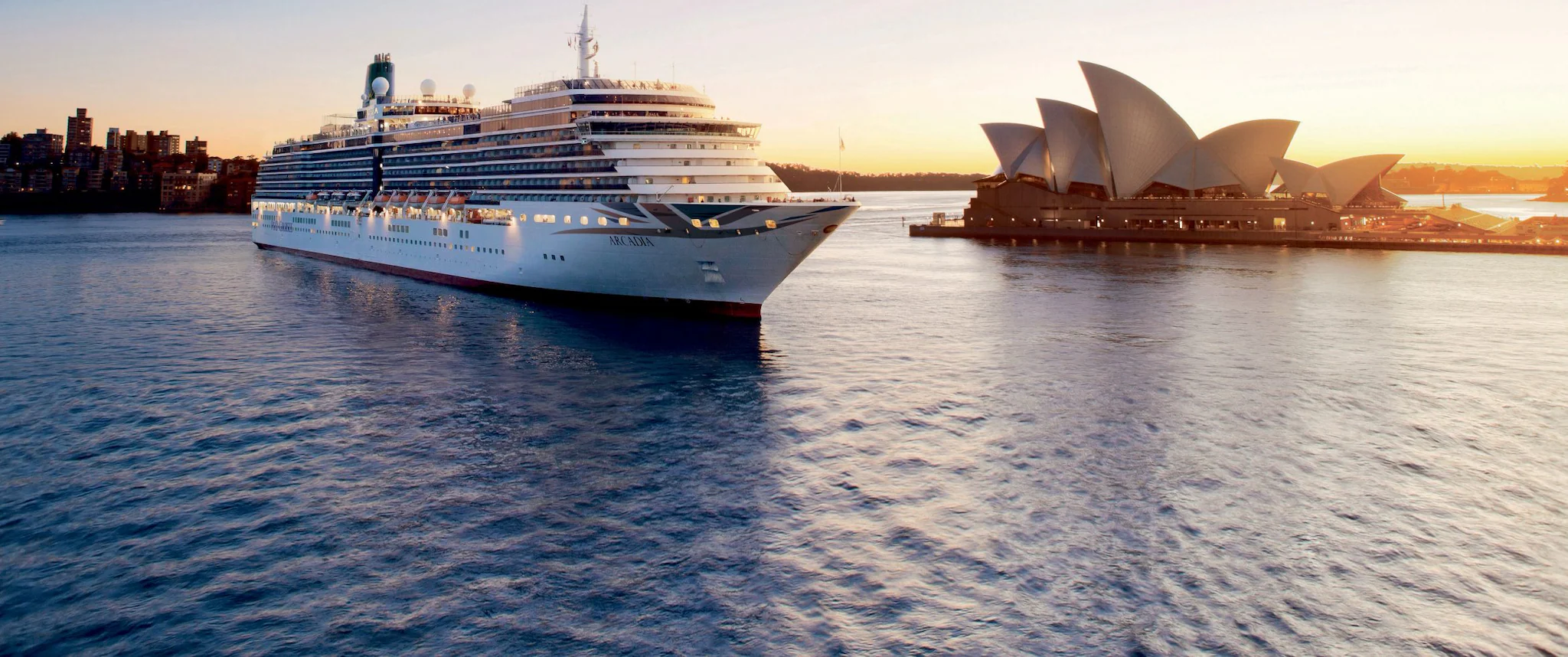
P&O Cruises and Saga Ocean Cruises are both proudly British cruise lines sailing from UK ports with British food, British entertainment, and a British passenger base — but the similarities mask fundamental differences in scale, inclusion, demographics, and ambition. Jake Hower compares the two most distinctly British cruise options for Australian travellers.
| P&O Cruises | Saga Ocean Cruises | |
|---|---|---|
| Category | Premium | Premium |
| Rating | ★★★★☆ | ★★★★☆ |
| Fleet size | 7 ships | 2 ships |
| Ship size | Large (2,500-4,000) | Small (under 1,000) |
| Destinations | Caribbean, Mediterranean, Norwegian Fjords, Canary Islands | Mediterranean, Norwegian Fjords, Caribbean, Canary Islands |
| Dress code | Smart casual | Smart casual |
| Best for | British holiday-makers and families | Over-50s British cruise travellers |
P&O Cruises and Saga Ocean Cruises are the two most authentically British cruise lines afloat, but they serve different segments of the British market and have very different value propositions. Saga is the better choice for travellers aged 50 and over who want a genuinely all-inclusive boutique experience — every drink, every meal, every excursion, and a chauffeur from your front door included in one price. P&O is the better choice for British cruise travellers of all ages who want modern mega-ship design, celebrity chef dining, the SkyDome, and a lively social atmosphere with more itinerary options and fleet variety. For Australian travellers, neither line has a meaningful local presence. P&O's world cruise sectors occasionally call at Australian ports, while Saga has no Australian deployment. Both lines require flying to the United Kingdom. The choice comes down to atmosphere and inclusion model: Saga's intimate all-inclusive boutique versus P&O's broader, entertainment-forward mainstream.
The core difference
P&O Cruises and Saga Ocean Cruises are the two most authentically British cruise lines operating today. Both sail from UK ports. Both serve afternoon tea as a daily institution. Both attract a predominantly British passenger base. Both understand the British cruiser’s expectations — from a proper roast dinner to a well-run quiz night. But beneath this shared national character lie fundamental differences in scale, pricing philosophy, demographic, and the overall proposition.
P&O Cruises traces its passenger heritage to 1837 and claims to be the oldest cruise brand in the world. Headquartered at Carnival House in Southampton and owned by Carnival Corporation, P&O commands approximately 26 per cent of the UK cruise market. The fleet of seven ships ranges from the 1,874-guest Aurora to the 5,200-guest LNG-powered Excel-class mega-ships Iona and Arvia. Five ships welcome families; two — Arcadia and Aurora — have historically been adults-only, though selected sailings will open to families from December 2026. The onboard identity is headlined by celebrity chef partnerships with Marco Pierre White, Atul Kochhar, and Olly Smith, the SkyDome retractable-roof entertainment venue on Iona and Arvia, and Gary Barlow’s 710 Club music venue.
Saga Ocean Cruises operates two purpose-built ships — Spirit of Discovery (2019) and Spirit of Adventure (2021) — exclusively for British travellers aged 50 and over. At 58,250 gross tonnes carrying approximately 1,000 guests each, these are intimate boutique vessels. Every cabin has a private balcony. Roughly 20 per cent of accommodation is dedicated to solo travellers at no single supplement. Saga is part of the Saga Group, which has served the British over-50s across travel, insurance, and financial services since 1951. The all-inclusive package from 2026 covers all dining, house drinks, Wi-Fi, gratuities, shore excursions at every port, and the signature chauffeur service from your front door.
The most direct comparison within P&O’s fleet is Arcadia and Aurora against Saga’s two ships. These adults-only P&O vessels carry 1,874-2,094 guests, attract a similar demographic, and sail similar itineraries including world cruises. But even here, the gap in inclusions is significant — Saga covers excursions, drinks, dining, and transfers that P&O charges for separately.
What is actually included
The inclusions comparison reveals the sharpest philosophical difference between these two British lines.
Saga includes in every fare from 2026: all dining venues without surcharges; house wines, beers, and spirits; 24-hour room service; Wi-Fi; gratuities; a shore excursion at every port; and chauffeur service from home to the departure port and back. The chauffeur covers journeys of up to 250 miles each way. This is one of the most comprehensive all-inclusive packages in the premium segment — and the chauffeur service is genuinely unique in the industry.
Saga does not include: premium wines and champagnes beyond the house selection; spa treatments; premium excursion upgrades; and flights for non-UK-based travellers.
P&O includes in the base fare: full-board dining in main restaurants and buffet; afternoon tea; continental room service at breakfast; entertainment including theatre shows and live music; children’s clubs on family ships; self-service laundry; port taxes; and — crucially — gratuities. P&O incorporated service charges into the ticket price in 2019, which is a genuine advantage shared with Saga but not offered by many competing lines.
P&O does not include: alcoholic and soft drinks; speciality dining (GBP 15-35 per person); Wi-Fi; spa thermal suite access (GBP 39 per day); The Retreat outdoor wellness area (GBP 40 per day); shore excursions; and premium room service items.
P&O launched its first all-inclusive packages in December 2025 for sailings from March 2026. The Classic Package at GBP 49 per person per day bundles a drinks selection, basic Wi-Fi, and a speciality dining credit. The Deluxe Package at GBP 59 per person per day upgrades drinks and adds streaming Wi-Fi and a larger dining credit. These are welcome additions but remain opt-in extras — not standard inclusions — and they still exclude shore excursions and transfers.
The gap is meaningful in practice. On a 14-night sailing, a couple on Saga pays the headline fare and boards with everything covered. A couple on P&O pays the base fare, adds approximately GBP 1,400-$1,650 for the Deluxe all-inclusive package (per couple), plus shore excursions at approximately GBP 40-80 per person per port. Saga’s headline fare is higher, but the total holiday cost comparison is closer than it first appears — and Saga’s chauffeur service saves hundreds of pounds in transfers that P&O guests must arrange independently.
Dining and culinary experience
Both lines take food seriously as a core part of the British cruise experience, but the approach, scale, and pricing differ substantially.
P&O’s culinary identity revolves around celebrity chef partnerships. Marco Pierre White has a 20-plus-year association with the line, designing main dining room menus fleet-wide and creating the Ocean Grill restaurant. Atul Kochhar, the Michelin-starred chef, created Sindhu Indian-British fusion restaurants across the fleet and the East pan-Asian concept on Iona and Arvia. Olly Smith curates The Glass House wine bars. Jose Pizarro brings Spanish cuisine to the Excel-class ships. The Food Hero programme features live chef appearances with Cookery Club masterclasses, Q&A sessions, and curated dinners. On Iona and Arvia, over 30 dining and bar venues include The Quays Food Hall, The Keel and Cow steakhouse, and The Olive Grove Mediterranean — with speciality surcharges ranging from GBP 15 to GBP 35 per person.
Saga’s dining is entirely included and surprisingly ambitious. Spirit of Adventure features Khukuri House — the world’s first Nepalese restaurant at sea — alongside Amalfi Italian and the Supper Club live entertainment dining. Spirit of Discovery offers La Vie en Rose at The Club with Phil Vickery menus, East to West fusion, and Coast to Coast seafood. Both ships have main dining rooms with open seating, buffet venues, 24-hour room service, and afternoon tea. Every restaurant, every evening, is included without surcharges or reservation charges.
The quality comparison is nuanced. P&O’s included main dining room food is variable — some passengers praise it, others describe it as average. The celebrity chef speciality venues are consistently stronger, but they carry surcharges. Saga’s food is described as reliably good across all venues — well-prepared British and international cuisine with quality ingredients, served in intimate settings where the chef’s team can maintain consistency across just two ships. P&O wins on variety and culinary celebrity; Saga wins on value and the certainty that every meal is included. For food-motivated travellers who want to dine at Marco Pierre White’s Ocean Grill and Kochhar’s Sindhu and are happy to pay the supplements, P&O. For travellers who want excellent dining without ever signing a bill, Saga.
Suites and accommodation
The accommodation comparison reflects the broader difference between modern mega-ships and intimate boutique vessels.
P&O’s cabin range spans seven ships and multiple generations. Inside cabins start from approximately 101 square feet on some ships, with sea view cabins from 210 square feet and balcony cabins from 142 square feet. Conservatory Mini Suites on Iona and Arvia feature bi-folding doors that open to the balcony at approximately 274 square feet. Standard Suites range from 382 to 698 square feet. Penthouse Suites reach up to 937 square feet. All suite guests receive butler service, priority embarkation, Epicurean breakfast, and complimentary room service from the main dining room menu. The Family Sea View Suites on Iona and Arvia accommodate up to four guests.
Saga’s cabin range is narrower but every cabin has a private balcony. Standard balcony cabins start at approximately 215 square feet plus balcony. Superior and deluxe categories offer larger spaces. Suites include separate living areas, walk-in wardrobes, and premium bathroom fittings. There is no butler service at any level. The standout is Saga’s solo cabin inventory: over 100 dedicated sole-occupancy rooms per ship — roughly 20 per cent of capacity — at no single supplement, including balcony categories.
P&O offers wider variety from budget interiors to butler-serviced suites. Saga offers consistency — every guest gets a balcony, every guest gets the full all-inclusive package. P&O’s butler service for suite guests is a genuine differentiator that Saga does not match. Saga’s solo cabin programme is a genuine differentiator that P&O cannot match. The comparison turns on what matters most to you: range and luxury at the top, or consistency and all-inclusive value throughout.
Pricing and value
Comparing headline fares between two British lines sailing similar itineraries from the same ports provides one of the more meaningful like-for-like comparisons on this site.
Saga’s directional pricing for a 7-night Norwegian Fjords cruise (standard balcony, per person): approximately GBP 200-$300 per night depending on season. This includes the balcony cabin, all dining, house drinks, Wi-Fi, gratuities, a shore excursion at every port, and chauffeur transfers.
P&O’s directional pricing for a 7-night Norwegian Fjords cruise (Iona, balcony cabin, per person): approximately GBP 130-$180 per night for the Early Saver fare including gratuities. Add the Deluxe all-inclusive package at GBP 59 per day. Add shore excursions at approximately GBP 40-60 per port. The total for a balcony cabin with comparable inclusions reaches approximately GBP 230-$300 per night.
The convergence is real. When you add P&O’s drinks package, Wi-Fi, speciality dining, and excursions, the total cost for a comparable experience approaches Saga’s headline fare. The key differences are: Saga’s fare covers everything including the chauffeur, while P&O’s requires arithmetic and choices. P&O retains a clear advantage at the entry level — an inside cabin at GBP 107 per night has no Saga equivalent. And P&O’s mega-ships provide more facilities, more dining variety, and more entertainment for the money.
For solo travellers, Saga’s value equation is particularly strong. A solo traveller in a dedicated Saga cabin at no supplement versus a P&O cabin at a 25-50 per cent single supplement can save hundreds of pounds — a difference that compounds on longer voyages.
Both lines price in GBP. For Australian travellers, the exchange rate applies equally, and neither offers AUD pricing as standard.
Spa and wellness
Both lines offer spa facilities at additional cost, with P&O’s newer ships providing more extensive wellness infrastructure.
P&O’s Oasis Spa reaches its fullest expression on Iona and Arvia, spanning two decks with a Thermal Suite (heated loungers, sauna, steam room, hydrotherapy pool — GBP 39 per day), The Retreat adults-only outdoor wellness area (infinity whirlpools, cabanas, hammocks — GBP 40 per day), and a fully equipped gym with complimentary classes. Treatment pricing runs from GBP 89 for a Swedish massage to GBP 199 for specialist therapies. Arcadia and Aurora offer more modest but well-maintained spa facilities.
Saga’s spa is intimate and well-appointed on both ships, with treatment rooms, salon, fitness centre, and thermal facilities. Fitness classes are complimentary. The smaller ship size means the spa never feels crowded — a practical advantage over P&O’s larger ships where spa bookings fill quickly on sea days.
P&O’s Iona and Arvia offer more comprehensive spa facilities — the SkyDome-adjacent Retreat is genuinely special. Saga’s spa is proportionate to its intimate ship size. Neither line includes spa treatments in the fare. For dedicated wellness seekers, P&O’s Excel-class ships have the edge. For travellers who want a quiet sauna and an occasional massage without competing for appointments, Saga delivers.
Entertainment and enrichment
The entertainment comparison mirrors the broader product gap — P&O invests in scale and celebrity partnerships while Saga curates intimate experiences for its demographic.
P&O’s entertainment peaks on the Excel-class ships. The SkyDome on Iona and Arvia — a retractable glass-roof entertainment venue — hosts acrobatic shows, aerial acts, open-air cinema, and late-night DJ sets under the stars. There is no equivalent on Saga or, indeed, on most other British lines. Gary Barlow’s 710 Club curates live music performances. Arvia stages “Greatest Days” — the official Take That musical. The Headliners Theatre presents West End-style productions. The full casino operates nightly. Children’s clubs serve families during school holidays. Cookery Club masterclasses, escape rooms, and quiz nights fill the programme.
Saga’s entertainment is intimate and culturally focused. The main theatre hosts cabaret, musical performances, comedy, and guest speakers. Enrichment lectures cover history, wildlife, culture, and destination-specific topics. Art tours showcase the 1,000-plus pieces of original British artwork aboard each ship. The Supper Club combines dining with live entertainment. There is no casino, no children’s entertainment, and no mega-venue spectacles.
The gap in entertainment investment is substantial, but the relevance depends entirely on the audience. P&O’s SkyDome and celebrity partnerships are impressive and create genuine moments of spectacle. Saga’s programme is designed for an older audience that wants conversation, enrichment, and a civilised evening rather than aerial acrobatics. Passengers who choose Saga are not seeking P&O-level entertainment — they are seeking the opposite. Both lines deliver precisely what their audiences want.
Fleet and destination coverage
The fleet comparison reveals different strategies in scale, investment, and market positioning.
P&O operates seven ships built across 22 years. Iona (2020) and Arvia (2022) are Excel-class mega-ships at 184,700 gross tonnes carrying 5,200 guests, powered by LNG. Britannia (2015) carries 3,647 guests. Ventura (2008) and Azura (2010) carry approximately 3,100 each. Arcadia (2005) and Aurora (2000) are the smaller, historically adults-only ships at 2,094 and 1,874 guests. P&O sails from Southampton to Norwegian Fjords, the Mediterranean, Canary Islands, British Isles, the Caribbean from Barbados, and annual world cruises.
Saga operates two ships — Spirit of Discovery (2019) and Spirit of Adventure (2021) — both at 58,250 gross tonnes carrying approximately 999 guests. Both are modern, purpose-built vessels, newer than all but P&O’s Excel-class ships. Saga sails from Southampton, Dover, and Portsmouth to the Mediterranean, Norwegian Fjords, Canary Islands, Caribbean, British Isles, and Iceland.
The destination overlap is substantial. Both lines sail Norwegian Fjords, Mediterranean, Canary Islands, and British Isles from UK ports. Both operate Caribbean programmes. The key differences are scale and variety — P&O offers more ships, more departure dates, more itinerary permutations, and the mega-ship experience on Iona and Arvia. Saga offers two intimate alternatives with everything included. P&O’s world cruises provide the broadest geographic reach, including occasional Australian port calls.
Where each line excels
P&O excels in:
- Celebrity chef dining. Marco Pierre White, Atul Kochhar, and Olly Smith create a culinary programme no other British line matches. Food Hero sailings with live chef appearances are a genuine unique draw.
- Modern mega-ship design. Iona and Arvia are LNG-powered state-of-the-art vessels with the SkyDome, 30-plus venues, and contemporary design. Saga’s ships are modern and attractive but cannot match this scale of investment.
- Entertainment breadth. The SkyDome, Gary Barlow’s 710 Club, West End-style productions, a full casino, and children’s clubs create options for every taste and age group.
- Fleet variety. Seven ships from intimate adults-only Aurora to 5,200-guest Arvia allow P&O to serve different markets. Saga has two virtually identical ships.
- World cruises. Arcadia’s annual circumnavigation visits Australian ports — a genuine touchpoint for Australian travellers.
- Family cruising. Five ships welcome children with dedicated clubs and family suites. Saga serves no one under 50.
Saga excels in:
- All-inclusive comprehensiveness. From 2026, every fare includes all dining, house drinks, Wi-Fi, gratuities, shore excursions, and chauffeur transfers. No other British line — including P&O — matches this scope.
- Solo traveller infrastructure. Over 100 dedicated sole-occupancy cabins per ship at no single supplement — the strongest solo proposition of any British cruise line.
- Guaranteed adults-only. The 50-plus-only policy is absolute and permanent. P&O’s Arcadia and Aurora are opening selected sailings to families from December 2026, diluting their adults-only identity.
- Chauffeur service. Door-to-door transfers from anywhere in mainland Britain eliminate travel logistics entirely.
- Intimate ship size. Approximately 1,000 guests versus P&O’s 1,874-5,200 creates a notably calmer, more communal atmosphere.
- Ship quality consistency. Both Saga ships were purpose-built in 2019 and 2021. P&O’s fleet spans from the 25-year-old Aurora to the brand-new Arvia — the experience varies significantly by ship.
Standout itineraries for Australian travellers
P&O
Arcadia 100-Night World Cruise (Southampton to Southampton, January to April). An adults-only circumnavigation touching 28 ports across six continents including an overnight in Sydney. Australians can book sectors joining or leaving in Australian ports. This is P&O’s most relevant itinerary for Australian travellers. From approximately GBP 10,780 per person.
Iona 7-Night Norwegian Fjords (ex-Southampton, summer). The SkyDome under the midnight sun, Geirangerfjord, Bergen, and Stavanger. P&O’s flagship experience on its largest ship. From approximately GBP 849 per person. Ideal for Australians visiting the UK.
Arvia 14-Night Caribbean Fly-Cruise (ex-Barbados, winter). St Lucia, Grenada, Martinique, and the islands on P&O’s newest mega-ship. Air-inclusive packages from the UK. A compelling tropical option.
Aurora 75-Night Grand Voyage (January departure). An intimate adults-only world cruise on P&O’s most traditional ship. Grand voyage segments through Australian waters are bookable.
Saga
14-Night Mediterranean (Spirit of Discovery, ex-Southampton). All dining, drinks, excursions, and chauffeur included. Outstanding all-inclusive value for Australian travellers already in the UK.
7-Night Norwegian Fjords (Spirit of Adventure, ex-Dover or Southampton). Intimate 1,000-guest fjord sailing with everything included. A perfect short-break add-on to a UK holiday.
Extended Caribbean Voyage (Spirit of Discovery, winter, 28-35 nights from Southampton). No-fly from the UK to the Caribbean with the full all-inclusive package.
Ship-by-ship recommendations
P&O
Iona or Arvia — The Excel-class flagships and the best introduction to modern P&O. The SkyDome, 710 Club, Headliners Theatre, and 30-plus venues showcase P&O at its most ambitious. Arvia hosts “Greatest Days” — the Take That musical.
Britannia — The Cookery Club teaching kitchen is exclusive to Britannia. Refreshed for its 10th anniversary in 2024. A manageable 3,647 guests versus the Excel-class 5,200.
Arcadia — The adults-only world cruise ship and P&O’s closest competitor to Saga. Smaller at 2,094 guests with a more refined atmosphere. The world cruise sector through Sydney is the most relevant P&O option for Australian travellers.
Aurora — The fleet’s most traditional ship at 1,874 guests. Currently adults-only, though select family sailings begin from December 2026. For travellers who want P&O’s most intimate, classic experience.
Saga
Spirit of Adventure — The newer ship (2021) with Khukuri House Nepalese restaurant and the Supper Club. Marginally more adventurous dining.
Spirit of Discovery — The original (2019) with La Vie en Rose featuring Phil Vickery menus. Choose based on itinerary — both ships deliver equivalent quality.
For Australian travellers specifically
Neither P&O Cruises UK nor Saga Ocean Cruises has a meaningful direct presence in the Australian market. Both are relevant primarily for Australians planning UK-based travel who want to incorporate a cruise, or for those interested in world cruise sectors.
P&O has marginally more Australian relevance. World cruises on Arcadia regularly call at Australian ports — the 2026 circumnavigation includes an overnight in Sydney, and the 2027 world cruise confirms Newcastle, Australia, as a port. Australians can book world cruise sectors through agencies like Cruise Guru and Clean Cruising. P&O’s seven-ship fleet provides more itinerary options for Australians visiting the UK. The brand name carries recognition in Australia due to the defunct P&O Australia operation — though the UK product is fundamentally different.
Saga has no Australian presence. There is no deployment, no website, no AUD pricing, and no marketing directed at Australian consumers. All sailings depart from UK ports. Australian travellers must fly to the United Kingdom and must be aged 50 or over. The chauffeur service operates within mainland Britain only.
For Australian travellers visiting the UK who want to add a British cruise, the choice comes down to preference. P&O from Southampton offers a broader selection of ships and itineraries, celebrity chef dining, and modern mega-ship entertainment. Saga from Southampton, Dover, or Portsmouth offers a genuinely all-inclusive boutique experience with intimate ships and a curated community atmosphere. P&O is the mainstream British cruise. Saga is the insider’s British cruise. Both are thoroughly, unapologetically British in character — which is part of the charm for Australian visitors.
The onboard atmosphere
The atmosphere comparison between these two British lines is particularly revealing because they share a national character while diverging in execution.
P&O’s atmosphere varies by ship. On Iona and Arvia, the mood is contemporary and energetic — the SkyDome creates moments of spectacle, the 710 Club hums with live music, and the pool deck is lively. The passenger demographic on the Excel-class ships is younger and broader, including families during school holidays. On Arcadia and Aurora, the atmosphere shifts closer to Saga’s territory — predominantly older couples who value conversation, enrichment, and a gentler pace. The dress code includes Celebration Nights where black tie is expected in the main dining rooms. The atmosphere is unmistakably British — pub quizzes, afternoon tea, Sunday roasts, and cricket commentary.
Saga’s atmosphere is consistently warm, communal, and intimate across both ships. The 50-plus-only policy creates a homogeneous passenger base united by life experience, cultural references, and social expectations. People talk to their neighbours at dinner. Solo travellers are genuinely welcomed. The crew know guests by name. Over 1,000 pieces of original British artwork create a gallery-like quality. The dress code is smart casual with no formal nights — though guests tend to make an effort as a matter of personal pride. The community feel is Saga’s most distinctive quality. Passengers describe returning to Saga as returning to a family rather than a holiday.
The critical comparison is between P&O’s adults-only ships and Saga. Arcadia and Aurora’s atmosphere is closer to Saga’s than any other P&O ship — mature, refined, and conversation-driven. But Saga goes further: smaller ships, a formal age restriction, included excursions that keep guests together on shared experiences, and the chauffeur service that begins the community-building before embarkation. The decision between P&O’s Arcadia and Saga’s Spirit of Discovery — for the over-50 British traveller choosing between them — often comes down to whether you want more facilities and celebrity dining (P&O) or more inclusive, intimate community (Saga).
The bottom line
P&O Cruises and Saga Ocean Cruises are both proudly British, both sailing from UK ports, and both delivering a genuinely British cruise experience. But they serve different audiences at different price points with different philosophies.
Choose P&O if you want the breadth of a seven-ship fleet with everything from intimate adults-only sailings to 5,200-guest mega-ships. Choose it for celebrity chef dining, the SkyDome, West End shows, and a full casino. Choose it for family-friendly options on five ships. Choose it for the world cruise sectors that call at Australian ports. Choose it for the lower entry-level pricing and the sheer variety of itineraries and departure dates. Accept that drinks, speciality dining, Wi-Fi, and excursions cost extra unless you purchase an all-inclusive package, that the Excel-class ships can feel crowded, and that the adults-only promise on Arcadia and Aurora is being relaxed from late 2026.
Choose Saga if you are a traveller aged 50 or over who wants the most comprehensive all-inclusive package of any British cruise line. Choose it for the chauffeur service from your front door, included excursions at every port, included drinks and dining, and over 100 dedicated solo cabins at no supplement. Choose it for the intimate community atmosphere on modern 1,000-guest ships where the crew know your name and your fellow passengers become friends. Accept that you must be over 50 to sail, that the fleet of two ships limits itinerary choice, that entertainment is modest compared to P&O’s mega-ships, and that there is no Australian deployment.
For Australian travellers visiting the United Kingdom, both lines offer a distinctly British cruise experience that you will not find anywhere else. P&O is the obvious choice for those who want scale, variety, and celebrity-chef dining. Saga is the insider’s choice for those who qualify, who value all-inclusive simplicity, and who prefer a ship where everyone knows your name. They are different answers to the same question: what does the best of British cruising look like? P&O says it looks like Iona’s SkyDome and Marco Pierre White’s Ocean Grill. Saga says it looks like a chauffeur at your door and a ship that feels like home.