Saga Ocean Cruises and Virgin Voyages occupy opposite ends of the adults-only cruise spectrum — a British over-50s boutique line with chauffeur service and a modern disruptor with nightclubs and tattoo parlours. Jake Hower explores what each delivers and who each is for.
| Saga Ocean Cruises | Virgin Voyages | |
|---|---|---|
| Category | Premium | Premium |
| Rating | ★★★★☆ | ★★★★☆ |
| Fleet size | 2 ships | 4 ships |
| Ship size | Small (under 1,000) | Mid-size (1,000-2,500) |
| Destinations | Mediterranean, Norwegian Fjords, Caribbean, Canary Islands | Caribbean, Mediterranean, Northern Europe, South Pacific |
| Dress code | Smart casual | Relaxed |
| Best for | Over-50s British cruise travellers | Adults-only modern cruise explorers |
Saga Ocean Cruises and Virgin Voyages are both adults-only cruise lines, and that is roughly where the similarities end. Saga is a boutique British cruise for travellers over 50 who want an all-inclusive, socially warm, culturally enriching voyage on intimate 1,000-guest ships departing from UK ports with chauffeur transfers from their front door. Virgin is a modern adults-only cruise for travellers in their 30s to 50s who want 20-plus included restaurants, nightclubs, immersive entertainment, and a design-forward aesthetic on 2,700-guest ships sailing globally. The demographics barely overlap. The onboard atmospheres share nothing. For Australian travellers, Virgin has intermittent relevance through Resilient Lady's deployments to Sydney and Melbourne. Saga has no Australian presence whatsoever — it sails exclusively from UK ports, restricts guests to those aged 50 and over, and its chauffeur service operates only within the United Kingdom. If you are an Australian choosing between these two, the question is not which is better but which holiday you actually want — and your age will likely make the decision for you.
The core difference
Saga Ocean Cruises and Virgin Voyages are both adults-only cruise lines, and using that single shared characteristic as a basis for comparison is like comparing a country house hotel with a Miami Beach club because both serve adults. The overlap is superficial. Everything else — the demographic, the atmosphere, the dining, the entertainment, the pace, and the purpose — is fundamentally different.
Saga Ocean Cruises operates two purpose-built boutique ships — Spirit of Discovery (2019) and Spirit of Adventure (2021) — exclusively for British travellers aged 50 and over. At approximately 58,250 gross tonnes carrying around 1,000 guests each, these are intimate vessels designed to feel like floating luxury hotels. Every cabin has a private balcony. Roughly 20 per cent of accommodation is dedicated to solo travellers without supplements. The all-inclusive proposition covers all speciality dining, house drinks, Wi-Fi, gratuities, shore excursions (from 2026), and Saga’s signature chauffeur service — a car that collects guests from their front door and drives them to the port. The atmosphere is warm, sociable, and distinctly British. There is no casino, no nightclub, and no late-night energy. Saga reportedly holds the highest repeat passenger rate in the cruise industry.
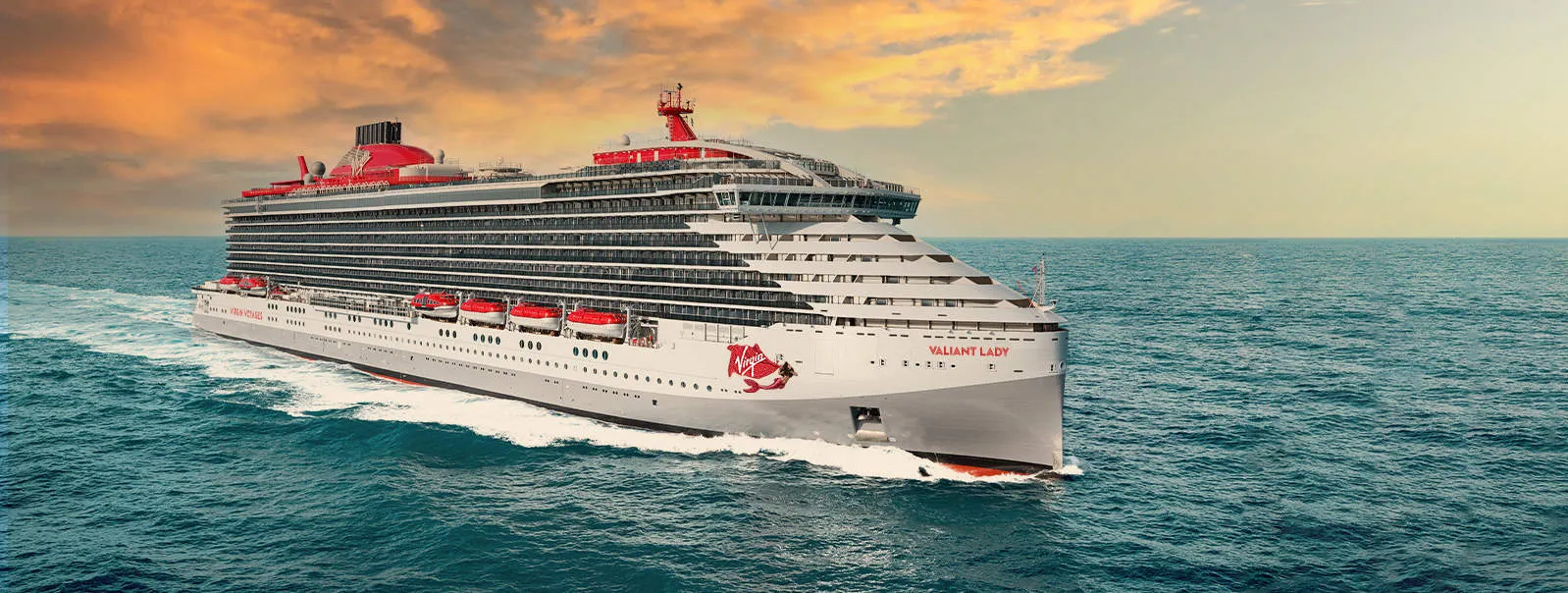
Virgin Voyages operates four ships — Scarlet Lady, Valiant Lady, Resilient Lady, and Brilliant Lady — each carrying approximately 2,700 adults in an atmosphere that feels more like a floating boutique hotel crossed with a nightclub than anything resembling traditional cruising. More than 20 dining venues, each with a dedicated galley and executive chef, are all included without surcharges. There is no main dining room, no buffet, no formal night, and no children under 18. The design is bold — iPad-controlled cabins, balcony hammocks, a tattoo parlour, and Scarlet Night transforming the entire ship into a red-lit carnival. The Manor nightclub operates until the early hours. Named Travel + Leisure’s World’s Best Mega Ship three years running.
Saga’s ideal guest is a retired British couple who want to be collected from their front door, driven to the ship, dined and entertained in comfortable elegance, and returned home — all without ever reaching for a wallet. Virgin’s ideal guest is a couple in their late 30s who want to eat at a Korean BBQ, dance at a nightclub, get a tattoo, and wake up in a hammock on their balcony. The shared “adults-only” label masks an ocean of difference.
What is actually included
The inclusions comparison reveals Saga as the more comprehensive all-inclusive product, with one critical exception.
Saga includes in every fare: cabin accommodation with private balcony (every cabin); all speciality dining across multiple restaurants without surcharges; house wines, selected beers, spirits, and cocktails throughout the day; 24-hour room service; Wi-Fi; all gratuities; chauffeur service from the guest’s UK home to the departure port (within 250 miles); optional travel insurance; shore excursions at every port (from 2026 sailings); enrichment lectures and guest speakers; and entertainment.
Saga does not include: premium wines and champagnes above the house selection; spa treatments; and flights (UK port departures make flights unnecessary for most guests).
Virgin Voyages includes: all dining across 20-plus restaurants without surcharges; Wi-Fi; gratuities; group fitness classes (yoga, cycling, HIIT, barre, boxing); basic beverages (water, drip coffee, tea, select juices); and entertainment.
Virgin does not include: alcoholic beverages (purchased individually — no drink packages available); shore excursions; spa treatments; the Redemption Spa thermal suite; and speciality fitness sessions.
The inclusions gap is significant. Saga’s fare covers substantially more — drinks, shore excursions, chauffeur transfer, and insurance on top of dining and Wi-Fi. Virgin’s fare covers dining more broadly (20-plus venues versus Saga’s five or six) but excludes drinks entirely. For a traveller who consumes alcohol regularly, Saga’s all-inclusive drinks provision represents genuine value — potentially GBP 50 to $100 per person per day in savings compared to purchasing individually on Virgin.
Dining and culinary experience
The dining comparison reveals two very different approaches to quality and variety.
Saga’s dining is boutique cruise dining at its most inclusive. Spirit of Adventure features five dining venues: the Grand Dining Room with a daily-changing menu; Amalfi for Italian fine dining; Khukuri House, the world’s first Nepalese restaurant at sea; Coast to Coast for seafood and grill; and the East to West supper club with live entertainment. Spirit of Discovery offers a comparable range including The Grill and The Club with menus by celebrity chef Phil Vickery. Every restaurant is included without surcharges. House drinks flow at every meal and throughout the day. Afternoon tea is served daily. The food is well-prepared, with an emphasis on British and European cuisine adapted for the mature palate.
Virgin Voyages operates 20-plus distinct venues, all included. Gunbae (Korean BBQ), Pink Agave (modern Mexican), Extra Virgin (Italian), The Wake (steakhouse), Razzle Dazzle (vegetarian-forward), The Test Kitchen (experimental), The Galley (global food hall), The Pizza Place, Dock (harbour-side small plates), and Sun Club (pool deck) represent a fraction of the programme. Each venue has a dedicated galley and executive chef. There is no main dining room and no buffet.
Virgin offers dramatically more dining variety — four times as many venues covering cuisines from Korean to Mexican to experimental molecular gastronomy. Saga offers fewer venues but includes drinks with the dining experience, creating a more cohesive all-inclusive meal. The culinary ambition differs as well: Virgin’s Test Kitchen and Gunbae push creative boundaries; Saga’s Khukuri House and Amalfi deliver refined comfort. Neither is objectively superior — they serve different palates and different expectations.
Suites and accommodation
The accommodation comparison reflects different design philosophies for different demographics.
Saga’s cabins are uniformly comfortable. Every cabin has a private balcony — no inside staterooms exist. Standard balcony cabins start from approximately 215 to 230 square feet. Dedicated single-occupancy cabins (roughly 150 to 170 square feet with balcony) number approximately 109 per ship — no single supplement required. Superior and deluxe cabins range from 250 to 400 square feet. Suites reach approximately 500 to 800 square feet. The design is contemporary British — clean, warm, well-lit, with excellent storage and accessible design throughout. The ships were purpose-built for a mature demographic, and thoughtful details like superior reading lights, walk-in showers, and generous wardrobe space reflect this.
Virgin’s cabins are design-forward and tech-driven. The Insider (inside) at approximately 150 square feet uses transformable features and mood lighting to maximise compact spaces. The Sea Terrace (balcony) at approximately 225 square feet features the signature hammock on the balcony and iPad-controlled ambience. RockStar Suites range from Seriously Suites (approximately 354 square feet) to the Mega RockStar Suite (approximately 2,147 square feet with a two-deck slide, in-room bar, and outdoor hot tub). All RockStar guests access Richard’s Rooftop.
Saga’s cabins prioritise comfort and practicality for the over-50 traveller. Virgin’s cabins prioritise design impact and Instagram-worthy moments. The balcony hammock on Virgin is a signature detail that younger travellers love; Saga’s emphasis on reading lights and accessible bathrooms reflects a different set of priorities. For solo travellers, Saga’s dedicated single cabins at no supplement are genuinely superior to Virgin’s single-occupancy model at full fare.
Pricing and value
The pricing comparison requires careful analysis of total cost given the different inclusion models.
Saga’s directional pricing for a 12 to 14-night Mediterranean or Norwegian Fjords cruise: standard balcony cabin from approximately GBP 2,400 to GBP 3,500 per person (roughly GBP 200 to GBP 290 per night). This includes all dining, house drinks, Wi-Fi, gratuities, chauffeur transfer, and from 2026, shore excursions at every port.
Virgin’s directional pricing for a 7-night Mediterranean cruise: Sea Terrace (balcony) from approximately US$160 to $250 per person per night. This includes all dining, Wi-Fi, and gratuities. Drinks are additional — a moderate-drinking couple might spend US$40 to $60 per person per day on beverages.
On a per-night basis, Saga’s all-inclusive fare (GBP 200 to 290, roughly US$250 to $370) and Virgin’s fare plus moderate drinks (approximately US$200 to $310) often land in a similar range. But Saga includes shore excursions (worth GBP 30 to $80 per port), the chauffeur transfer (worth GBP 200 to $400), and drinks — inclusions that on Virgin would add substantially to the total cost.
For value-conscious travellers who drink regularly and want excursions, Saga’s all-inclusive model delivers more for the money. For lighter drinkers who prefer to explore ports independently, Virgin’s a la carte approach avoids paying for inclusions they will not use.
For Australian travellers, neither line offers particular value because both require international flights. However, Virgin’s periodic Australian deployments eliminate airfare costs entirely, creating a genuine value advantage for Australians when Resilient Lady is in the region.
Spa and wellness
The spa comparison reflects different wellness philosophies for different age groups.
Saga’s spa facilities are proportionate to the 1,000-guest capacity. Both Spirit of Discovery and Spirit of Adventure feature a spa with treatment rooms, thermal suite with sauna and steam room, beauty salon, and fitness centre. The pool area includes a swimming pool and whirlpools. The facilities are well-maintained but modest in scale compared to larger ships. Group fitness classes are available. The spa experience is gentle, therapeutic, and designed for relaxation.
Virgin’s Redemption Spa is designed for the 30-to-50 demographic. The hydrotherapy circuit includes a mud room, salt room, cold plunge pools, quartz beds, and rainforest showers. The Athletic Club features a full-size boxing ring, outdoor training area, and a comprehensive group fitness programme — yoga, cycling, HIIT, barre, boxing, and strength classes — all included in the fare. The pool deck is designed as a social hub with DJ sets and the Aquatic Club atmosphere.
The wellness gap reflects the audience gap. Saga’s spa is restful and therapeutic — massages, facials, and gentle stretching for travellers who want to relax. Virgin’s wellness programme is active and social — boxing, HIIT, and cycling for travellers who want to maintain their fitness routine at sea. Neither is better; both are precisely calibrated for their target guest.
Entertainment and enrichment
The entertainment comparison captures the full width of the generational divide.
Saga delivers boutique cruise entertainment for the over-50s. Both ships feature a main theatre with nightly shows — production revues, guest vocalists, comedians, magicians, and speciality acts. Live music plays in multiple lounges. Guest speakers cover history, natural science, travel writing, and current affairs. Themed cruises bring celebrity guests aboard. The Supper Club on Spirit of Adventure combines dining with cabaret entertainment. Craft workshops, dance classes, and wine tastings round out the programme. The entertainment is warm, participatory, and sociable — designed to bring a community of like-minded travellers together.
Virgin delivers the most boundary-pushing entertainment in cruising. Scarlet Night transforms the ship into a red-lit carnival. The Manor nightclub operates until the early hours. Immersive shows in The Red Room push beyond traditional production values. Ships R Us is a drag brunch. Private karaoke suites and a tattoo parlour add unconventional options. DJ sets play across multiple venues throughout the evening. The entertainment is deliberately edgy, design-conscious, and tuned for adults who go out in cities and want that energy at sea.
The contrast is generational and cultural. Saga’s evening entertainment builds community — guests know each other by name, join table quizzes together, and dance to familiar music. Virgin’s evening entertainment generates energy — guests lose themselves in a nightclub, cheer at an immersive show, and photograph the spectacle. Saga winds down at 10pm. Virgin winds up at midnight. Both deliver exactly what their guests expect.
Fleet and destination coverage
The fleet comparison reveals dramatically different scales.
Saga operates two ships — Spirit of Discovery and Spirit of Adventure — sailing from UK ports to the Mediterranean, Norwegian Fjords, Canary Islands, Caribbean, British Isles, and Baltic. World cruise segments extend the range. The two-ship fleet limits itinerary variety and departure flexibility but allows Saga to maintain intimate, consistent quality.
Virgin operates four ships sailing globally — Caribbean, Mediterranean, Greek Isles, Northern Europe, South Pacific, and Australia. Scarlet Lady is based in Miami. Valiant Lady covers the Mediterranean. Resilient Lady repositions seasonally. Brilliant Lady (2025) adds capacity. The fleet is young and uniformly modern.
Virgin covers more destinations with more ships but Saga’s focused programme — fewer ships, fewer itineraries, more attention per voyage — creates a curated experience. For Australian travellers, Virgin’s global deployment includes periodic Australian seasons. Saga’s UK-only departures are the least accessible option for travellers on the other side of the world.
Where each line excels
Saga Ocean Cruises excels in:
- All-inclusive comprehensiveness. Dining, drinks, Wi-Fi, gratuities, shore excursions, chauffeur transfer, and insurance — the most complete inclusion package in the premium segment.
- Solo traveller infrastructure. Twenty per cent dedicated single cabins at no supplement, with social programmes purpose-built for solo guests.
- Boutique intimacy. Approximately 1,000 guests on purpose-built ships where crew know returning passengers by name.
- Chauffeur service. Collected from your front door and driven to the port — a uniquely Saga benefit that eliminates transfer stress.
- Community and repeat loyalty. The highest repeat passenger rate in the industry reflects genuine guest satisfaction and social bonds formed aboard.
- British social atmosphere. Warm, welcoming, and familiar — many guests describe it as sailing with friends.
Virgin Voyages excels in:
- Culinary diversity. Twenty-plus included restaurants spanning Korean BBQ, Mexican, Italian, experimental, steakhouse, and global street food — the broadest complimentary dining programme in cruising.
- Entertainment and nightlife. Scarlet Night, The Manor, immersive shows, drag brunch, and a tattoo parlour create evening energy unmatched in the industry.
- Design aesthetic. Bold, modern cabins and public spaces that appeal to travellers who find traditional cruise ships unappealing.
- Fitness inclusion. Boxing ring, cycling, HIIT, barre, and yoga — all complimentary.
- Australian deployment. Resilient Lady’s periodic Sydney and Melbourne sailings provide domestic departures unavailable from Saga.
- Appeal to non-cruisers. Virgin was purpose-built for people who said they would never go on a cruise — and it succeeds.
Standout itineraries for Australian travellers
Saga Ocean Cruises
14-Night Norwegian Fjords (ex-Dover). Saga’s take on Norwegian waters — a boutique all-inclusive experience with included excursions, drinks, and the intimate scale of a 1,000-guest ship. Accessible only for Australians planning a UK trip.
21-Night Mediterranean Discovery (ex-Dover). A longer voyage with comprehensive inclusions making it reasonable value for Australians absorbing UK flight costs into an extended holiday.
World Cruise Segments. Bookable sections of Saga’s world voyages allow Australians to join for portions that transit through accessible ports.
Virgin Voyages
Australian Season Sailings (Resilient Lady, from Sydney or Melbourne). Domestic departures with no international flights required. The most practical option for Australians.
7-Night Greek Island Hop (ex-Piraeus). Mykonos, Santorini, and Rhodes with 20-plus restaurants and Mediterranean sunshine.
7-Night Caribbean (Scarlet Lady, ex-Miami). The core Virgin product — Scarlet Night, The Beach Club at Bimini, and Caribbean warmth.
Ship-by-ship recommendations
Saga Ocean Cruises
Spirit of Adventure (2021) — The newer ship with the broader dining programme. Khukuri House (Nepalese), Coast to Coast (seafood), and the Supper Club with live entertainment offer slightly more variety than Spirit of Discovery.
Spirit of Discovery (2019) — The original Saga newbuild with La Vie en Rose at The Club. Essentially the same product — choose on itinerary.
Virgin Voyages
Resilient Lady — Book for Australian deployments when available.
Brilliant Lady — The newest ship (2025) with fleet refinements.
All four ships are essentially identical. Choose on itinerary and departure port.
For Australian travellers specifically
The Australian relevance of these two lines could not be more different.
Virgin Voyages has direct Australian relevance. Resilient Lady has deployed to Sydney and Melbourne, offering domestic sailings to the South Pacific and regional destinations. When in Australian waters, Virgin eliminates international flight costs and provides a product unlike anything else in the domestic market. The adults-only, nightlife-forward, 20-restaurant proposition appeals to younger Australian travellers. Fares are in USD.
Saga Ocean Cruises has no Australian relevance. The line sails exclusively from UK ports and restricts guests to those aged 50 and over. The chauffeur service — Saga’s signature inclusion — operates only within the United Kingdom. There are no Australian departures, no AUD pricing, and no plans for Australian deployment. Booking from Australia requires arranging international flights, finding a UK departure port, and meeting the age requirement. Saga is a niche option for Australians already planning an extended UK holiday.
For Australian travellers under 50, the comparison is moot — Saga’s age restriction excludes them entirely. For Australians over 50 who want an adults-only cruise, Viking Ocean Cruises (with Sydney deployments and Companion Fly Free), Oceania Cruises, and other premium lines offer more accessible alternatives than Saga’s UK-only departures. Virgin’s periodic Australian presence makes it the practical adults-only choice from this pairing for most Australians.
The onboard atmosphere
The atmospheric contrast between Saga and Virgin represents the widest generational gap in this comparison series.
Saga’s atmosphere is warm, sociable, and gently paced. The ships feel like a well-run country house hotel at sea. Guests mingle at cocktail parties with included drinks, join table quizzes, and form friendships across voyages — many Saga guests travel specifically for the social connections. The passenger base is exclusively British and aged 50-plus. Entertainment winds down by 10pm. The mood is convivial, familiar, and community-driven. Returning guests greet each other by name.
Virgin’s atmosphere is energetic, curated, and modern. The pool deck pulses with DJ sets. Scarlet Night transforms the ship into a carnival. The Manor nightclub operates until the early hours. The design is Instagram-ready at every turn. The passenger base is international, predominantly couples and friend groups in their 30s to 50s. The energy is high, the music is loud, and the atmosphere rewards those who want to participate in something that feels nothing like a traditional cruise.
Saga creates warmth. Virgin creates energy. Saga builds community over days at sea. Virgin builds moments that guests photograph and share. Both deliver exactly what their guests want — which is why both lines generate devoted loyalty despite being almost incomparably different products.
The bottom line
Saga Ocean Cruises and Virgin Voyages are both adults-only cruise lines, but using that single commonality to compare them is like comparing a gentlemen’s club with a nightclub because both serve adults. The products, demographics, atmospheres, and purposes are entirely different.
Choose Saga if you are a British traveller over 50 who wants a boutique all-inclusive cruise with everything covered — dining, drinks, excursions, chauffeur transfer, Wi-Fi, and gratuities — on an intimate 1,000-guest ship with a warm social community. Choose it for the 20 per cent dedicated solo cabins at no supplement. Choose it for the chauffeur from your front door. Choose it for the quiet, sociable, culturally enriching atmosphere that generates the highest repeat booking rate in the industry. Accept that the ships sail from UK ports only, that the age restriction limits companions, and that the fleet of two provides limited itinerary flexibility.
Choose Virgin if you want a modern, adults-only cruise that deliberately rejects every traditional cruise convention. Choose it for 20-plus included restaurants, immersive nightlife, design-forward ships, and a fitness programme included in the fare. Choose it for Scarlet Night, The Manor, the tattoo parlour, and an atmosphere built for adults who go out. Choose it for Australian departures when Resilient Lady is in the region. Accept that drinks are not included and there are no packages, that the nightlife-forward atmosphere will not suit all travellers, and that the fleet of four ships limits destination breadth.
For Australian travellers, this is not a genuine either-or comparison. The demographics, geographies, and products are so different that few travellers will seriously weigh both options. But if the comparison helps clarify where each line sits in the vast spectrum of modern cruising — from chauffeur-serviced British boutique luxury to floating nightclub with tattoo parlour — then it has served its purpose.