Scenic and Swan Hellenic both operate ice-class expedition ships with Zodiac fleets and polar capability, yet they deliver radically different products. One is an Australian-owned Discovery Yacht with helicopters, a submarine, and ten dining venues. The other is a heritage cultural expedition line with stronger ice class and NASA-affiliated scientists. Jake Hower compares their hardware, inclusions, and value for Australians.
| Scenic Ocean Cruises | Swan Hellenic | |
|---|---|---|
| Category | Expedition / Luxury | Expedition |
| Rating | ★★★★☆ | ★★★★☆ |
| Fleet size | 2 ships | 3 ships |
| Ship size | Yacht (under 300) | Small (under 200) |
| Destinations | Mediterranean, Antarctica, Arctic, Northern Europe | Polar, Mediterranean, South America, Asia |
| Dress code | Casual elegance | Relaxed |
| Best for | Ultra-luxury all-inclusive ocean travellers | Cultural expedition and enrichment travellers |
Scenic is the most comprehensively all-inclusive expedition product afloat — butler service in every suite, ten dining venues, two helicopters, a submarine, and a fare that covers virtually everything on a 228-guest Discovery Yacht with Australian ownership and permanent homeporting from 2028. Swan Hellenic counters with stronger PC5 ice class on two of three ships, intimate 152-guest vessels, a SETI Institute science partnership with NASA-affiliated researchers, JRE-Michelin-starred culinary programming, and pricing thirty to fifty per cent below Scenic on comparable itineraries. Choose Scenic for all-inclusive luxury, expedition hardware, and the satisfaction of sailing with an Australian company. Choose Swan Hellenic for cultural depth, intellectual enrichment, and exceptional expedition value.
The core difference
Scenic and Swan Hellenic are both genuine expedition cruise lines — both carry Zodiac fleets, both hold polar ice-class ratings, both operate in Antarctica, and both deliver luxury accommodation on purpose-built ships. This is not a comparison between an ocean cruise line and an expedition specialist. This is a comparison between two fundamentally different philosophies of what expedition cruising should prioritise, what it should cost, and what it should feel like when you step aboard.
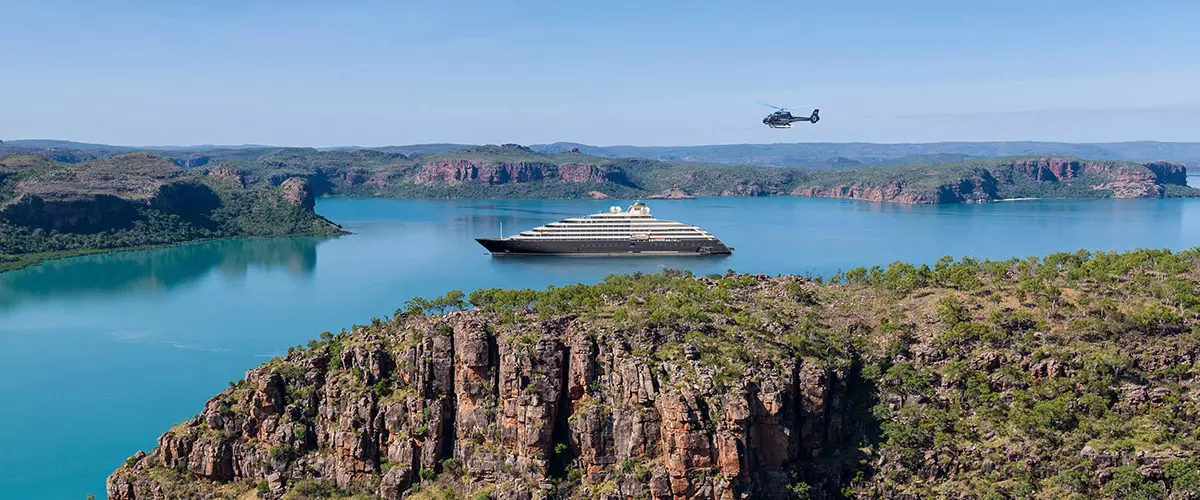
Scenic’s identity is luxury adventure. The Australian-owned line — founded by Glen Moroney in Newcastle, NSW in 1986 — built its reputation on European river cruising before launching what it calls the “world’s first Discovery Yachts”: Scenic Eclipse (2019) and Eclipse II (2023). At 228 guests with PC6 ice class, two Airbus H130-T2 helicopters, a Scenic Neptune submarine certified to 300 metres depth, ten dining venues, butler service in every suite, and a “Truly All-Inclusive” fare, the Eclipse ships represent the most comprehensively equipped expedition product available. The third ship, Scenic Ikon, arrives in April 2028 with 270 guests, fifteen dining venues, an 18,298-square-foot two-level spa, and a Triton AVA-9 submersible. Eclipse II will be permanently homeported in Australia from April 2028. Scenic won Cruise Critic’s Best Expedition Line for Dining in consecutive years — a recognition of the extraordinary ambition of operating ten restaurants on a ship that also carries helicopters and a submarine.
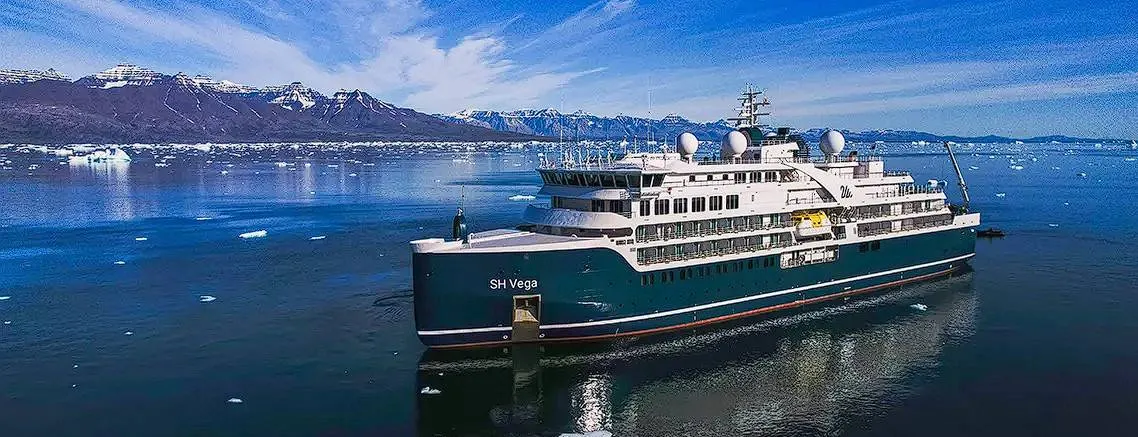
Swan Hellenic’s identity is cultural expedition. The brand traces its origins to the 1950s, when Swan’s Tours began carrying British guests to historic Mediterranean sites aboard chartered vessels — pioneering the concept of intellectually enriched cruising decades before the term “expedition” entered the luxury lexicon. After multiple ownership changes through P&O, Carnival Corporation, All Leisure Holidays, and G Adventures, the brand was relaunched in 2021 under CEO Andrea Zito — who received the Seatrade Cruise Personality of the Year award in 2025 — with three purpose-built ice-class expedition ships from Helsinki Shipyard: SH Minerva (2021, 152 guests, PC5), SH Vega (2022, 152 guests, PC5), and SH Diana (2023, 192 guests, PC6). The PC5 ice class on Minerva and Vega is one grade stronger than Scenic’s PC6 — a critical distinction for polar expedition capability. All three ships feature diesel-electric hybrid propulsion, full Zodiac fleets, and expedition teams of twelve to fifteen specialists including historians, naturalists, and ornithologists. The 2026 programme includes a partnership with the SETI Institute placing NASA-affiliated scientists on designated voyages. The Maris culinary programme, developed with JRE-Jeunes Restaurateurs and Michelin-starred chefs Andrea Ribaldone and Sang Keun Oh, gives Swan Hellenic a culinary credibility that extends well beyond what a line at this price point might suggest.
For Australian travellers, the choice often crystallises around a defining question: do you want the most comprehensively equipped and all-inclusive expedition yacht afloat — with Australian ownership, helicopters, and a submarine — or do you want cultural expedition depth with stronger ice class, NASA scientists, Michelin-starred cuisine, and genuinely outstanding value at roughly thirty to fifty per cent less?
Expedition team and guides
The expedition team shapes every landing, every Zodiac cruise, and every evening lecture. Both Scenic and Swan Hellenic invest seriously in their teams, but the composition and emphasis differ in ways that reflect each brand’s identity.
Scenic’s Discovery Team numbers up to twenty specialists on Expedition Voyages (polar regions) and up to fifteen on Discovery Voyages (non-polar destinations). Disciplines include marine biologists, historians, geologists, glaciologists, ornithologists, naturalists, archaeologists, photographers, and local guides — handpicked for each destination and among the largest expedition teams in the industry relative to guest count. The guide-to-guest ratio on polar expeditions is approximately 1:10 — twenty team members for 200 passengers. This is competitive for the luxury-expedition segment, though behind pure expedition operators like Aurora Expeditions at 1:8 and Quark at a claimed 1:6. Scenic’s Kimberley voyages are led by Mike Cusack, an award-winning wilderness expert with over thirty years of guiding experience in Australia’s northwest. Team members are IAATO and AECO trained and certified. Daily briefings and evening recaps are delivered in a purpose-built theatre with 180-degree projection screens — presentation technology that exceeds what most expedition competitors offer. Scenic lists citizen science as an included activity, though the programme is informal and guide-led rather than institutionalised — no formal research partnerships or published outcomes comparable to Aurora Expeditions or HX Expeditions.
Swan Hellenic’s expedition team numbers twelve to fifteen members per ship, producing a ratio of approximately 1:10 to 1:12 based on typical sailing numbers of 120 to 150 guests. While this is comparable to Scenic’s ratio, what distinguishes Swan Hellenic’s team is its breadth beyond traditional expedition disciplines. Alongside the standard naturalists, marine biologists, and ornithologists, Swan Hellenic deploys historians, archaeologists, anthropologists, and regional cultural experts tailored to each specific itinerary. On Mediterranean voyages, the team includes classical scholars. On Asia-Pacific sailings, cultural anthropologists specialising in Melanesian and Southeast Asian traditions join the roster. Most distinctively, the SETI Institute partnership places NASA-affiliated scientists on nine designated voyages per season — delivering approximately five lectures per voyage on astronomy, astrophysics, astrobiology, and the search for extraterrestrial intelligence. This is not a marketing exercise: SETI’s scientists are active research professionals who bring genuine frontier science to the expedition experience. Guest lecturers from leading universities, including Oxford, are a regular feature. The lecture programme is not supplementary — it is the core product, inherited from seventy years of cultural cruising heritage. Expedition guides dine with guests, join them for morning coffee, and are available throughout the day for informal conversation — the intimacy of 152 guests makes this natural rather than staged.
The distinction matters on the ground. On a shared Antarctic Peninsula itinerary, Scenic will have more specialists simultaneously covering more disciplines during landings — more marine biologists interpreting penguin behaviour, more geologists explaining glacial formations. Swan Hellenic will have fewer guides at each landing site but richer contextual programming onboard — the historical framework of Antarctic exploration, the science of glacial retreat, and potentially an astrophysicist connecting the polar landscape to planetary science. Scenic’s team is larger. Swan Hellenic’s team is wider in intellectual range.
Ships and expedition hardware
This is where the comparison becomes most consequential. Both lines have invested heavily in purpose-built expedition ships, but the hardware differences are substantial and shape the daily experience in material ways.
Passenger capacity and IAATO classification: Scenic’s Discovery Yachts carry 228 passengers in standard configuration, reduced to 200 in polar waters. This places them in IAATO Category C1 — vessels carrying fewer than 201 passengers that make landings. Swan Hellenic’s three ships all carry fewer than 200 passengers — SH Minerva and SH Vega at 152 guests, SH Diana at 192 — also placing them in IAATO Category C1. Both lines get all passengers ashore simultaneously under IAATO rules without the frustrating group rotations that plague larger 500-passenger expedition ships. In practice, Swan Hellenic’s ships frequently sail below maximum capacity — often 100 to 120 guests on the smaller ships and 150 to 170 on Diana — producing an even more intimate atmosphere and a higher effective crew-to-guest ratio. Swan Hellenic’s crew-to-passenger ratio of approximately 0.8 is among the highest in the cruise industry — 120 to 140 crew for 152 to 192 guests.
Ice class — Swan Hellenic’s technical edge: SH Minerva and SH Vega hold PC5 ice class — rated for year-round operation in medium first-year ice that may include old ice inclusions. This is one grade stronger than the PC6 rating on Scenic Eclipse, Eclipse II, and SH Diana. PC5 is rated for medium first-year ice; PC6 handles only thin first-year ice in summer conditions. The practical difference is not academic. In January 2026, Scenic Eclipse II became trapped in Ross Sea pack ice and required the US Coast Guard icebreaker Polar Star to free the vessel. No passengers were injured, and Scenic managed the crisis competently, but the incident underscored the real-world limitations of PC6 ice class when conditions deteriorate beyond forecast. Swan Hellenic’s PC5-rated Minerva and Vega — built at Helsinki Shipyard by icebreaker specialists — are designed to handle heavier ice that would challenge a PC6 vessel. For travellers whose ambitions include deep Antarctic penetration, early or late season departures, or destinations like the Weddell Sea, this ice-class differential is operationally significant.
Hull design and propulsion: Scenic’s ships feature the patented Ulstein X-BOW inverted hull — originally developed by Norway’s Ulstein Group for offshore vessels. The X-BOW splits wave energy rather than punching through it, reducing slamming, spray, vibration, and seasickness — particularly through the Drake Passage. Swan Hellenic’s three ships were built on the same Helsinki Shipyard platform with conventional ice-strengthened bows and hybrid diesel-electric propulsion with selective catalytic reduction for emissions. All three Swan Hellenic ships are battery-ready, designed to receive a 3 MW battery package. Both lines use dynamic positioning technology, allowing ships to hold station without dropping anchor — protecting sensitive seabeds. Scenic’s X-BOW provides a measurably smoother ride in rough head seas, a genuine advantage for the Drake Passage crossing.
Helicopters and submarine — Scenic’s defining hardware: Each Scenic Discovery Yacht carries two Airbus H130-T2 helicopters — the quietest in commercial aviation — seating six passengers with Bose noise-cancelling headsets and floor-to-ceiling windows. Uses include scenic flightseeing over glaciers, heli-hiking to remote landings, Emperor penguin colony access in Antarctica (unreachable by Zodiac), heli-fishing for barramundi in the Kimberley, and remote beach picnics. Flights cost approximately USD 695 to 1,500 per person depending on the experience. Each ship also carries a U-Boat Worx Cruise Sub 7 (Scenic Neptune) taking six guests to depths of 300 metres for approximately USD 775 per person. The upcoming Scenic Ikon adds a Triton AVA-9 submersible. No Swan Hellenic ship carries helicopters or a submarine. This is Scenic’s single most powerful hardware differentiator — no other expedition line operating at this scale carries both on every voyage.
Zodiac fleet: Scenic carries 12 Zodiacs per ship. Swan Hellenic’s SH Minerva and SH Vega each carry 12 Zodiacs (10 MK5 plus 2 MK6 military-grade rigid inflatables), and SH Diana carries 14 MK5 Zodiacs plus two dedicated 48-seat tender boats for port transfers. The fleets are comparable in size, and both lines deploy efficiently for their respective passenger counts.
Observation spaces: Swan Hellenic’s ships feature the Swan’s Nest — a circular glass-enclosed observation platform at the very front of the bow, allowing guests to stand directly over the water. It is one of the most distinctive design features in expedition cruising, ideal for ice navigation viewing, wildlife spotting, and contemplative moments at sea. Scenic’s Observatory Lounge offers panoramic windows and telescopes but does not have a comparable bow observation platform.
Fleet size: Swan Hellenic operates three purpose-built ships today; Scenic operates two, becoming three from April 2028 when Scenic Ikon enters service. Swan Hellenic’s fleet breadth allows simultaneous deployment across more distinct regions — three ships covering Antarctica, Asia-Pacific, the Arctic, Mediterranean, and West Africa at the same time. Scenic’s smaller fleet restricts departure options until Ikon arrives, but each ship is more comprehensively equipped than any Swan Hellenic vessel.
Landing experience and shore programme
Both lines deliver the core expedition promise — daily landings with expert guides, Zodiac cruises through iceberg alleys, and wildlife encounters that define expedition travel. The differences lie in landing logistics and activity scope.
Scenic’s landing programme typically delivers one to two landings per day when conditions permit, with two to three hours per landing. With 200 passengers in polar waters and the IAATO 100-person shore limit, Scenic conducts split landings — 100 ashore while 100 on Zodiac cruises, then swap. The smaller passenger count means efficient rotations and generous time at each site. Activity options during landings include guided nature walks, Zodiac wildlife cruising, kayaking (included), paddleboarding (included), snorkelling (warm-water itineraries), photography walks, snowshoeing, helicopter excursions (extra cost), and submarine dives (extra cost). Scenic distinguishes between Expedition Voyages (polar, up to twenty team members, more landings) and Discovery Voyages (non-polar, up to fifteen specialists, port-based excursions with Scenic Freechoice activities). Eight tandem kayaks, e-bikes, stand-up paddleboards, and trekking poles are all carried at no extra charge — an impressive array of included equipment.
Swan Hellenic’s landing programme follows a similar two-landings-per-day pattern in polar waters, with two to three hours per landing based on passenger reviews. With all three ships carrying fewer than 200 passengers, every guest goes ashore simultaneously — no group rotation required. This is a significant practical advantage that eliminates waiting and maximises time on the ground. Activity options include Zodiac cruises, guided hikes, snowshoeing (polar itineraries), snorkelling (tropical itineraries), and one included shore excursion per port of call — a meaningful inclusion on Mediterranean and Asia-Pacific itineraries where guided cultural visits to archaeological sites and regional landmarks are part of the programme. Kayaking is available on Swan Hellenic but must be pre-booked at additional cost. Swan Hellenic does not offer camping, stand-up paddleboarding, or helicopter activities.
The practical comparison: Both lines get all guests ashore without rotations under IAATO C1 classification. Scenic offers a wider range of included adventure equipment — kayaks, paddleboards, e-bikes — that Swan Hellenic charges extra for or does not carry. Swan Hellenic includes a cultural shore excursion at every port, which adds substantial value on non-polar itineraries with multiple port calls. In polar waters specifically, the landing experience is functionally similar. The divergence becomes pronounced on mixed itineraries: Scenic’s hardware offers more adventure options at each site; Swan Hellenic’s included excursion programme offers more cultural depth at every port.
Physical fitness requirements are comparable on both lines. Guests must be able to step in and out of Zodiacs — sometimes in surf conditions — and walk on uneven terrain including rocks, snow, and ice. Swan Hellenic requires “Fit for Travel” clearance through VIKAND Medical Services before polar expeditions. Scenic recommends contacting their team before booking to discuss specific mobility requirements. Neither line is suitable for guests who cannot manage Zodiac boarding with reasonable agility.
What is actually included
Both lines market genuine all-inclusivity, and both deliver on the promise more comprehensively than most competitors — but the specifics differ in ways that matter when calculating total cost and setting daily expectations.
Scenic’s “Truly All-Inclusive” fare is among the most comprehensive in expedition cruising. The fare covers all dining across ten venues without surcharges, premium branded beverages including champagne, spirits, wines, and cocktails (with only rare vintages excluded), three tiers of shore excursions (Freechoice for independent exploration, Enrich for exclusive cultural events, and Discovery for expedition-specific Zodiac and landing activities), butler service in every suite regardless of category, gratuities for all services including onshore guides and drivers, Starlink Wi-Fi, port charges, taxes, transfers on embarkation and disembarkation days, and charter flights between Buenos Aires and Ushuaia on Antarctic voyages. An expedition parka is provided for polar voyages — yours to keep — along with loaned polar boots. Complimentary laundry (self-service and butler-assisted), a daily-restocked mini-bar, and 24-hour in-suite dining from any restaurant menu are standard across all suite categories. The only significant extras are helicopter flights (approximately USD 695 to 1,500 per person), submarine dives (approximately USD 775 per person), spa treatments, and international flights.
Swan Hellenic’s all-inclusive fare covers all meals including 24-hour room service, an open bar with selected wines, spirits, beer, cocktails, coffee, and soft drinks, shore excursions and all expedition activities including Zodiac landings and guided cultural walks, the full onboard lecture programme, Wi-Fi (Silver Connect tier supporting messaging apps), gratuities, and — uniquely among expedition lines at this level — a one-night pre-cruise hotel stay with breakfast plus airport-to-ship transfers. On Cruise Plus packaged sailings designed for the Australian market, charter flights from Brisbane and additional hotel nights are included in the advertised fare. Every cabin is equipped with an Illy espresso machine, and select categories include Nikon Prostaff 3S 10x42 binoculars for wildlife observation — standard amenities that many competitors reserve for suite categories. A branded expedition parka (yours to keep), loaned muck boots, and a waterproof backpack are provided on polar voyages. What Swan Hellenic does not include: spa treatments, premium wines or spirits beyond the standard open bar selection, kayaking (optional add-on), and premium Wi-Fi upgrades for browsing or streaming.
The practical difference for Australian travellers: Scenic’s butler service is universal and substantial — butlers manage unpacking, dining reservations, in-suite service, and daily preferences from entry-level upward. Swan Hellenic does not offer butler service except in Premium Suites. Scenic’s Starlink Wi-Fi is generally faster than Swan Hellenic’s included messaging-only tier. Scenic’s premium branded beverages cover a wider selection of spirits and champagnes. Scenic includes kayaking, paddleboarding, and e-bikes at no extra charge. But Swan Hellenic’s pre-cruise hotel night and airport transfers add genuine practical value — particularly when the embarkation port is Ushuaia, Honiara, or another remote gateway where a good night’s sleep and a managed transfer eliminate real logistical stress. Both lines include excursions, drinks, and gratuities as core fare inclusions. The difference lies in the quality tier of certain inclusions, and in the fact that Swan Hellenic delivers all of this at a fare that runs thirty to fifty per cent below Scenic’s.
Destination coverage and itinerary depth
The fleet comparison shapes itinerary choice, departure flexibility, and the range of regions each line can access — and it reveals two very different strategies for covering the expedition market.
Scenic’s destination coverage spans Antarctica (Peninsula, South Georgia, Falklands, and select Ross Sea itineraries), the Arctic (Svalbard, Greenland, Iceland, Northwest Passage, Norwegian Fjords, Faroe Islands), Australia’s Kimberley (Eclipse II, returning 2028 after a gap in 2026-2027), the Mediterranean, Japan, South Pacific (New Zealand, Papua New Guinea, Pacific Islands), and the Americas (Panama Canal, Central America, Caribbean, South American coast). Combined across both ships: 500-plus ports across 63 countries and all seven continents. Scenic typically operates multiple Antarctic departures per season across both ships. From 2028, Eclipse II is permanently based in Australia and Asia-Pacific while Ikon and Eclipse serve Europe and Antarctica. The fleet is small today — two ships — but each is extraordinarily well-equipped, and the addition of Ikon in April 2028 will significantly expand capacity.
Swan Hellenic’s destination coverage is remarkable for a three-ship fleet. The line deploys simultaneously across Antarctica (approximately twelve voyages per season), the Mediterranean, the Arctic, Asia-Pacific, West Africa, South America, and the British Isles. Antarctica includes classic Peninsula voyages, the comprehensive eighteen-night “In Shackleton’s Footsteps” expedition combining Antarctica, South Georgia, and the Falkland Islands, and Weddell Sea itineraries. The Arctic programme covers Svalbard, Iceland, Greenland, the Norwegian coast, and select Northwest Passage departures. The 2026 Asia-Pacific debut is particularly significant for Australian travellers: seven itineraries aboard SH Minerva covering the Solomon Islands, Papua New Guinea, Indonesia, Raja Ampat, the Philippines, and Japan — all combinable into a 55-day grand voyage with no port repeated. Swan Hellenic reaches destinations that Scenic does not currently serve: Papua New Guinea, the Solomon Islands, Raja Ampat, the Philippines, West Africa (Ghana, Gabon, Angola), and the British Isles. The 2025-2026 programme features 34 maiden-call destinations that no other cruise line visits, including Hermanus in South Africa — the first cruise line to call there.
The itinerary depth comparison: Fleet breadth clearly favours Swan Hellenic — three ships covering more distinct regions simultaneously than Scenic’s two, with more Antarctic departures per season. Swan Hellenic’s willingness to explore genuinely unusual destinations — West Africa, remote South Pacific islands, first-time ports — reflects the brand’s heritage principle of never repeating an itinerary. Scenic counters with Discovery Yachts carrying equipment that no Swan Hellenic ship can match, permanent Australian homeporting from 2028, and the sheer ambition of operating ten restaurants and twin helicopters in some of the most remote waters on Earth.
Cabins and accommodation
Both lines offer thoughtfully designed accommodation for expedition cruising, but Scenic’s suites are substantially larger and come with universal butler service — a meaningful difference for travellers who value cabin comfort as part of the daily expedition experience.
Scenic Eclipse’s 114 suites start at 345 to 365 square feet for the entry-level Verandah Suite — generous by any expedition standard and nearly seventy per cent larger than Swan Hellenic’s entry-level cabin. Every suite includes a private balcony and full butler service. The Scenic Slumber Bed (a king-size pillow-top mattress), complimentary daily-restocked mini-bar, illy coffee machine, Dyson hairdryer, L’Occitane amenities, and 24-hour in-suite dining from any restaurant menu are standard across all categories. Spa Suites (495 to 540 square feet) include a Philippe Starck spa bath and direct spa access — a genuine indulgence after a morning of Zodiac landings. The Owner’s Penthouse Suite spans 2,100 square feet with a private spa pool terrace, walk-in wardrobe, and separate living and dining areas — the largest suite in expedition cruising. Fourteen suite grades across five decks provide genuine choice at every price point. Critically, every guest receives butler service regardless of category — the solo traveller in the entry Verandah Suite receives the same butler attention as the couple in the Owner’s Penthouse.
Swan Hellenic’s three ships offer a well-defined cabin hierarchy across six to eight categories that prioritises thoughtful design over raw square footage. On SH Diana, Oceanview staterooms measure 215 square feet — roughly sixty per cent of Scenic’s entry suite, and without a balcony. Balcony staterooms step up to 301 square feet of interior plus a 65-square-foot private terrace. Junior Suites on SH Diana offer 376 square feet with a 75-square-foot balcony, super king bed, separate living area, and private kitchenette. Premium Suites top out at 505 to 527 square feet with a wraparound veranda of approximately 130 square feet, separate living room, bathtub, walk-in wardrobe, and butler service. On the slightly smaller SH Minerva and SH Vega, Oceanview cabins measure 205 square feet, Balcony cabins approximately 301 square feet, and Premium Suites 527 square feet. Eighty per cent of cabins across the fleet feature private balconies.
What every Swan Hellenic cabin shares — regardless of category — is a level of amenity detail that consistently exceeds expectations for the price point. Every stateroom features Scandinavian-inspired design by Tillberg Design of Sweden with softwood fittings and earthy tones, an Illy espresso machine, a faux holographic fireplace, a pillow menu, premium toiletries, a safe, minibar replenished daily, individual climate control, and a flatscreen TV with media library. Select categories include Nikon Prostaff 3S 10x42 binoculars. These touches are standard in the entry-level Oceanview cabin — they are not reserved for suites.
The space gap is intentional on both sides. Scenic’s larger suites reflect a philosophy that the cabin is part of the luxury experience — morning coffee on a private balcony, butler-managed in-suite dining, a Philippe Starck bath after an Antarctic landing. Swan Hellenic’s more compact cabins reflect the expedition philosophy that guests spend their days on Zodiacs, at shore landings, and attending lectures in the Observation Lounge. For travellers who view the suite as sanctuary, Scenic wins. For those who view the cabin as a well-appointed base camp, Swan Hellenic delivers quiet elegance at a substantially lower price.
Solo travellers: Neither line offers dedicated solo cabins. Swan Hellenic frequently offers zero to twenty-five per cent single supplements — and occasionally waives the supplement entirely on promotional departures. Scenic typically charges higher supplements, though periodic promotions reduce them to 55 to 75 per cent off on entry-level suites (maximum two cabins per departure). For solo expedition travellers, the supplement gap is worth thousands of dollars on every voyage, and Swan Hellenic holds a clear advantage.
Pricing and value
The pricing gap between these lines is the single most striking difference in this comparison — and it overwhelmingly favours Swan Hellenic for budget-conscious expedition travellers while making a compelling case for Scenic among those who maximise luxury inclusions.
Scenic’s directional pricing for Antarctic voyages starts from approximately AUD 15,000 to 19,000 per person twin-share for a thirteen-night Peninsula voyage in a Verandah Suite, rising to AUD 22,000 to 30,000 for a twenty-one-night Antarctic and South Georgia itinerary. Kimberley voyages (when available, returning 2028) start from approximately AUD 12,000 to 15,000 for ten nights. Mediterranean Discovery Voyages from approximately AUD 8,000 to 12,000 for ten nights. The all-inclusive nature means the sticker price is close to the total holiday cost — add only international flights, helicopter and submarine experiences, and spa treatments. For a couple on a thirteen-night Antarctic expedition, expect a total outlay of approximately AUD 30,000 to 40,000 per person including return flights from Australia, with virtually everything else covered. Scenic regularly offers promotional savings of AUD 3,000-plus per person on select sailings, fly-free offers, and reduced single supplements.
Swan Hellenic’s pricing sits thirty to fifty per cent below Scenic’s for comparable itineraries. A nine-night Antarctic Peninsula voyage starts from approximately USD 11,029 per person for an Oceanview cabin — roughly AUD 17,000 at current exchange rates. Longer eighteen-night voyages including South Georgia and the Falklands range from approximately AUD 22,000 to 25,000 per person. Mediterranean cultural expeditions start from approximately USD 5,000 to 7,000 per person. Asia-Pacific Cruise Plus voyages for the 2026 season — including charter flights from Brisbane, hotel nights, and transfers — are expected in the USD 8,000 to 15,000 range. Promotional fares of twenty to thirty per cent off brochure rates are frequently available through Australian agents.
A direct Antarctic comparison illustrates the gap. A thirteen-night Antarctic Peninsula expedition costs approximately AUD 32,000 to 38,000 per person on Scenic in a Verandah Suite (345 square feet, butler service, ten dining venues, premium branded drinks). A comparable duration on Swan Hellenic costs approximately AUD 22,000 to 29,000 per person in a Balcony stateroom (301 square feet plus 65-square-foot terrace, no butler, three dining venues, open bar with selected spirits and wines, pre-cruise hotel and transfers included). The Scenic premium of roughly AUD 10,000 per person — AUD 20,000 per couple — buys a larger suite, butler service, seven additional dining venues, premium branded beverages, Starlink Wi-Fi, and access to helicopter and submarine experiences. Whether that premium represents value depends entirely on how much those particular inclusions matter to the individual traveller.
For solo travellers, the gap widens further. Swan Hellenic regularly offers zero to twenty-five per cent single supplements. Scenic’s standard supplements are substantially higher. On a twenty-thousand-dollar voyage, that difference alone can reach AUD 8,000 to 10,000 — enough to fund a separate holiday entirely.
For budget-conscious Australian expedition travellers — and there are many who are culturally curious but not inclined toward resort-level luxury — Swan Hellenic’s pricing opens up Antarctica, Papua New Guinea, and the Arctic at fare levels that make expedition cruising genuinely accessible. The AUD 20,000 per couple saved on an Antarctic voyage versus Scenic is enough to fund an entire second expedition on Swan Hellenic.
Onboard enrichment and science
Both lines invest in enrichment programming, but the depth, institutional backing, and intellectual ambition differ substantially — and it is here that Swan Hellenic makes its strongest case as a product differentiated from every other expedition line, including Scenic.
Scenic’s Discovery Team delivers daily expert lectures from up to twenty specialists on wildlife, glaciology, history, and the destinations visited. The “B My Guest” partnership provides bespoke musical performances with projection backdrops. Photography walks and photography expeditions are listed among landing activities, though Scenic does not operate dedicated photography-themed voyages or structured multi-day workshops comparable to Aurora’s “Antarctica Through the Lens” departures. Cooking masterclasses run at the Chef’s Garden at Epicure, connecting culinary education to the expedition programme. The evening atmosphere is intimate, social, and entirely English-speaking — cocktails, conversation, and a late supper after the day’s recap briefing. The Observatory Lounge offers panoramic windows, telescopes, and a curated library. The wine programme, curated by Keith Isaac (one of approximately 400 Master of Wine holders globally), features fifty wines on the pouring programme with different selections in each restaurant, plus a Chairman’s Cellar featuring first and second growth Bordeaux clarets and Penfolds Grange — a distinction for Australian wine enthusiasts. The enrichment is strong, science-focused, and professionally delivered with superior presentation technology.
Swan Hellenic’s enrichment programme is the intellectual heart of the product — and it is where the line’s heritage as the originator of cultural expedition cruising manifests most powerfully. Twelve to fifteen carefully selected expedition guides and guest lecturers sail every voyage, drawn from fields including history, archaeology, ecology, marine biology, ornithology, and cultural anthropology. The SETI Institute partnership — launched in 2022 and expanded through 2026 — places NASA-affiliated scientists on nine designated voyages covering Chile, Peru, Iceland, Greenland, and Canada. SETI scientists deliver approximately five lectures per voyage on astronomy, astrophysics, astrobiology, and the search for extraterrestrial intelligence. Guests participate in guided stargazing sessions using an advanced onboard telescope on Deck 9 and contribute to citizen science projects. This is genuine frontier science aboard a commercial expedition vessel — unique in the industry. The Maris culinary programme adds rotating JRE guest chefs who deliver cooking demonstrations and themed dinners that become enrichment events in their own right. Guest lecturers from leading universities contextualise every destination with historical, scientific, and cultural depth. The Observation Lounge — with panoramic views, a white baby grand piano, and the ship’s library — functions as the intellectual hub: lectures by day, cocktails and piano by evening. Evening entertainment is deliberately low-key: conversation, quizzes, movie nights, and stargazing from the open deck.
The distinction matters profoundly for certain travellers. Scenic delivers a polished, well-resourced enrichment programme with a larger team, superior presentation technology, and a strong nature and wildlife focus. Swan Hellenic delivers a programme built around intellectual curiosity and institutional partnerships — SETI scientists, JRE chefs, specialist historians — that creates a deeper cerebral experience on a more intimate ship. Scenic’s twenty-person Discovery Team covers more disciplines simultaneously. Swan Hellenic’s institutional partnerships bring external expertise aboard — NASA-affiliated astrophysicists, Michelin-recognised chefs — that no internal team, regardless of size, can replicate. For travellers who want broad expedition science delivered professionally alongside luxury amenities, Scenic. For travellers who want their expedition to feel like a floating seminar with world-class external experts, Swan Hellenic.
Dining on expedition
This comparison pits extraordinary variety against focused culinary artistry — and both approaches have genuine merit for food-motivated travellers choosing an expedition line. Dining is secondary to the expedition programme for most bookers, but on longer voyages, the quality and variety of what lands on your plate shapes daily satisfaction.
Scenic Eclipse delivers ten dining venues on a 228-guest ship — a ratio unmatched in expedition cruising and recognised with Cruise Critic’s Best Expedition Line for Dining award in consecutive years. Elements is the a la carte main restaurant with rotating menus sourced from regional cuisines. Lumiere serves contemporary French fine dining with pre-dinner champagne and caviar — reviewers consistently describe it as one of the finest dining experiences on any expedition ship. Koko’s offers Asian fusion with a dedicated sushi bar seating just eighteen guests using ingredients flown from Japan, plus the intimate Night Market teppanyaki experience for eight guests. The Chef’s Table at Elements (or Chef’s Garden at Epicure on Eclipse II) is an invitation-only molecular gastronomy degustation for ten guests — one of the most exclusive dining experiences afloat. Azure Bar and Cafe provides all-day casual fare. The Yacht Club serves poolside grill cuisine. Every venue is included without surcharges, and on a ship carrying 228 guests, securing reservations is rarely an issue. The wine programme features over one hundred whisky varieties at the Whisky Bar (all complimentary) and a full sake selection at Koko’s.
Swan Hellenic’s culinary programme operates on a fundamentally different philosophy — fewer venues, deeper craft. The Swan Dining Room is the primary venue for sit-down dinners with white tablecloths and linen napkins, serving international and regional cuisine adapted to each itinerary — Melanesian-inspired dishes on Papua New Guinea sailings, Japanese kaiseki elements approaching Hokkaido, and Antarctic-themed gala evenings on polar voyages. The Club Lounge transforms through the day from early-riser continental service through afternoon tea to casual evening dining with Piemonte-style pizza and family-style sharing plates. The Pool Grill serves al fresco classics. What distinguishes Swan Hellenic’s kitchen is the Maris culinary programme — developed in partnership with JRE-Jeunes Restaurateurs, a prestigious European association of young chefs who hold Michelin recognition. On dedicated Maris voyages, a rotating JRE guest chef joins the ship to curate menus, host themed dinners, lead cooking demonstrations, and build toward a climactic Gala Dinner showcasing their creativity. The permanent culinary programme was shaped by Michelin-starred Italian chef Andrea Ribaldone and Korean chef Sang Keun Oh. Room service is included 24 hours. Passengers consistently describe the food as exquisite — everything is made from scratch on board, from bread to pastry to sauces.
Scenic wins decisively on variety, venue count, and the sheer ambition of ten restaurants on an expedition ship. Swan Hellenic wins on culinary intimacy and the prestige of JRE-calibre guest chefs rotating through a kitchen small enough that the head chef knows every table. For travellers who want a different restaurant every night with dramatically different cuisines, Scenic delivers more choice than any expedition competitor. For those who value concentrated craft where the kitchen responds creatively to the destinations being explored, Swan Hellenic delivers a more intimate and intellectually integrated dining experience.
Standout itineraries for Australian travellers
Scenic
Eclipse II: East Antarctica (approximately 20 nights, departing Queenstown, returning Hobart) — Among the most accessible Antarctic voyages for Australian travellers, departing from New Zealand rather than Ushuaia. Complimentary helicopter shuttle to Mawson’s Huts — a Discovery excursion that would cost thousands on other lines. Full Zodiac programme, submarine opportunities, and the complete ten-venue dining experience. Domestic connections only for Australians flying to Queenstown.
Eclipse II: The Kimberley (returning 2028, approximately 10 nights, Darwin to Broome) — The only Kimberley expedition ship with onboard helicopters for flightseeing over King George Falls and the ancient Bungle Bungle formations. Discovery Team led by specialist Australian guides including Mike Cusack with over thirty years in Australia’s northwest. Butler service, ten restaurants, and all excursions included. The submarine cannot operate in the Kimberley due to regulatory restrictions.
Eclipse: Antarctic Peninsula (13 days, from approximately AUD 15,000 per person) — The classic Scenic Antarctic experience. Multiple Zodiac landings daily, kayaking, paddleboarding, and the option of helicopter flights over the ice shelf and submarine dives beneath it at additional cost. Butler service, ten restaurants, and premium drinks throughout. Lumiere French dining and Chef’s Table molecular gastronomy make for extraordinary evenings between expedition days.
Scenic Ikon: Mediterranean Inaugural (April 2028, Venice) — Maiden voyage of the third Discovery Yacht. 270 guests, fifteen dining venues, the 18,298-square-foot two-level Senses Rejuvenation Spa, and the Triton AVA-9 submersible. First two voyages sold out — early commitment essential for Australians interested in the launch season.
Swan Hellenic
SH Minerva: Wild Eden of Papua New Guinea (13 nights, Honiara to Jayapura, April 2026) — Swan Hellenic’s inaugural Asia-Pacific sailing and the voyage most tailored for Australian travellers. Charter flight from Brisbane to Honiara included in the Cruise Plus package, along with a Brisbane hotel night and all transfers. Explore Second World War history in the Solomon Islands, volcanic landscapes of Rabaul, coral gardens of Kimbe Bay, and Sepik River cultural communities with twelve expedition specialists including historians, marine biologists, and cultural experts.
SH Minerva: 55-Day Asia-Pacific Grand Voyage (Honiara to Otaru, April to May 2026) — All five Asia-Pacific itineraries linked seamlessly into a single grand voyage. No port visited twice. Solomon Islands, Papua New Guinea, Raja Ampat, Indonesia, the Philippines, and the length of Japan from south to north. For the most ambitious Australian cultural expedition traveller, this is the defining voyage of the season — and at Swan Hellenic’s pricing, fifty-five days of fully inclusive expedition cruising costs less than a fortnight on Scenic.
SH Vega: SETI “Explore Space at Sea” (various durations, 2026, Chile, Peru, Iceland, Greenland) — NASA-affiliated scientists from the SETI Institute join designated voyages to deliver lectures on astronomy, astrophysics, astrobiology, and the search for extraterrestrial intelligence. For Australians fascinated by the intersection of frontier science and expedition travel, these sailings offer a genuinely unique enrichment programme unavailable on any Scenic voyage — or on any other expedition line.
SH Vega or SH Diana: Antarctica (9 to 18 nights, roundtrip Ushuaia, November 2026 to March 2027) — Multiple Antarctic departures across the season, including the eighteen-night “In Shackleton’s Footsteps” expedition combining Antarctica, South Georgia, and the Falkland Islands. PC5 ice class on SH Vega provides stronger polar capability than Scenic’s PC6. Expert-led snowshoeing and the full Zodiac programme included. Charter flights and pre-cruise hotel covered in the fare. At thirty to fifty per cent below Scenic’s Antarctic pricing, this is the value choice for polar expedition.
For Australian travellers specifically
Both lines have genuine Australian connections, but the nature and depth of those connections differ — and both are investing meaningfully in the Australian market.
Scenic is Australian-owned, Australian-headquartered, and Australian at heart. Glen Moroney founded the company in Newcastle, NSW in 1986. Global headquarters remain on Watt Street, Newcastle. The river cruise brand is a household name through decades of Australian media advertising. The Scenic and Emerald Rewards programme (launched February 2026) unifies loyalty across ocean cruises, river cruises, and Emerald Cruises — existing river cruise members carry status directly to ocean expeditions, a genuine advantage for the tens of thousands of Australians who have sailed Scenic’s European rivers over three decades. Eclipse II will be permanently homeported in Australia from April 2028 with Sydney, Darwin, and Hobart as base ports. All pricing is in AUD through scenic.com.au. Phone: 1300 173 812. Chairman’s Club members will receive a complimentary helicopter or flightseeing experience on select departures from April 2028 — a milestone loyalty benefit. For Australians who want to support an Australian-owned company, sail from Australian ports without international flights, and earn loyalty across the broadest range of cruise products under one brand, Scenic is the natural choice.
Swan Hellenic’s Australian operation is based at Suite 14b, Level 1, 123 Clarence Street, Sydney NSW 2000. CEO Andrea Zito has spoken at CLIA Australasia events and publicly identified Australia as a key growth market. The inaugural 2026 Asia-Pacific season is designed specifically for Australian travellers: Cruise Plus packages depart from Brisbane with charter flights to Honiara and connections to subsequent ports; Easter school holiday dates are offered for family-friendly sailings; and the twelve itineraries cover destinations within the Australian time zone and travel radius — Papua New Guinea, the Solomon Islands, Raja Ampat, Indonesia, the Philippines, Japan, and Korea. Swan Hellenic has described Australia as one of its fastest-growing source markets. Australian specialist agents including Cruise Traveller, Expedition Cruise Specialists, and Antarctica Travel Centre sell Swan Hellenic fares in AUD. Virtuoso travellers booking through affiliated advisors can access up to USD 150 onboard credit per person.
Getting to the ship: For Antarctic voyages on both lines, Australian travellers fly to Buenos Aires (approximately 14 to 15 hours from Sydney on Qantas, LATAM, or Aerolineas Argentinas), then take charter flights to Ushuaia — included in the fare on both lines. Swan Hellenic also includes a pre-cruise hotel night that Scenic charges separately unless part of a promotional package. For the Kimberley (Scenic, returning 2028), Broome and Darwin are served by direct domestic flights — no passport required. For Swan Hellenic’s 2026 Asia-Pacific programme, Honiara is accessible from Brisbane via charter flight (included in Cruise Plus); Manila and Hiroshima are served by direct or one-stop flights from Australian cities. Universal advice: arrive at least one day early at the embarkation gateway — a missed expedition ship is unrecoverable and the financial loss is total.
Travel insurance: Standard policies often exclude Antarctic and expedition cruise activities. Specialist expedition insurance with minimum AUD 500,000 medical coverage and AUD 250,000 evacuation coverage is strongly recommended. Both lines require mandatory travel insurance. Scenic offers a Platinum Protection Plan at USD 495 per person per ocean voyage; travellers should compare this against independent specialist policies for broader coverage.
The loyalty question favours Scenic for existing cruise customers. The Scenic and Emerald Rewards programme carries status across ocean, river, and Emerald Cruises — a significant advantage for Australians with established Scenic history. Swan Hellenic does not operate a formal loyalty programme as of February 2026, though repeat guests may receive preferential offers informally. For Australians starting fresh with no loyalty history in either line, the product and pricing will matter far more than the programme — and at Swan Hellenic’s fare levels, the savings on a single voyage exceed what most loyalty discounts deliver over years of cruising.
A note on the Eclipse II Ross Sea incident. In January 2026, Scenic Eclipse II became trapped in pack ice in the Ross Sea and required the US Coast Guard icebreaker Polar Star to free the vessel. No passengers were injured, and the ship was safely extracted. The incident highlighted the operational limitations of PC6 ice class in challenging Antarctic conditions — conditions that Swan Hellenic’s PC5-rated Minerva and Vega are better equipped to handle. This does not render Scenic unsafe — PC6 is a legitimate ice-class rating for summer polar operations, and hundreds of PC6 vessels operate safely in Antarctic waters every season. But it is a data point worth weighing for travellers whose itineraries prioritise deep polar penetration, late-season departures, or destinations like the Ross Sea where conditions are inherently less predictable.
The onboard atmosphere
These two lines feel quite different despite occupying the same expedition category — and choosing correctly on atmosphere matters as much as choosing correctly on cabin category or destination.
Scenic’s atmosphere is polished, English-speaking, and social. With 228 guests and a crew ratio approaching 1:1, the intimacy is pronounced without feeling sparse. Butler service creates personal relationships that define the daily rhythm — your butler unpacks your luggage, draws your bath, serves canapes at sunset, manages dining reservations across ten venues, and remembers your coffee order by the second morning. On expedition sailings, the shared intensity of Zodiac landings, helicopter flights, and submarine dives forges genuine connections between guests — there is nothing quite like returning from a helicopter flight over an Antarctic ice shelf to find your fellow passengers gathered in the Scenic Lounge comparing photographs over champagne. The Discovery Team’s daily briefings and evening recaps create a communal structure that punctuates each day. The passenger mix is international but English-speaking, with strong Australian and British representation — Scenic’s Australian heritage resonates with its home market. Evenings feature live piano, musical performances through the “B My Guest” partnership, and cocktails in the Observatory Lounge or Scenic Lounge and Bar. The dress code is elegant casual — no formal nights, no enforced glamour. For Australians, sailing Scenic feels like sailing with an Australian company. The service culture is warm and personal rather than stiff and formal.
Swan Hellenic’s atmosphere is intimate, intellectual, and quietly cosmopolitan. With never more than 192 guests — and typically 152 — the scale creates a community rather than a passenger list. The captain is visible daily, often dining with guests. Expedition leaders join breakfast tables. The naturalist who lectured on whale migration that morning sits across from you at dinner. The historian who explained the Kokoda Trail joins you for coffee the next morning. The passenger mix is internationally diverse — British, European, Australian, and North American — united by intellectual curiosity rather than nationality. Guests choose Swan Hellenic because they want to understand, not just to see. The average age skews sixty and above, though the Asia-Pacific sailings with Easter school holiday dates are expected to attract a broader demographic. The dress code is casual throughout — expedition gear during the day, smart casual in the evening. No formal nights, no enforced programming. The pace is contemplative, the ship is quiet, and the focus is decidedly cerebral. Evenings feature conversation over drinks in the Observation Lounge, live piano, a quiz or movie night, or stargazing from the open deck. For English-speaking Australians, Swan Hellenic presents no language barrier — the onboard language is English throughout, with an internationally diverse crew.
The difference is not quality — both lines deliver attentive service and genuine expedition engagement. The difference is identity. Scenic’s atmosphere says: you are on a luxury yacht that happens to visit extraordinary places. Swan Hellenic’s atmosphere says: you are on a cultural expedition that happens to be comfortably appointed. Neither is superior. They serve fundamentally different motivations — and for Australian travellers, getting this choice right is as important as any technical comparison of ice class or dining venue count.
The bottom line
Scenic and Swan Hellenic are genuine expedition competitors — both carry Zodiacs, both operate in Antarctica, both deliver ice-class capability, and both offer genuinely all-inclusive fares. For Australian travellers choosing between them, the decision is one of the most consequential in expedition cruising, because both lines deliver extraordinary experiences — but they deliver them in fundamentally different ways, at fundamentally different price points, and for fundamentally different reasons.
Choose Scenic for the most comprehensively all-inclusive expedition product afloat. Choose it for butler service in every suite, ten dining venues on a 228-guest ship, premium branded beverages, and three tiers of included excursions. Choose it for two Airbus helicopters and a submarine — expedition hardware that no Swan Hellenic ship can match and that creates once-in-a-lifetime moments above and below the ice. Choose it for Australian ownership, AUD pricing, and a Discovery Yacht permanently homeported in Australia from April 2028. Choose it for the Scenic and Emerald Rewards programme that rewards three decades of Australian river cruise loyalty. Choose it for suites that start at 345 square feet with universal butler service and a Scenic Slumber Bed. Accept the higher per-diem — roughly double Swan Hellenic’s on comparable itineraries — the PC6 ice class that proved its limitations in the Ross Sea, the two-ship fleet that restricts departure options until Ikon arrives, and the reality that helicopter and submarine availability is always subject to weather, regulation, and mechanical readiness.
Choose Swan Hellenic for cultural expedition depth at a price point that makes expedition cruising genuinely accessible. Choose it for PC5 ice class on two of three ships — stronger than Scenic’s PC6 and built by Helsinki Shipyard’s icebreaker specialists. Choose it for SETI Institute scientists delivering NASA-affiliated enrichment, JRE-Michelin-starred chefs creating menus that respond to each destination, and a heritage that stretches back to the 1950s as the original cultural expedition cruise line. Choose it for pricing that runs thirty to fifty per cent below Scenic on comparable itineraries — savings that fund a second expedition or open Antarctica, Papua New Guinea, and the Arctic to travellers who might not otherwise consider expedition cruising at Scenic’s price point. Choose it for the intimate scale of 152 to 192 guests, the pre-cruise hotel and airport transfers included in every fare, and the inaugural 2026 Asia-Pacific season with Brisbane charter flights to destinations no other luxury expedition line currently serves. Accept smaller cabins, no butler service in standard categories, no helicopters or submarine, a young fleet still building its operational track record, and a spa that is functional rather than spectacular.
For Australian travellers weighing both lines, the mathematics deserve close examination. The AUD 20,000 per couple saved on a Swan Hellenic Antarctic voyage over a comparable Scenic sailing is enough to fund an entire second Swan Hellenic expedition — a Papua New Guinea cultural voyage, an Arctic SETI science sailing, or a fifty-five-day Asia-Pacific grand voyage that costs less than a single fortnight on Scenic. Whether the premium for Scenic’s helicopters, submarine, butler service, and ten dining venues represents genuine value, or whether Swan Hellenic’s intellectual depth, stronger ice class, and all-inclusive fare at roughly half the price represents the smarter investment, is a question only the individual traveller can answer. Both lines deliver extraordinary expedition experiences. The question is which kind of extraordinary matters most to you.